101 / 249
Singapore
Island of Confluence
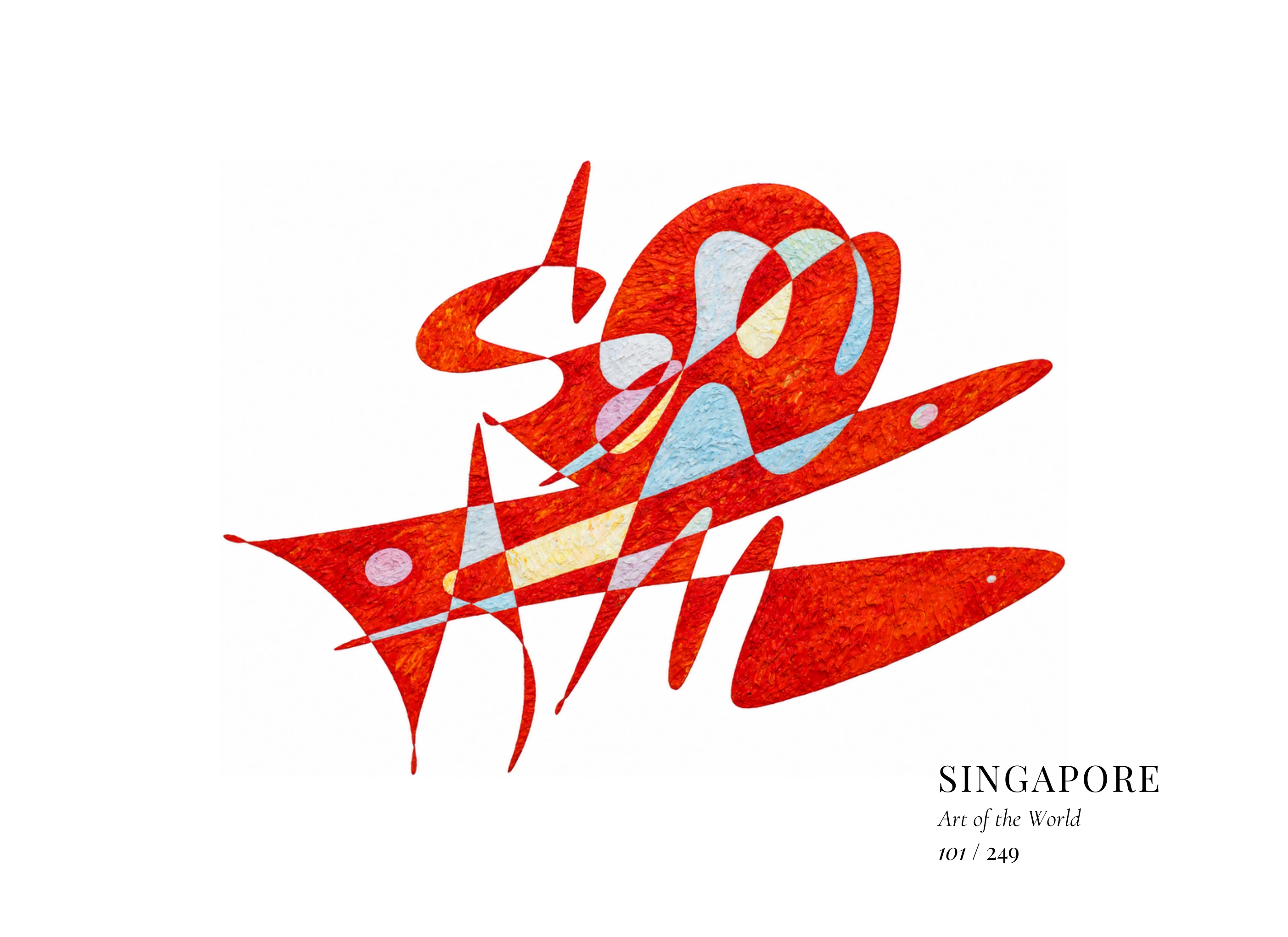
Description
The artwork is propelled by intense red and orange impasto, interrupted by pale blue, ivory, yellow and pink. Sweeping curves meet sharp diagonals and elongated pointed forms, creating a sense of constant movement. White negative spaces open within and around the composition, preventing its dense intersections from becoming static. The converging geometry suggests exchange and connectivity, while the balance between compact structures and outward extensions evokes an island whose cultural and economic life has long depended upon movement across borders.
Cultural Context
Singapore sits at the southern entrance to the Strait of Malacca, where maritime routes have connected Southeast Asia with wider trading worlds for centuries. Developed as a British trading port from 1819, it became independent in 1965 and rapidly evolved into a densely urbanised global centre of commerce, technology and transport.
Its cultural identity reflects Chinese, Malay, Indian, Eurasian and other communities. English, Malay, Mandarin and Tamil are official languages, while religious traditions, cuisines, festivals and neighbourhood histories reveal a complex multicultural society. Literature, architecture, theatre, film, design and contemporary art continue to explore the relationship between inherited traditions and accelerated modernity.
Exhibition Context
Long red points slice through curved loops, the entire composition leaning forward as though it were built for speed. Singapore grew from a maritime trading port into an independent city-state in 1965, and this image's converging routes evoke a place defined by circulation. A blue centre briefly slows the rush before the lines accelerate away again. The painting does not depict a skyline or container port; its iconography of intersection and propulsion gives the city's scale a sense of global reach.