88 / 249
South Korea
Tradition in Accelerated Motion
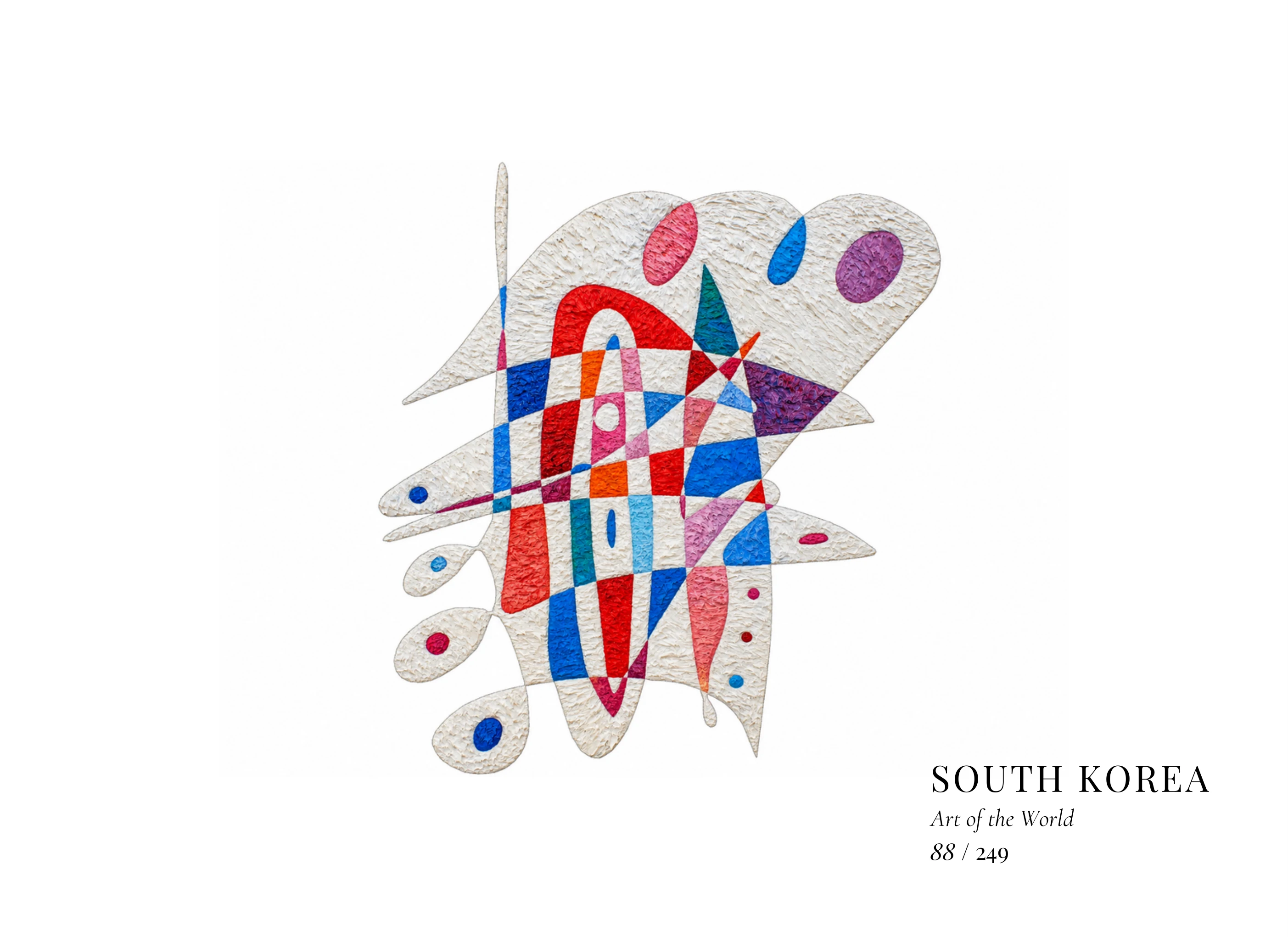
Description
The artwork is structured around expansive white impasto crossed by vivid red, blue, turquoise, pink, violet and orange. Vertical bands, pointed forms and interlocking geometric fragments create a dense central rhythm, while rounded masses and detached oval elements soften the composition’s sharper movement. White space remains active both within and around the silhouette. The tension between ordered divisions and energetic colour suggests continuity within rapid change, while the upward and outward extensions evoke a culture continually negotiating inheritance, modernity and global connection.
Cultural Context
South Korea occupies the southern portion of the Korean Peninsula, bordered by mountainous interiors and seas that historically connected it with China, Japan and wider maritime Asia. Korean kingdoms developed distinctive political and cultural traditions over many centuries. Following Japanese colonial rule, liberation in 1945 and the Korean War, the Republic of Korea underwent rapid industrialisation and urban transformation.
Korean cultural identity combines deep historical continuity with remarkable contemporary dynamism. The Korean language and Hangul script are central to national culture, alongside Confucian traditions, Buddhism and regional customs. Ceramics, calligraphy, architecture, textile arts and courtly music coexist with internationally influential literature, cinema, design and popular music.
Exhibition Context
Pale translucent ovals cross a bright red and blue inner lattice. South Korea's modern state emerged after the division of a peninsula with a longer shared Korean history. The composition's clear overlays and central crossings can be read through that experience of continuity and separation, though it contains no border or identifiable portrait. The white spaces between its large forms are especially eloquent: presence is defined partly by what has been divided away.