177 / 249
Sri Lanka
Island at the Ocean Crossroads
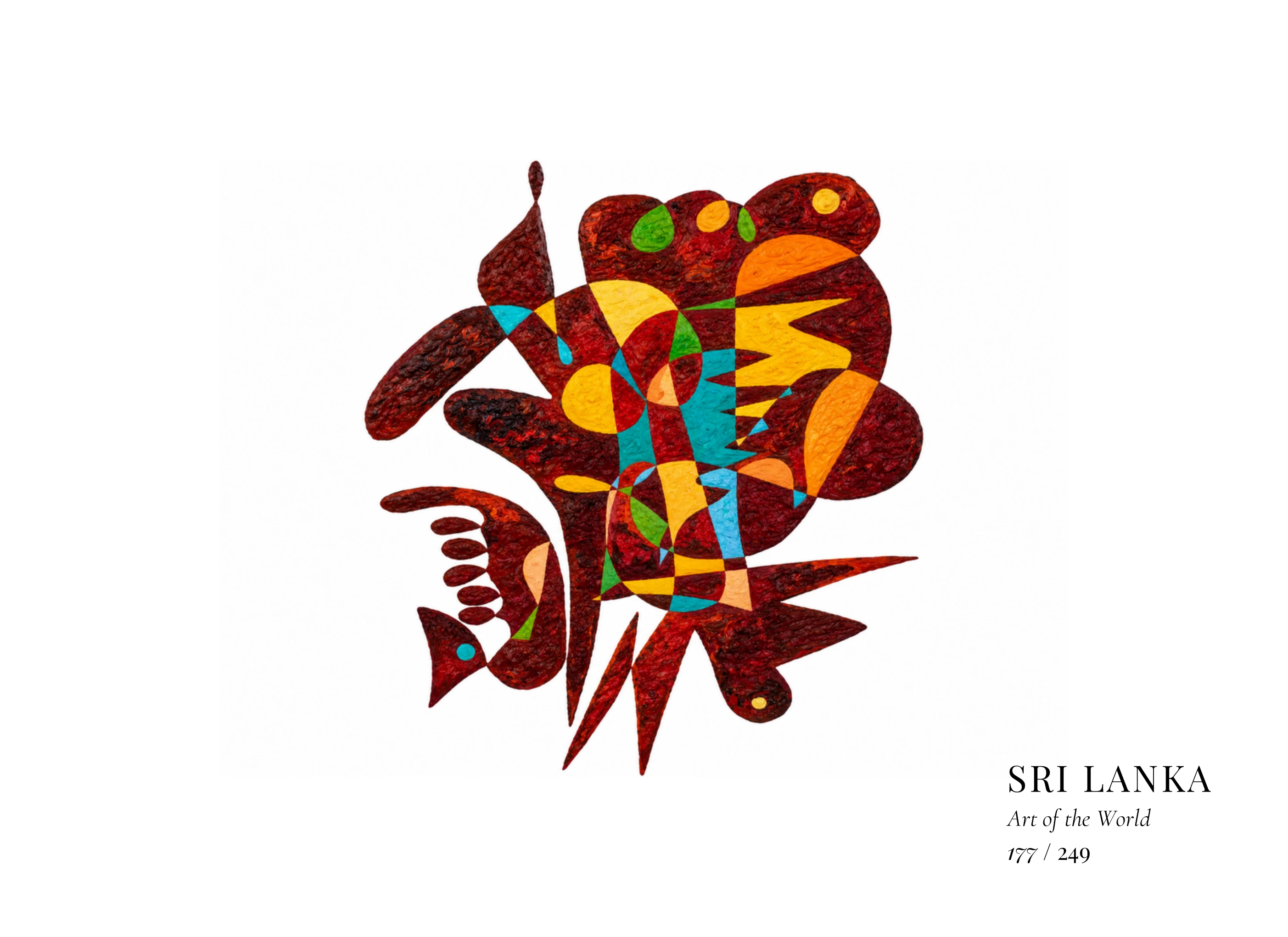
Description
The artwork gathers deep burgundy and earthen red into a dense, irregular silhouette animated by yellow, turquoise, green, orange and pale blue. Interlocking fragments compress toward the centre before extending into pointed forms, curved appendages and smaller detached elements. The heavy impasto reinforces a sense of accumulated layers, while flashes of brighter colour interrupt the darker mass. Its shifting balance can be read as evoking a complex cultural memory in which difference, continuity and historical change remain closely intertwined.
Cultural Context
Sri Lanka lies in the Indian Ocean south of India, where its position along maritime routes connected South Asia with the wider trading world. Ancient Sinhalese kingdoms developed major Buddhist centres and sophisticated irrigation systems, while Tamil kingdoms and communities shaped the island’s north and east. Portuguese, Dutch and British colonial periods preceded independence in 1948; the postcolonial era was deeply affected by civil war, which ended in 2009.
Sri Lankan culture reflects Sinhalese, Tamil, Muslim and other communities, with Sinhala and Tamil as official languages. Theravada Buddhism, Hinduism, Islam and Christianity contribute to a plural religious landscape. Literature, dance, drumming, temple architecture, textiles, carving and contemporary cinema preserve and reinterpret the island’s layered cultural inheritance.