176 / 249
Syria
Crossroads of Memory and Rupture
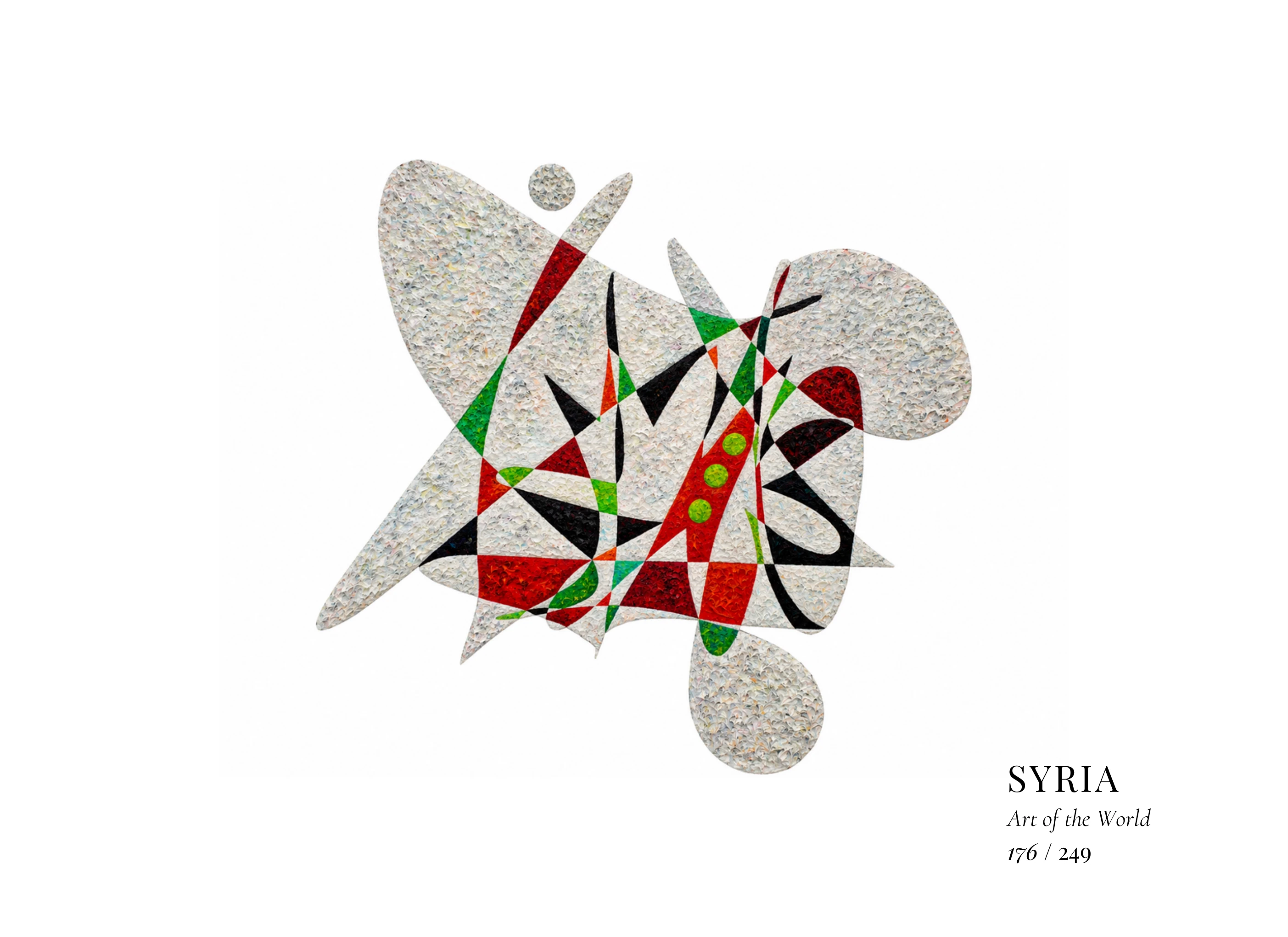
Description
The artwork is dominated by heavily worked whites and greys, fractured by concentrated passages of crimson, black and green. Large pale forms surround a dense central geometry of intersecting triangles, narrow blades and abrupt divisions. Three green circles punctuate a red diagonal, while detached forms and pointed extensions disturb any stable enclosure. The composition suggests fragmentation without complete dissolution: separate elements remain connected through an intricate visual rhythm. Dense impasto gives the pale areas physical weight, while the sharper coloured passages evoke tension, interruption and persistence within a layered historical memory.
Cultural Context
Syria lies at the eastern Mediterranean threshold, between Anatolia, Mesopotamia and the Arabian Peninsula. Its cities and landscapes have belonged to successive ancient civilisations and empires, while Damascus and Aleppo became enduring centres of commerce, scholarship and craftsmanship. The modern state emerged from Ottoman rule and the French Mandate, gaining independence in 1946. Since 2011, war, displacement and political fragmentation have profoundly altered the country and its communities.
Syrian culture draws upon Arab, Kurdish, Armenian, Assyrian and other traditions, alongside Muslim and Christian histories extending across centuries. Arabic is predominant, while Kurdish, Armenian and Syriac remain important within particular communities. Poetry, storytelling, music, calligraphy, architecture, mosaic, woodwork, metalwork and textile traditions reveal a cultural inheritance shaped by exchange between Mediterranean and inland worlds.