86 / 249
Taiwan
Island of Layered Currents
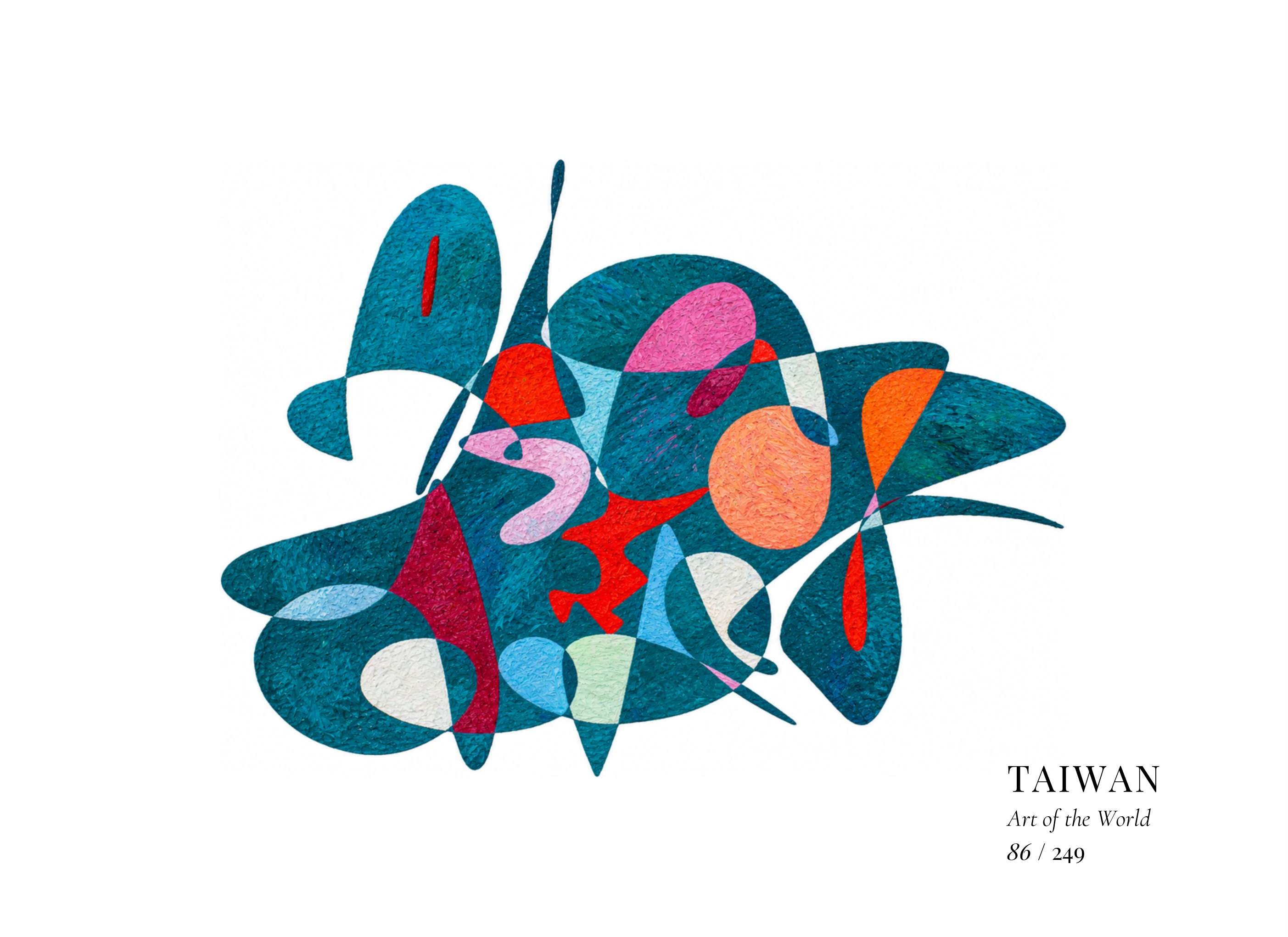
Description
Deep turquoise dominates the work, forming an expansive, irregular silhouette animated by red, orange, pink, pale blue and white. Rounded masses alternate with pointed extensions, narrow lines and openings of untouched white. The central geometry is restless rather than symmetrical: curved compartments overlap sharper divisions, while isolated marks and projecting forms pull the eye towards the edges. Dense impasto unifies these contrasts through a strongly tactile surface. The composition suggests an island identity formed through converging histories and outward connections, while its internal plurality remains visibly unresolved. Colour moves across the structure like intersecting currents, creating a balance between cohesion, difference and continual transformation.
Cultural Context
Taiwan lies off the southeastern coast of China, shaped by steep mountains, fertile western plains and surrounding seas. Indigenous Austronesian societies preceded large-scale migration from the Chinese mainland. Dutch and Spanish footholds, Qing rule and Japanese government from 1895 to 1945 contributed successive historical layers. After 1949, Taiwan underwent rapid industrialisation and, from the late twentieth century, a major democratic transformation.
Its culture brings together Indigenous traditions, Hoklo and Hakka inheritances, post-1949 mainland influences and elements retained from the Japanese period. Mandarin, Taiwanese Hokkien, Hakka and Indigenous languages form a complex linguistic landscape. Temple architecture, puppetry, ceramics, calligraphy and religious festivals coexist with internationally recognised literature, cinema, popular music, contemporary design and technological culture.