197 / 249
Tajikistan
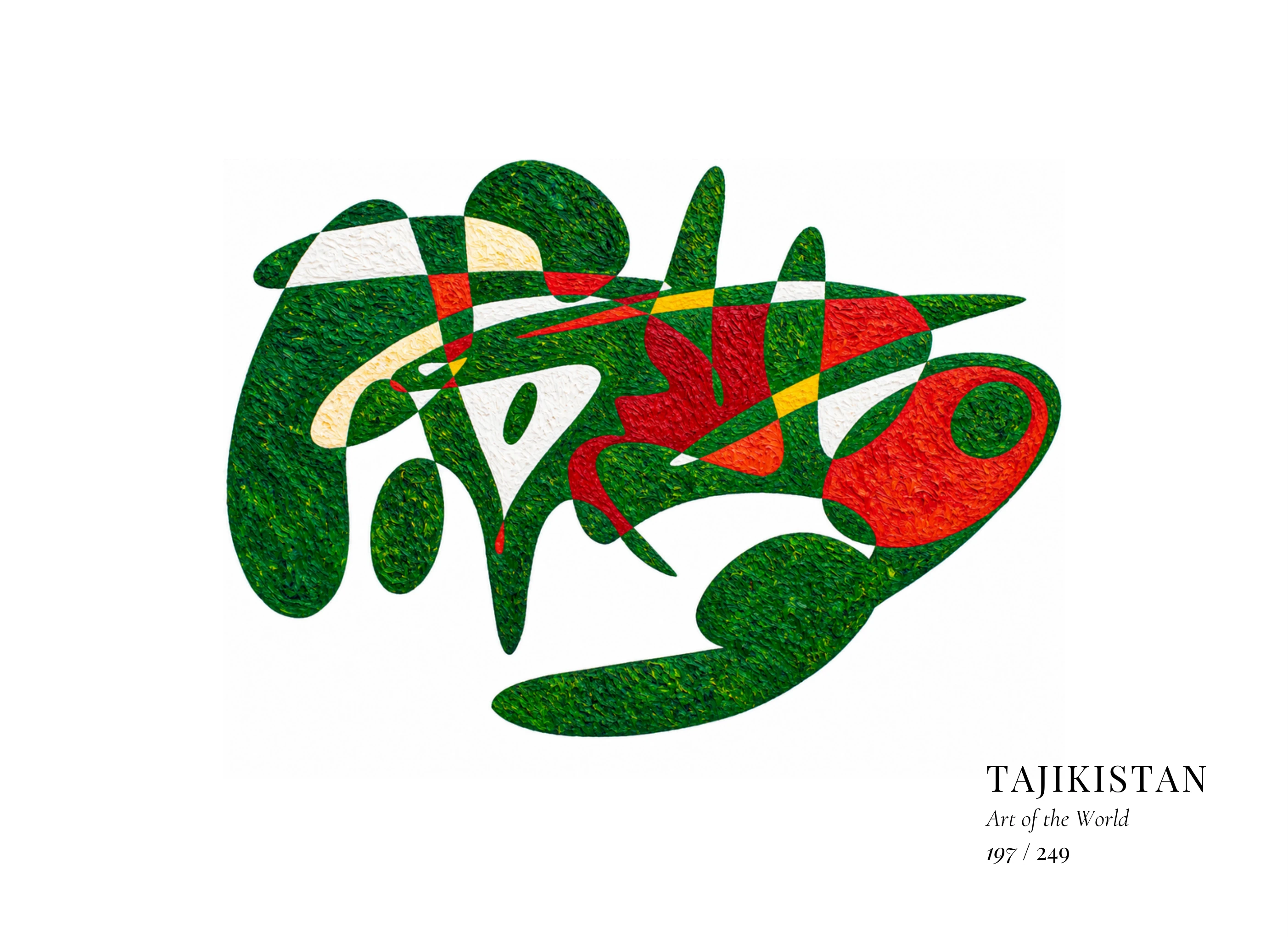
Mountains of Continuity
Description
Deep green gives the artwork its dominant weight, interrupted by crimson, orange, yellow and textured white. Broad rounded masses coexist with sharp projections, vertical blades and narrow crossing bands. The dense centre is organised through overlapping geometries, while detached green forms and generous white openings loosen the silhouette. Red passages travel through the composition like an internal current, repeatedly intersecting the prevailing green. The structure suggests continuity shaped by division and convergence: a compact visual field extending outward through pointed forms and isolated elements. Heavy impasto reinforces the sense of accumulated layers, while the balance between enclosure and open space evokes a cultural memory formed across mountains, borders and long historical connections.
Cultural Context
Tajikistan occupies the mountainous heart of Central Asia, dominated by the Pamirs and ranges extending from the great highlands of the region. Its territory stood within networks connecting Persia, Transoxiana, China and the Indian subcontinent. Iranian-speaking societies shaped its cultural foundations, while successive empires, Islamic dynasties, Russian expansion and Soviet rule transformed its political landscape. Independence came in 1991, followed by a devastating civil war and subsequent reconstruction.
Tajik identity is closely associated with the Persian cultural world. Tajik, a variety of Persian, is the state language, while Uzbek and several Pamiri languages contribute to the country’s linguistic plurality. Classical Persian literature, oral poetry, music, embroidery, woven textiles, woodcarving and architectural ornament remain important cultural forms. The traditions associated with figures such as Rudaki connect contemporary Tajik culture to a much older literary inheritance.