99 / 249
Thailand
Kingdom of Converging Rhythms
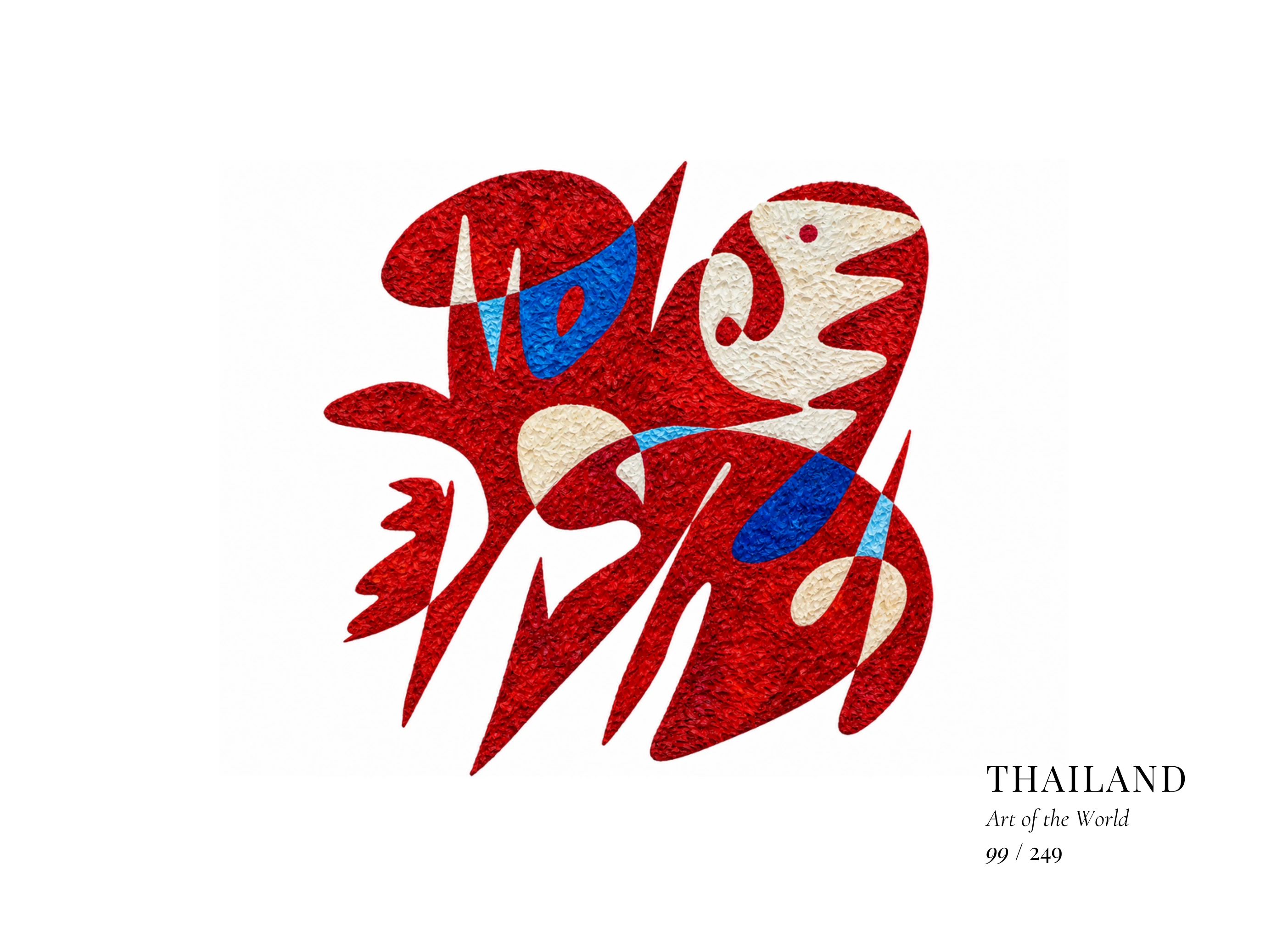
Description
Crimson dominates the artwork, giving its irregular silhouette an intense visual unity. White, cream and brilliant blue forms interrupt this field through sweeping curves, enclosed ovals and narrow pointed divisions. The upper-right white configuration creates a concentrated counterweight to the broader red mass, while elongated downward extensions produce a strong sense of movement. Detached forms on the left and generous areas of white space prevent the composition from becoming enclosed. Thick impasto intensifies every colour and gives the surface an almost sculptural density. The interplay of fluid curves and sharp projections suggests continuity shaped by multiple currents, while the restricted palette creates a powerful rhythm between concentration, openness and movement.
Cultural Context
Thailand occupies the continental heart of Southeast Asia, extending from the northern mountains through the Chao Phraya basin to the Malay Peninsula. Its history developed through kingdoms including Sukhothai and Ayutthaya before Bangkok became the centre of the Chakri kingdom in 1782. Unlike most neighbouring countries, Thailand was never formally colonised by a European power, although diplomacy, territorial concessions and regional pressures profoundly shaped its modern formation.
Thai culture combines Tai traditions with Mon, Khmer, Chinese, Malay and numerous regional and minority influences. Theravada Buddhism has deeply influenced architecture, sculpture, mural painting and ceremonial life, while Islam is important particularly in the south. Classical dance and music, silk weaving, ceramics, literature and elaborate temple arts coexist with vigorous traditions of cinema, popular music and contemporary design.