135 / 249
Timor-Leste
The Long Road to Independence
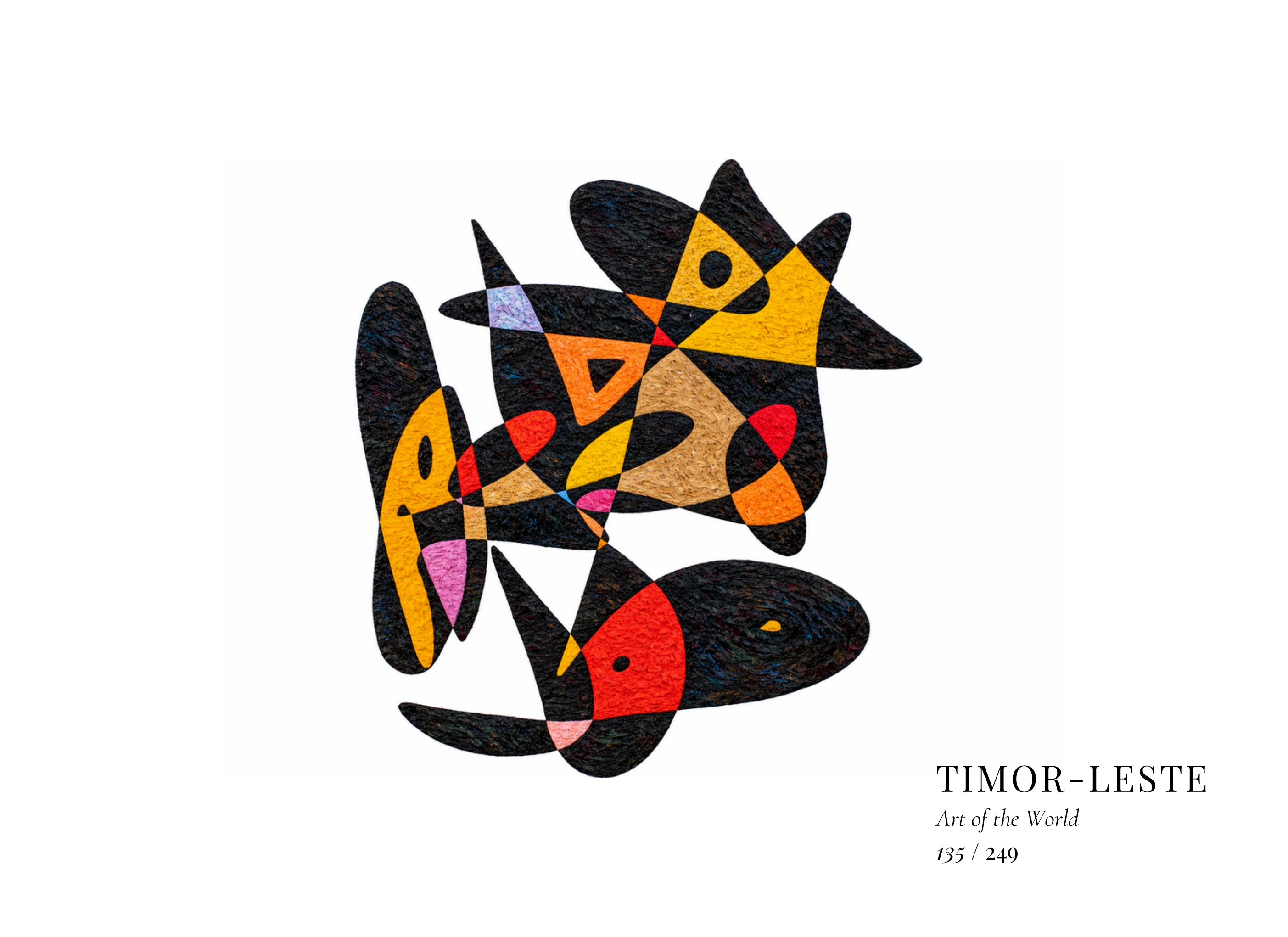
Description
The artwork is anchored by an unusually dense black field, illuminated by ochre, yellow, orange, red and small passages of pink and violet. Interlocking triangles, arcs and pointed forms create a structure that appears simultaneously joined and fragmented. A separate lower mass establishes a strong visual counterweight, while white space opens between the principal elements. Thick impasto gives the dark surfaces exceptional physical density, against which the warmer colours appear almost luminous. The composition can be read as an image of endurance and reconstruction: separate forms remain distinct yet participate in a tense, interconnected rhythm, evoking a national history marked by rupture, survival and renewed sovereignty.
Cultural Context
Timor-Leste occupies the eastern half of Timor in the Lesser Sunda Islands, with rugged mountains descending towards narrow coastal plains. Austronesian and Papuan-speaking communities developed complex local societies connected to regional maritime trade. Portuguese influence began in the sixteenth century and developed into colonial rule. After a brief declaration of independence in 1975, Indonesian occupation lasted until 1999. Following a United Nations-administered transition, Timor- Leste became fully independent in 2002.
Its cultural identity reflects numerous ethnolinguistic communities and strong local traditions alongside centuries of Portuguese contact. Tetum and Portuguese are official languages, while many Indigenous languages remain widely spoken. Catholicism has a major public presence, often existing alongside older customary beliefs and practices. Oral poetry, ritual performance, music, woodcarving and especially tais weaving preserve histories of kinship, place and communal identity.