233 / 249
Turkey
From Anatolia to the Republic
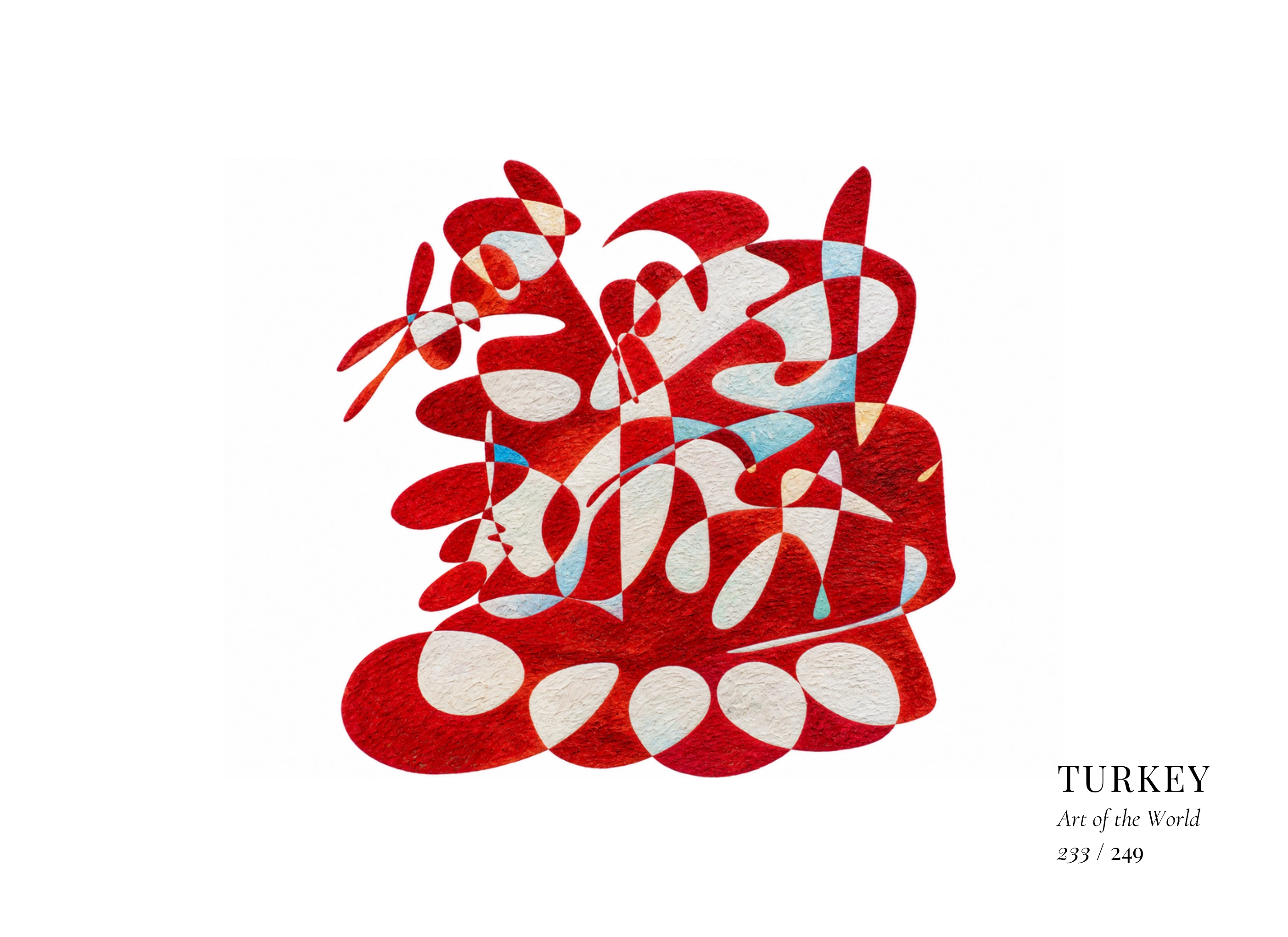
Description
The composition's intense crimson is interwoven with substantial passages of textured white, creating a powerful visual concentration. Curving bands, enclosed ovals and elongated vertical forms repeatedly divide and reconnect the composition, while pale blue and cream provide restrained accents. Dense impasto strengthens its physical presence, and detached elements animate the surrounding white space. The layered geometry suggests continuity through transformation, evoking a cultural memory shaped by successive historical formations while retaining a strong internal coherence.
Cultural Context
Turkey spans Anatolia and eastern Thrace at a historic meeting point of the Mediterranean, Black Sea, Balkans, Caucasus and Middle East. Its landscape preserves Hittite, Greek, Roman, Byzantine, Seljuk and Ottoman histories. Following centuries of Ottoman rule, the Republic of Turkey was founded in 1923 under Mustafa Kemal Atatürk, introducing extensive political, legal and cultural reforms.
Turkish culture reflects long interaction among Turkic, Anatolian, Balkan, Caucasian, Kurdish, Armenian, Greek and other traditions. Ottoman architecture, calligraphy, ceramics, miniature painting, carpets and kilims, poetry and music form an exceptional artistic inheritance. Modern literature, cinema, visual art and design continue to extend this cultural conversation.