104 / 249
United Arab Emirates
Federation and the Architecture of Acceleration
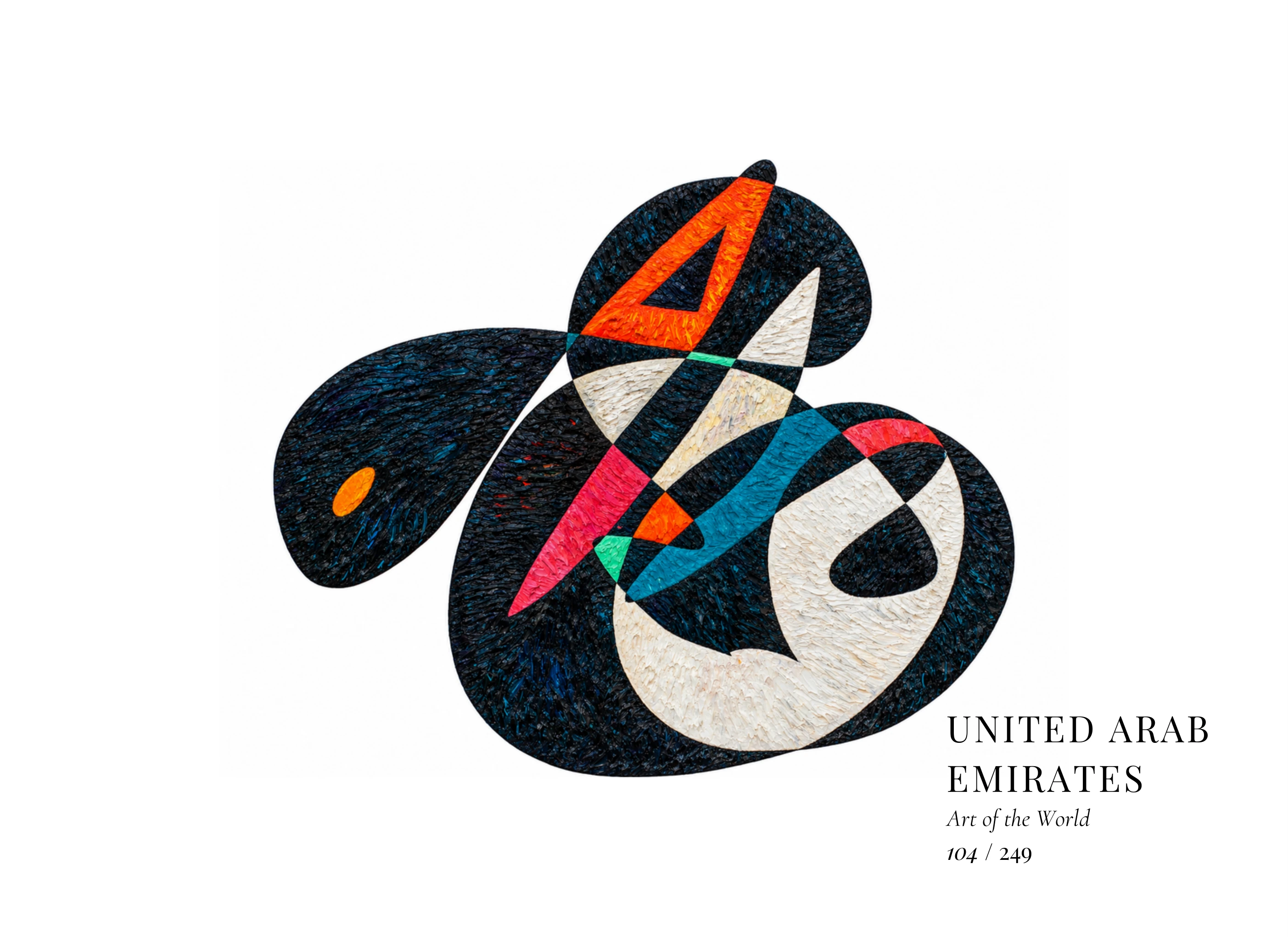
Description
The artwork is anchored by dense black-blue impasto, interrupted by emphatic white, turquoise, orange and magenta forms. Large rounded masses coexist with sharp triangular intersections and sweeping internal curves, producing a tension between stability and acceleration. A detached dark form at the left establishes spatial distance, while the concentrated geometry at the centre suggests convergence. Bright colour appears selectively rather than uniformly, intensifying the sense of compressed energy. The composition can be read as an abstract reflection on a federation in which separate territories retain distinct identities while participating in a rapidly constructed national structure.
Cultural Context
The United Arab Emirates occupies the south-eastern Arabian Peninsula, facing both the Persian Gulf and the Gulf of Oman. For centuries, coastal settlements participated in maritime trade, pearling and regional exchange, while inland communities maintained pastoral and oasis economies. British treaty relationships shaped the Trucial States before six emirates formed a federation in 1971; Ras Al Khaimah joined in 1972. Oil wealth subsequently enabled exceptionally rapid urban and infrastructural transformation.
Emirati culture combines Arab and Islamic traditions with the distinctive histories of seven emirates and an exceptionally international contemporary population. Arabic remains the official language, while poetry, falconry, dhow-building, weaving, jewellery and architectural traditions preserve older forms of social memory. Modern cities such as Abu Dhabi and Dubai have also become major centres for architecture, design, museums, publishing and contemporary cultural production.