199 / 249
Uzbekistan
Samarkand, Silk Roads and the Timurid Inheritance
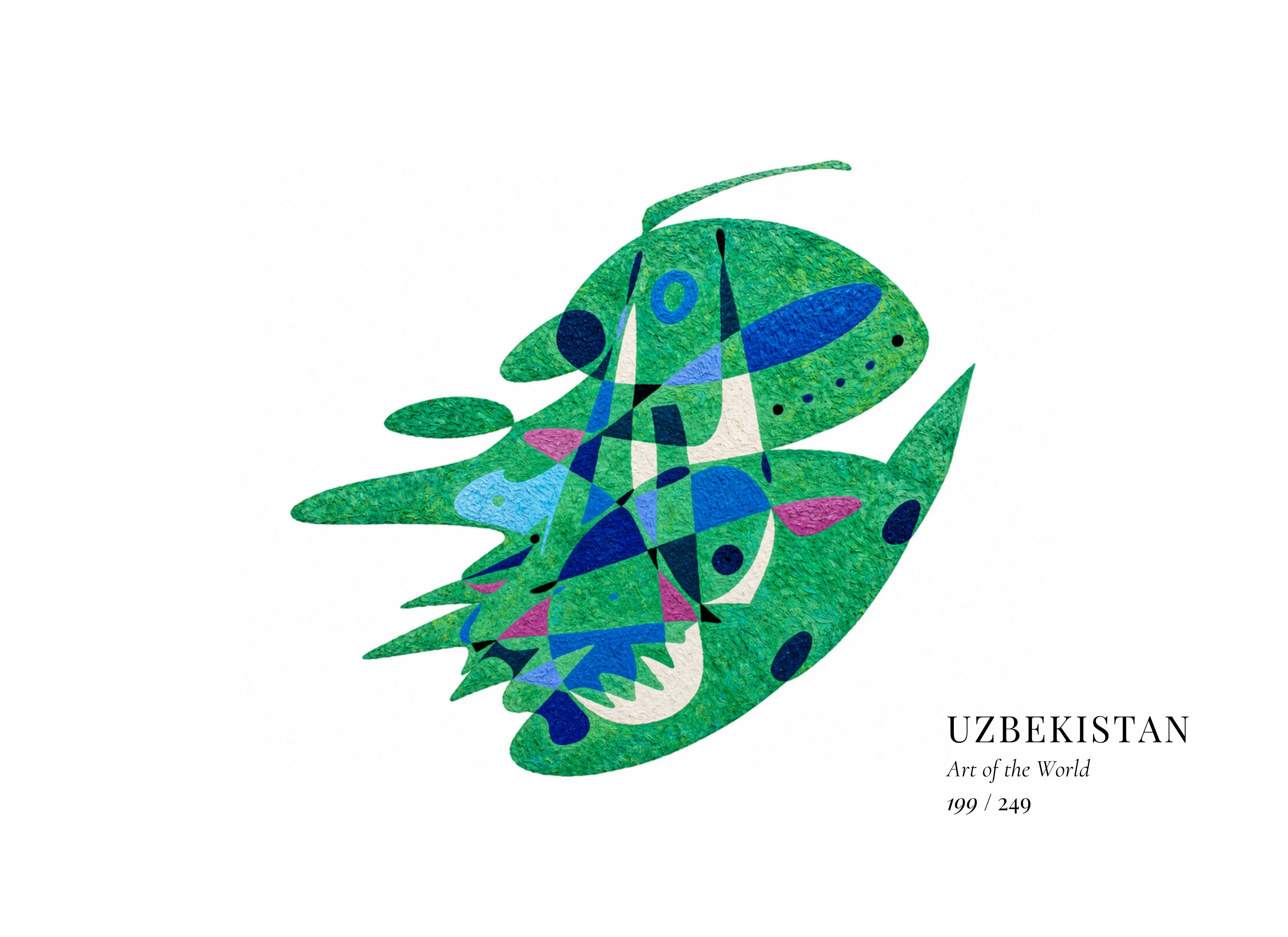
Description
The artwork is dominated by a luminous green field articulated through blue, turquoise, white, violet and dark accents. Broad rounded masses are penetrated by narrow points, arcs and intersecting geometric fragments, while detached forms create pauses around the main silhouette. Dense impasto gives the surface a woven physicality. The tension between expansive shapes and concentrated internal divisions can be read as recalling Uzbekistan’s historical position as a meeting ground of cultures, where continuity and transformation repeatedly occupy the same space.
Cultural Context
Uzbekistan lies at the historic centre of Central Asia, shaped by deserts, fertile oases and the great cities of Samarkand, Bukhara and Khiva. For centuries these centres connected China, Persia, India and the Mediterranean through Silk Road exchange. Persianate and Turkic cultures flourished under successive dynasties, while the Timurid period transformed Samarkand into an extraordinary centre of architecture, scholarship and artistic production. Russian imperial expansion was followed by Soviet rule and independence in 1991.
Uzbek cultural identity draws upon Uzbek, Tajik, Karakalpak and other communities, with Uzbek the principal language and Islam the majority religious tradition. Its heritage encompasses oral poetry, classical literature, maqom music, ceramics, woodcarving, metalwork and monumental architecture. Ikat textiles and suzani embroidery are especially distinguished by rhythmic pattern, saturated colour and intricate relationships between geometry and organic form.