85 / 249
Vietnam
The Long Memory of Đại Việt
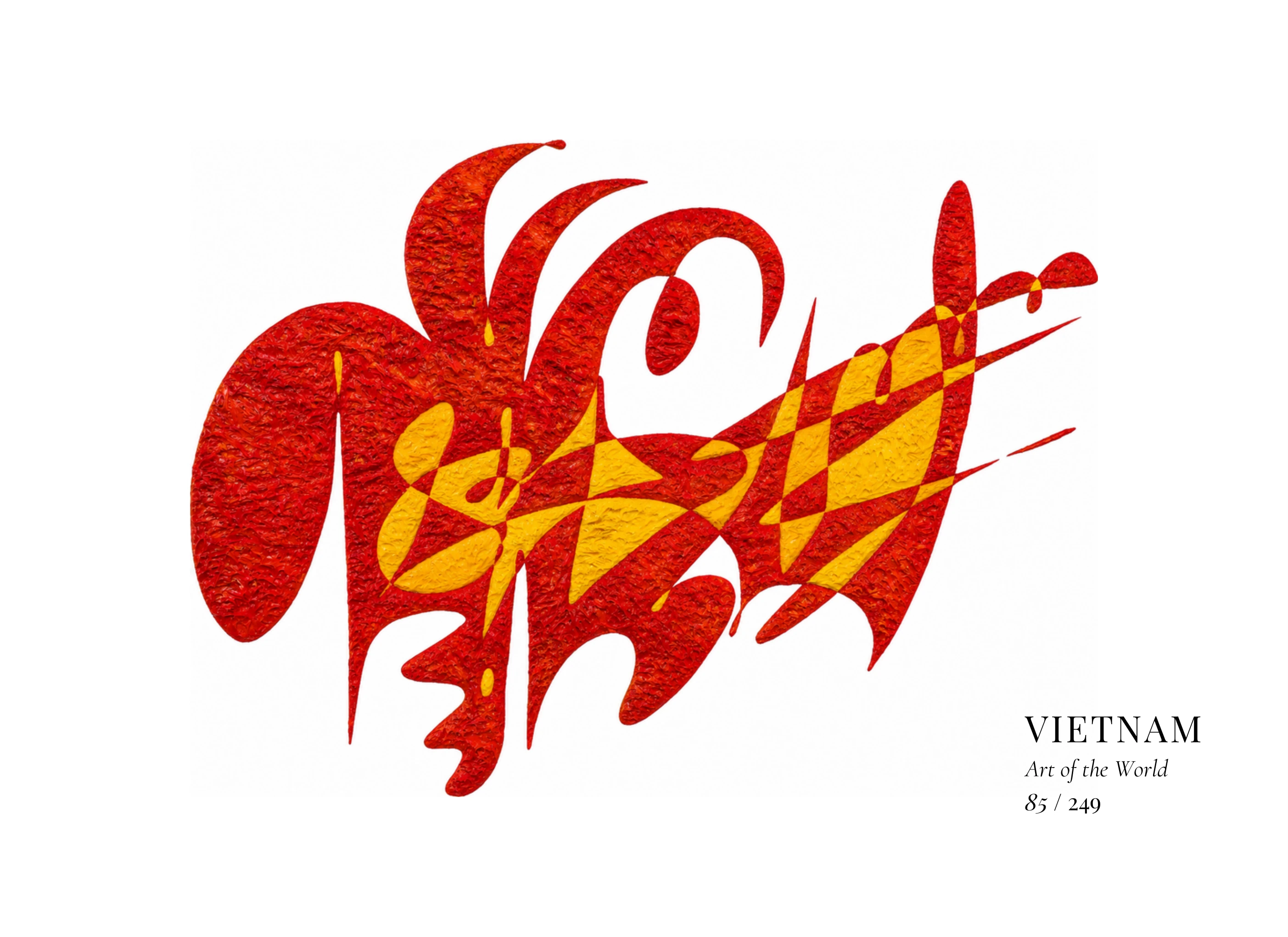
Description
The composition is dominated by incandescent red-orange, crossed by concentrated yellow and gold. Its silhouette combines broad rounded masses with hooks, crescents, narrow verticals and exceptionally sharp extensions. Dense impasto gives the limited palette unusual physical intensity, while white openings interrupt the mass and prevent visual closure. The central yellow geometry gathers into interlocking, almost tessellated fragments before accelerating towards the right. This compression and release can be read as an abstract meditation on Vietnam’s historical endurance: continuity maintained not through stillness, but through repeated periods of fracture, adaptation and renewal.
Cultural Context
Vietnam extends along the eastern edge of mainland Southeast Asia, with the Red River and Mekong deltas anchoring regions connected by a long coastal corridor. Early societies developed through indigenous traditions and sustained interaction with China; independent Đại Việt emerged in the tenth century and expanded southward over subsequent centuries. Nguyễn rule, French colonialism, revolutionary struggle, partition and the Vietnam War profoundly shaped the modern state, reunified in 1975.
Vietnamese culture reflects Kinh, Tày, Thái, Hmong, Khmer, Cham and many other communities. Its traditions encompass chữ Nôm literature, Confucian scholarship, Buddhist and ancestral practices, water puppetry, lacquer painting, silk, ceramics and distinctive regional musical forms. Contemporary culture continues to negotiate inherited traditions alongside rapid economic and urban transformation.