122 / 249
Yemen
Sabaean Inheritance and the Fractured Republic
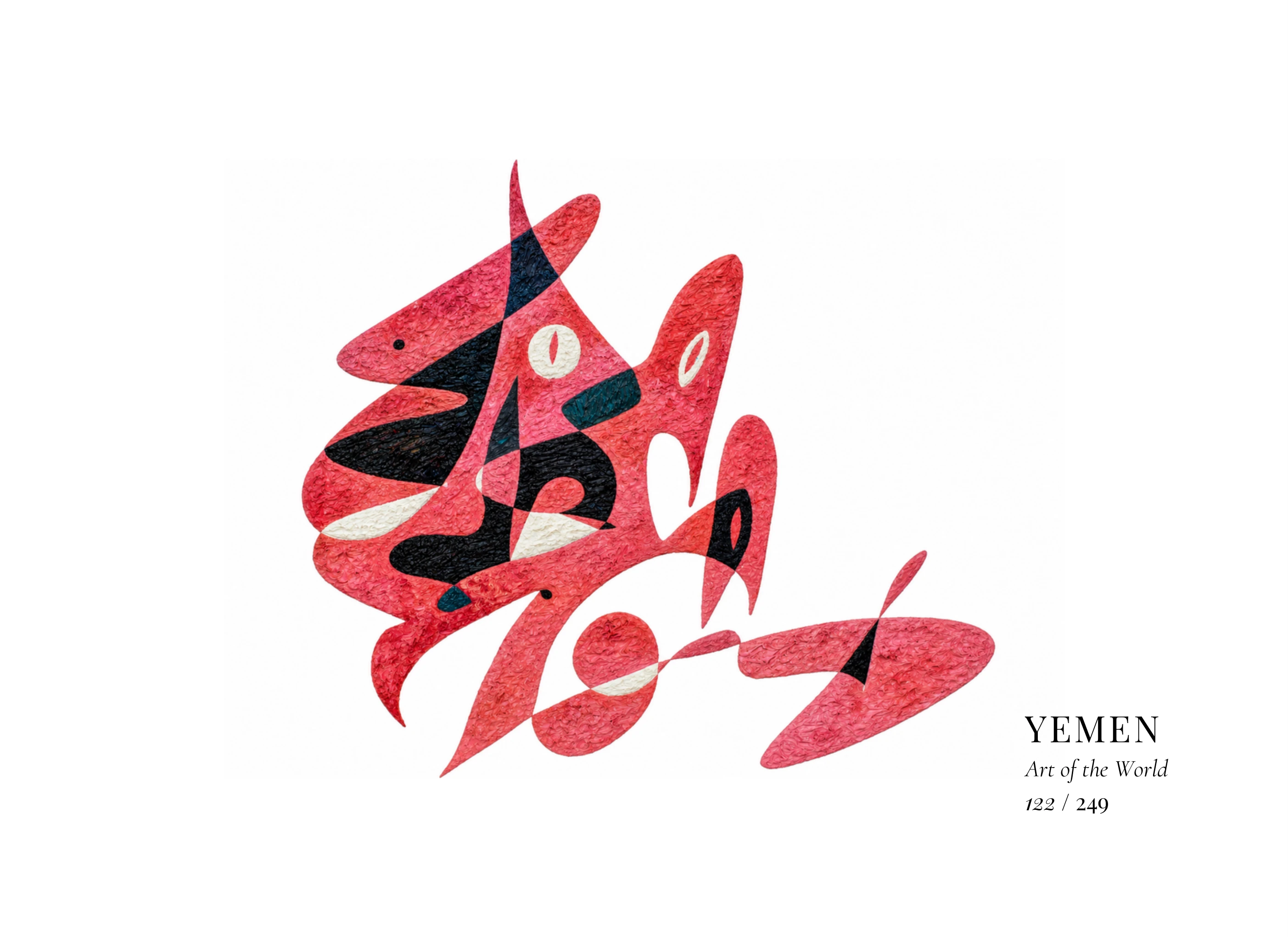
Description
The composition's dusty rose field is interrupted by black, deep blue-green and restrained white. Its silhouette rises through pointed vertical forms before breaking into detached elements across the lower and right margins. Curves, apertures and sharp intersections create an unstable balance between cohesion and separation. Thick impasto maintains material continuity even where the geometry fractures. The composition can be read as evoking Yemen’s historical depth alongside the divisions of its modern experience: a structure repeatedly separated, reconnected and held in visual tension.
Cultural Context
Yemen occupies the south-western corner of the Arabian Peninsula, commanding approaches to the Red Sea and Gulf of Aden. Ancient kingdoms including Saba, Qataban and Himyar prospered through agriculture and long-distance trade. Islam transformed the region from the seventh century, while powerful local dynasties and the Zaydi imamate shaped later history. Ottoman and British influence divided political trajectories before North and South Yemen unified in 1990; subsequent conflict has profoundly destabilised the republic.
Yemen’s cultural inheritance encompasses Arabic poetry, oral traditions, distinctive regional music, silverwork, textiles and elaborate architectural traditions. The extraordinary tower houses of Sana’a, the mud-brick architecture of Shibam and the cultural particularity of Hadramawt and Socotra demonstrate a society formed through strong regional identities as well as wider Arabian, African and Indian Ocean connections.