157 / 249
Albania
Illyrian Memory and the Albanian National Awakening
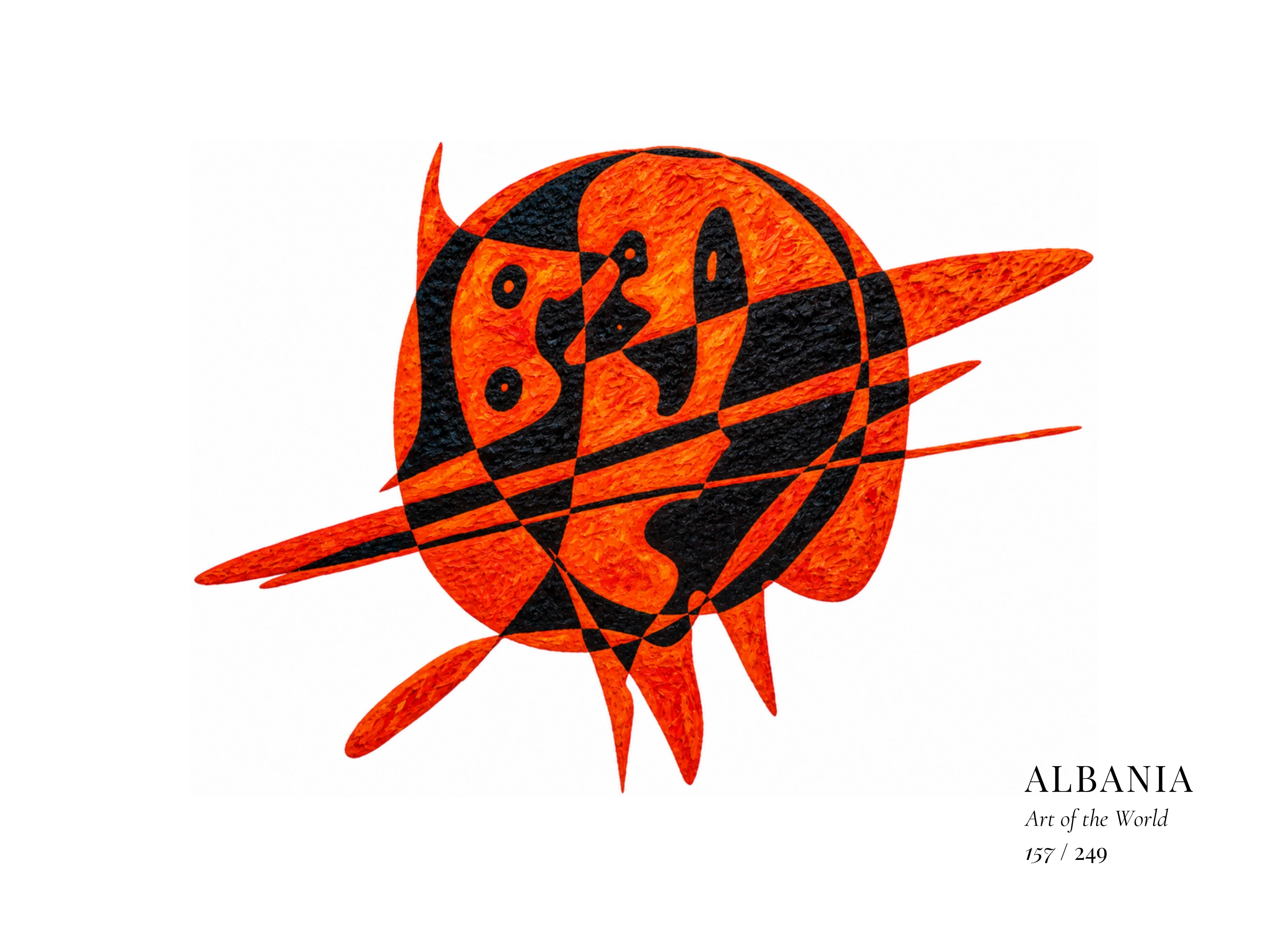
Description
The artwork concentrates almost entirely on fiery orange-red and dense black, producing exceptional graphic force. A rounded central mass is cut by sweeping bands, circular apertures, irregular black chambers and narrow intersecting lines. Long pointed extensions project outward, while the lower silhouette breaks into sharp descending forms. Thick impasto prevents the restricted palette from becoming flat, giving both colours a turbulent physical presence. The tension between enclosure and outward movement can be read as evoking Albania’s passage from prolonged isolation towards renewed international connection, while retaining a strongly defined cultural identity.
Cultural Context
Albania occupies the western Balkans, where Adriatic and Ionian connections have long intersected with the interior of south- eastern Europe. Ancient Illyrian communities, Roman and Byzantine rule, medieval principalities and centuries within the Ottoman Empire shaped its historical formation. The nineteenth-century Albanian National Awakening strengthened linguistic and political identity, leading to independence in 1912. A highly isolated communist state emerged after the Second World War; since 1991 Albania has undergone profound political, economic and social transformation.
Albanian culture is centred on the Albanian language and its Gheg and Tosk traditions, alongside Muslim, Orthodox and Catholic inheritances. Oral epic poetry, polyphonic singing, intricate textiles, woodcarving and distinctive regional costume preserve strong local traditions. Writers including Ismail Kadare brought Albanian historical experience into international literature, while contemporary music, cinema and visual culture increasingly connect the country with wider European networks.