202 / 249
Andorra
The Enduring Institution of the Co-Principality
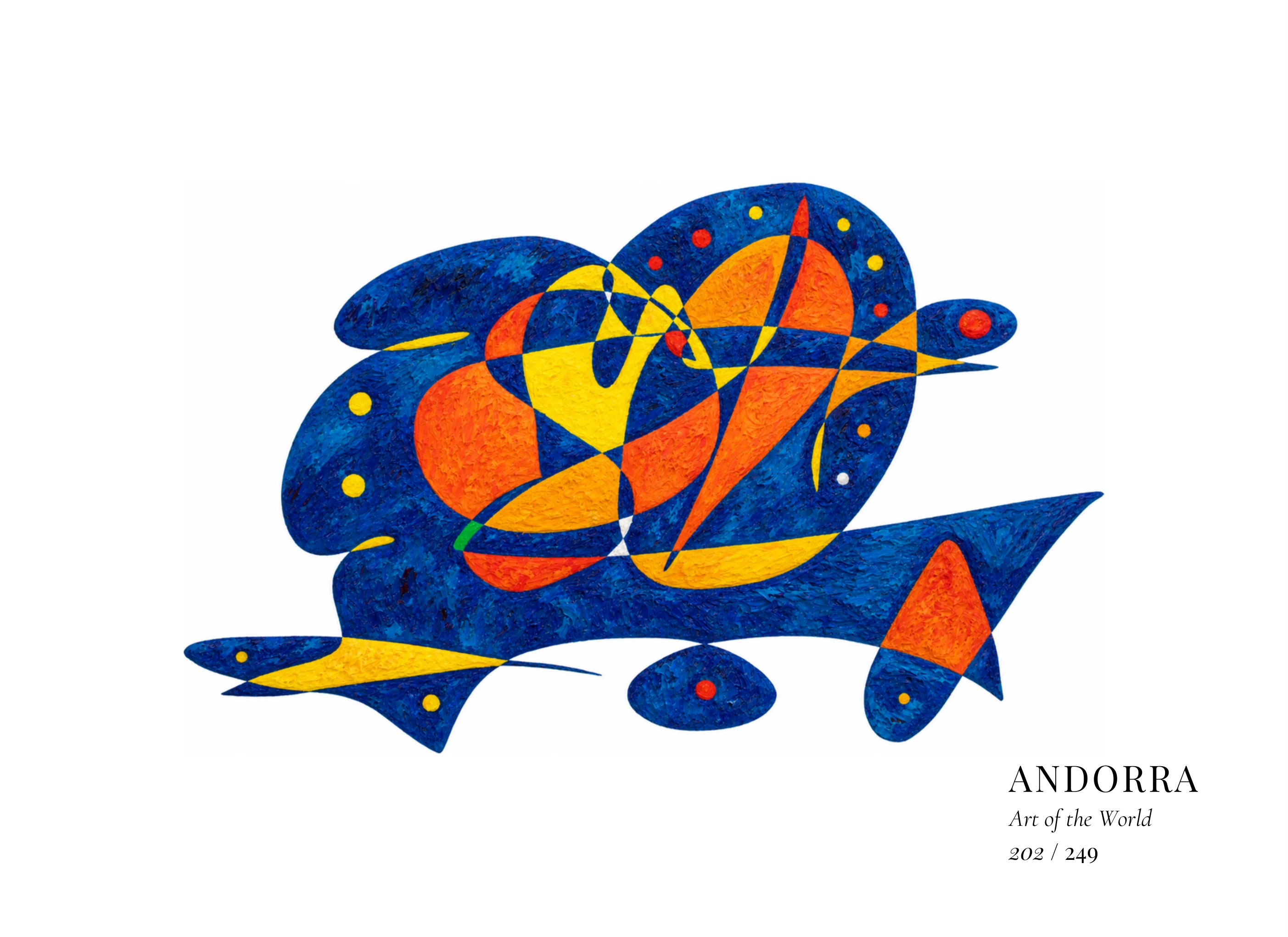
Description
The artwork builds its structure from intense cobalt and ultramarine, animated by luminous yellow, orange and small red, green and white accents. Broad rounded masses contain a concentrated network of intersecting triangles, arcs and narrow bands, while detached forms establish an outer rhythm. Dense impasto gives the blue passages considerable depth, against which the warmer geometry appears almost illuminated. The composition’s repeated balancing of paired forms, intersections and independent elements can be read as recalling Andorra’s distinctive political inheritance: authority negotiated between different centres while maintaining a coherent and remarkably durable sovereignty.
Cultural Context
Andorra is a small sovereign state in the eastern Pyrenees between France and Spain. Its political identity developed from medieval agreements between the Bishop of Urgell and the Counts of Foix, culminating in the paréages of 1278 and 1288. Their unusual division of authority evolved into Andorra’s co-principality, an institution that survives within the modern parliamentary system established by the 1993 constitution.
Catalan is the official language and a central expression of Andorran identity. Cultural traditions reflect the wider Catalan world while retaining distinctive Pyrenean characteristics shaped by mountain communities, Romanesque churches, seasonal agriculture and long-established local institutions. Stone architecture, religious art, festivals and folk traditions coexist with a contemporary society transformed by tourism, commerce and immigration.