187 / 249
Austria
Habsburg Legacies and the Culture of the Republic
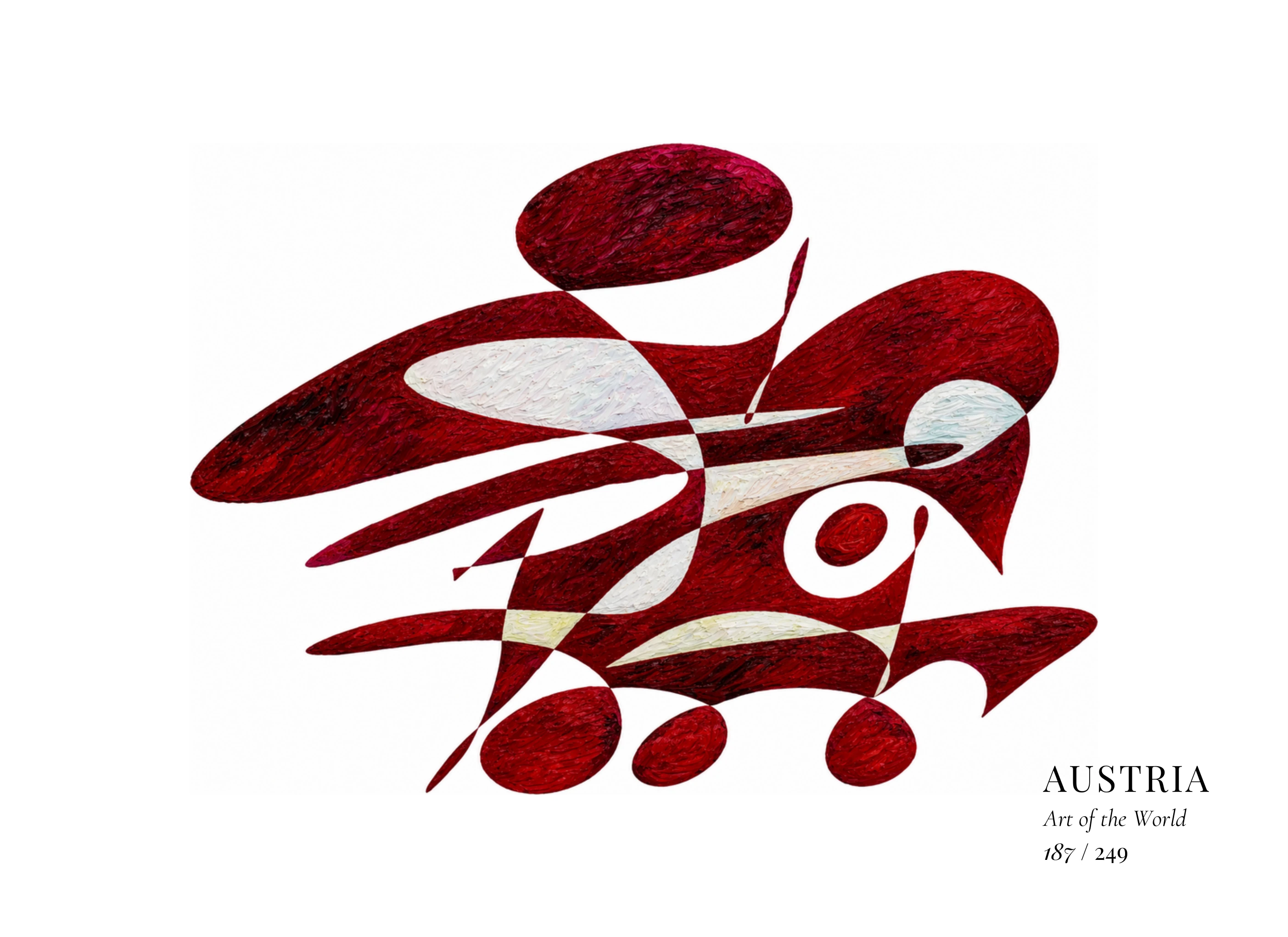
Description
The artwork is dominated by burgundy, crimson and near-black impasto, cut by restrained white and ivory. Sweeping pointed forms intersect with broad curves, circular openings and several detached ovals, creating a composition that alternates compression with separation. White passages act as structural interruptions rather than decoration, sharpening the darker geometry. The complex balance of concentrated centre and independent surrounding forms can be read as recalling Austria’s transformation from the nucleus of a multinational empire into a smaller republic whose cultural inheritance continues to exceed its present borders.
Cultural Context
Austria lies at the centre of Europe, historically connecting German-speaking lands with Central, Eastern and south-eastern Europe. The Habsburg dynasty transformed Vienna into the political centre of a vast composite monarchy, culminating in the Austro-Hungarian Empire. Its dissolution in 1918 created a smaller Austrian republic; annexation by Nazi Germany in 1938 and the catastrophe of the Second World War were followed by restored sovereignty and permanent neutrality in 1955.
Austrian culture reflects centuries of exchange across the former imperial territories. German is the principal language, while recognised minorities include Slovenes, Croats, Hungarians, Czechs, Slovaks and Roma. Vienna became particularly influential in classical music, architecture, psychoanalysis, literature and modernism, while regional traditions encompass woodcarving, textiles, religious art and distinctive vernacular architecture.