151 / 249
Croatia
Between Adriatic Stone and Continental Roads
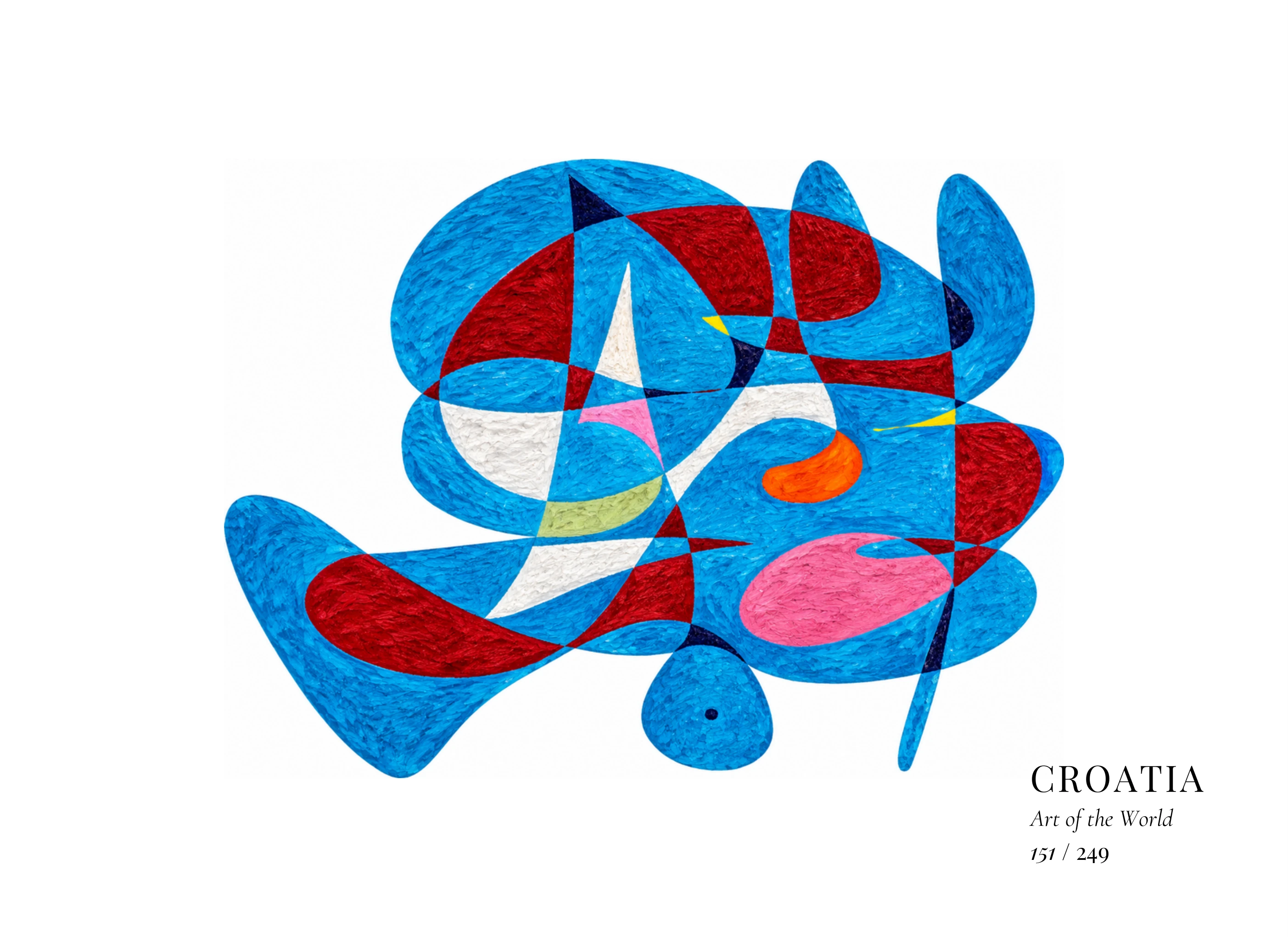
Description
The composition's expansive turquoise field suggests the Adriatic as both environment and connective space. Dense impasto gives its irregular silhouette a tactile, almost topographical energy, while crimson compartments, white wedges and smaller passages of pink, orange, yellow and deep blue establish a shifting internal rhythm. Curves intersect with pointed extensions and narrow linear forms; detached shapes preserve breathing space around the composition. Its balance of fragmentation and cohesion can be read as an evocative visual memory of Croatia’s layered regions, islands and historical crossings.
Cultural Context
Croatia occupies a distinctive meeting ground between Central Europe, the Balkans and the Adriatic Mediterranean, extending from the Pannonian plains through wooded uplands to a long, island-rich coastline. Its historical formation reflects Roman and medieval inheritances, the Croatian kingdom, centuries of connection with Central European and Mediterranean powers, and the cultural importance of maritime cities such as Dubrovnik and Split. Since independence in 1991, Croatia has developed as a modern European state while sustaining a strong consciousness of its regional histories and landscapes.
Croatian identity draws richness from varied regional traditions and communities, with Croatian as the national language and distinctive local dialects carrying deep literary and oral histories. Renaissance Dubrovnik, Dalmatian stone architecture, Romanesque and Baroque heritage, lace-making, woodcraft and textile traditions belong to a broad artistic inheritance. Music ranges from multipart vocal traditions such as klapa to diverse continental forms, while literature, sculpture, animation, film and contemporary design extend this cultural conversation into the present.