214 / 249
Estonia
Northern Light, Layered Memory
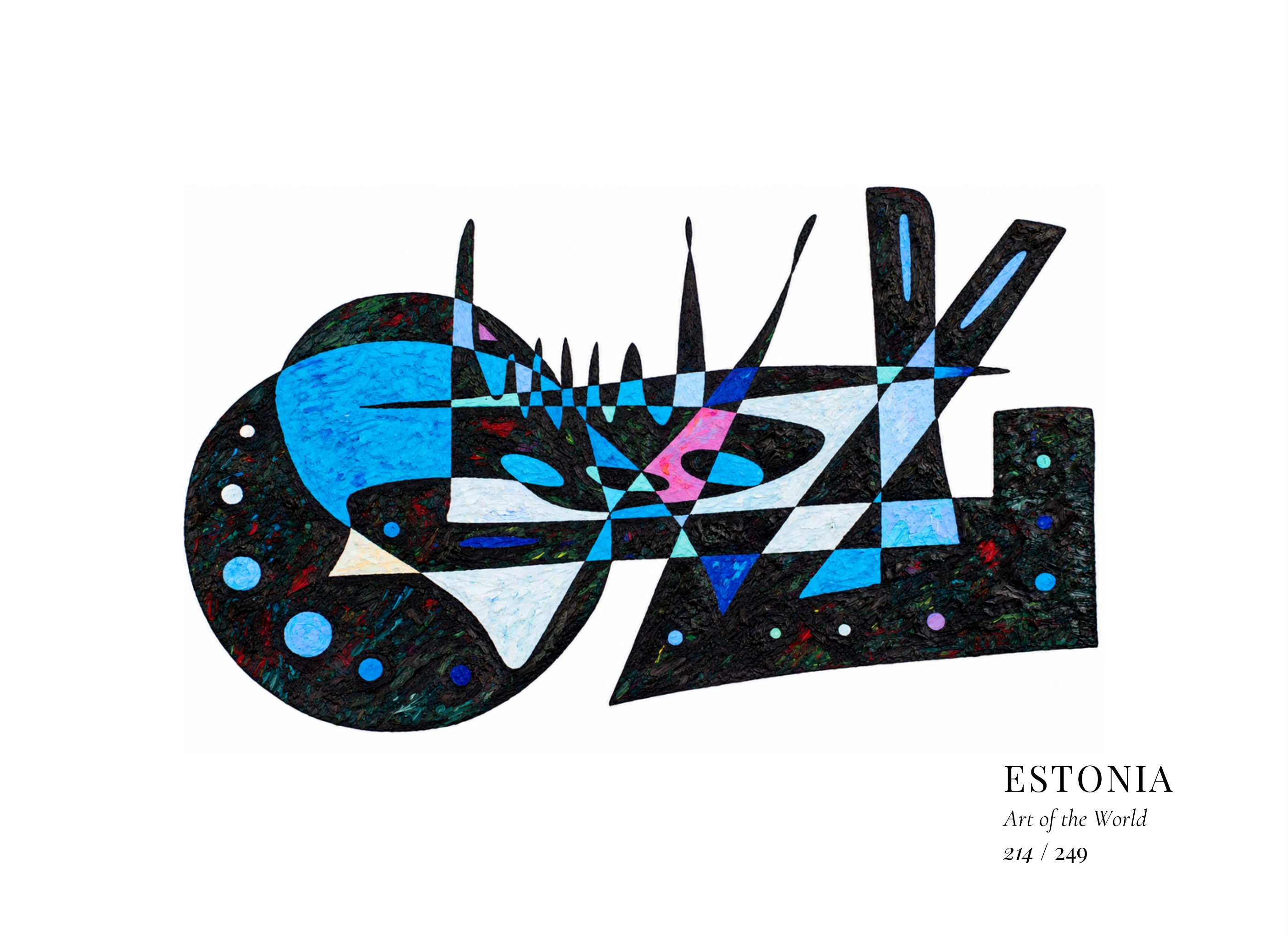
Description
The composition's dark, densely worked impasto establishes a powerful ground against which turquoise, icy blue and white forms appear almost luminous. A broad rounded mass meets an angular, horizontally driven structure, crossed by narrow lines, pointed vertical extensions and shifting geometric compartments. Small circular elements punctuate the darker areas, while a concentrated pink passage introduces a surprising chromatic centre. The alternation of enclosed density and open white space suggests a landscape of connections and intervals; its fragmented yet continuous rhythm can be read as evoking Estonia’s layered historical memory and its enduring orientation towards the Baltic horizon.
Cultural Context
Estonia stands on the eastern Baltic Sea, facing the Gulf of Finland and encompassing a mainland of forests, wetlands and lakes alongside more than two thousand islands and islets. Its position between northern and eastern Europe has long encouraged maritime exchange and cultural encounter. Medieval trading towns participated in Hanseatic networks, while successive periods of Danish, German, Swedish and Russian influence shaped its historical landscape. Independence was proclaimed in 1918 and restored in 1991, establishing the contemporary republic within a continuity of language, place and national culture.
Estonian identity is closely connected to the Estonian language, part of the Finnic branch of the Uralic family, and to an exceptionally rich tradition of oral poetry and communal song. The nineteenth-century national awakening gave literature, folklore and song festivals particular cultural importance. Historic wooden architecture, textiles and handicrafts coexist with modernist and contemporary design, while composers, writers, filmmakers and digital creators have extended Estonia’s cultural presence internationally. Its traditions reveal a productive dialogue between inherited forms and experimentation.