218 / 249
Finland
The Quiet Architecture of the North
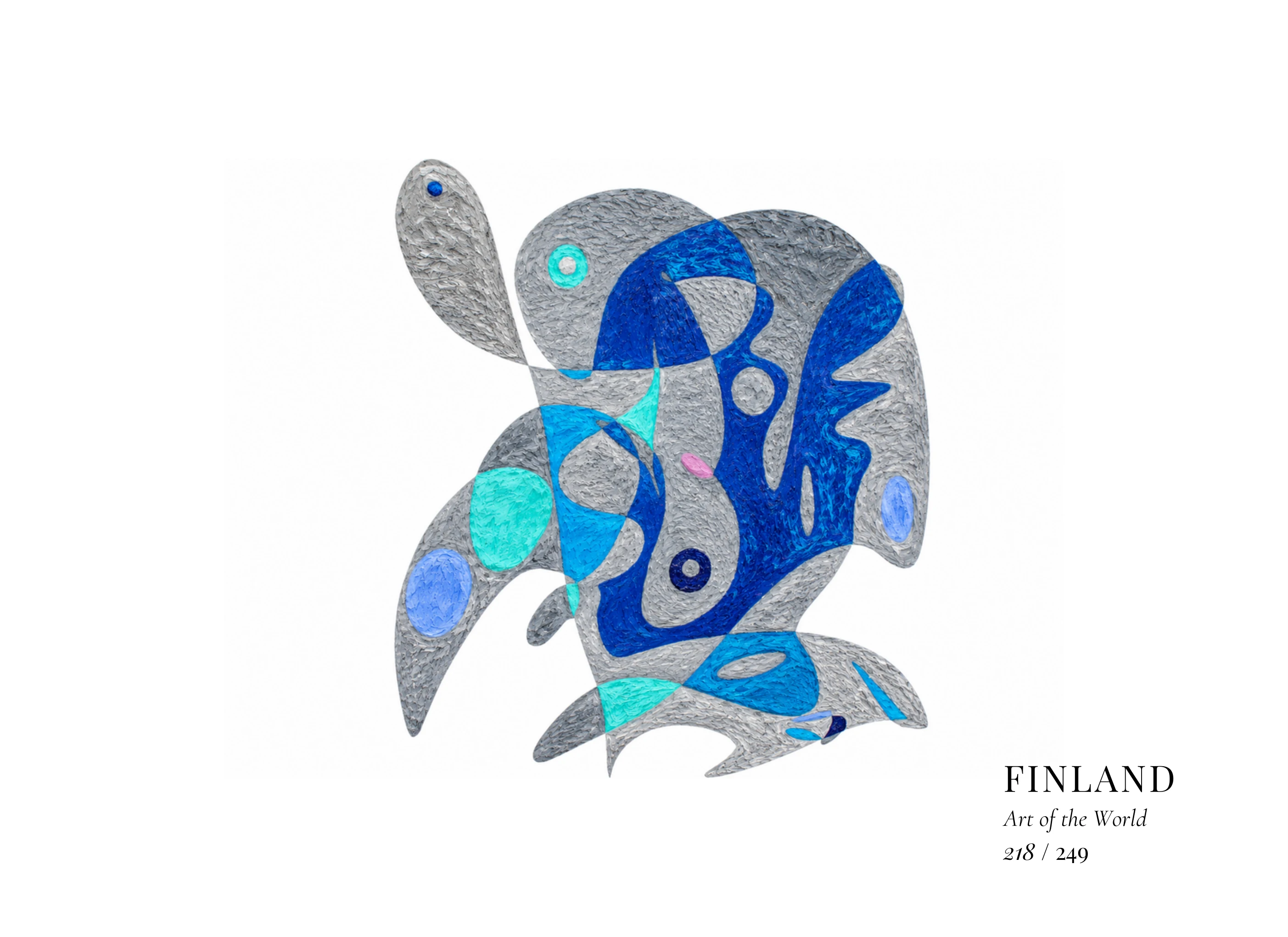
Artist: Gheorghe Virtosu
Catalogue: Art of the World
Catalogue Nr: 218/249
Source of Print: Excerpt from Divine DNA, 2016 (oil on canvas)
Medium: Limited Edition Print
Edition: 1/1
Authentication: Approved and signed by the artist on the reverse.
Artwork Classification: Civilisational Portraiture
Part of Art of the World, an El Arte Monumental project exploring contemporary art, cultural identity and visual memory.
Description
The composition's silvery-grey impasto forms an atmospheric ground through which cobalt, turquoise and pale blue move in branching currents. Rounded compartments meet sharp points, narrow extensions and detached forms, while small circular accents and a solitary pink passage interrupt the cool palette. Expansive white space heightens the silhouette’s clarity. Its fluid geometry suggests Finland’s abundant waters and northern luminosity, evoking resilience, spaciousness and continuity.
Cultural Context
Finland occupies Europe’s far north-east, between Sweden, Norway and Russia, with a Baltic coastline and landscapes shaped by forests, wetlands and thousands of lakes. Centuries within the Swedish realm were followed by autonomy as a Grand Duchy of the Russian Empire from 1809. Independence in 1917 established the modern Finnish state, deeply connected to both Nordic and Baltic worlds.
Finnish culture is shaped by Finnish and Swedish traditions alongside the Indigenous Sámi cultures of the north. Oral poetry associated with the Kalevala, folk music, weaving and woodcraft contribute to a rich inheritance. Finland has achieved particular international distinction in architecture, glass, ceramics, textiles, furniture and industrial design, complemented by influential literature, music, cinema and visual art.
Exhibition Context
Several blue eyes sit in gray, winglike bodies that overlap but never quite merge. Finland's Swedish and Russian periods preceded its independence in 1917, so the work's layered, pale figures can evoke a national outline made under more than one historical frame. Its white space feels almost wintry, but calling it a landscape would be too easy. What matters is the persistence of distinct gazes within a quiet, shared formation.