191 / 249
Germany
A Structure of Many Histories
Description
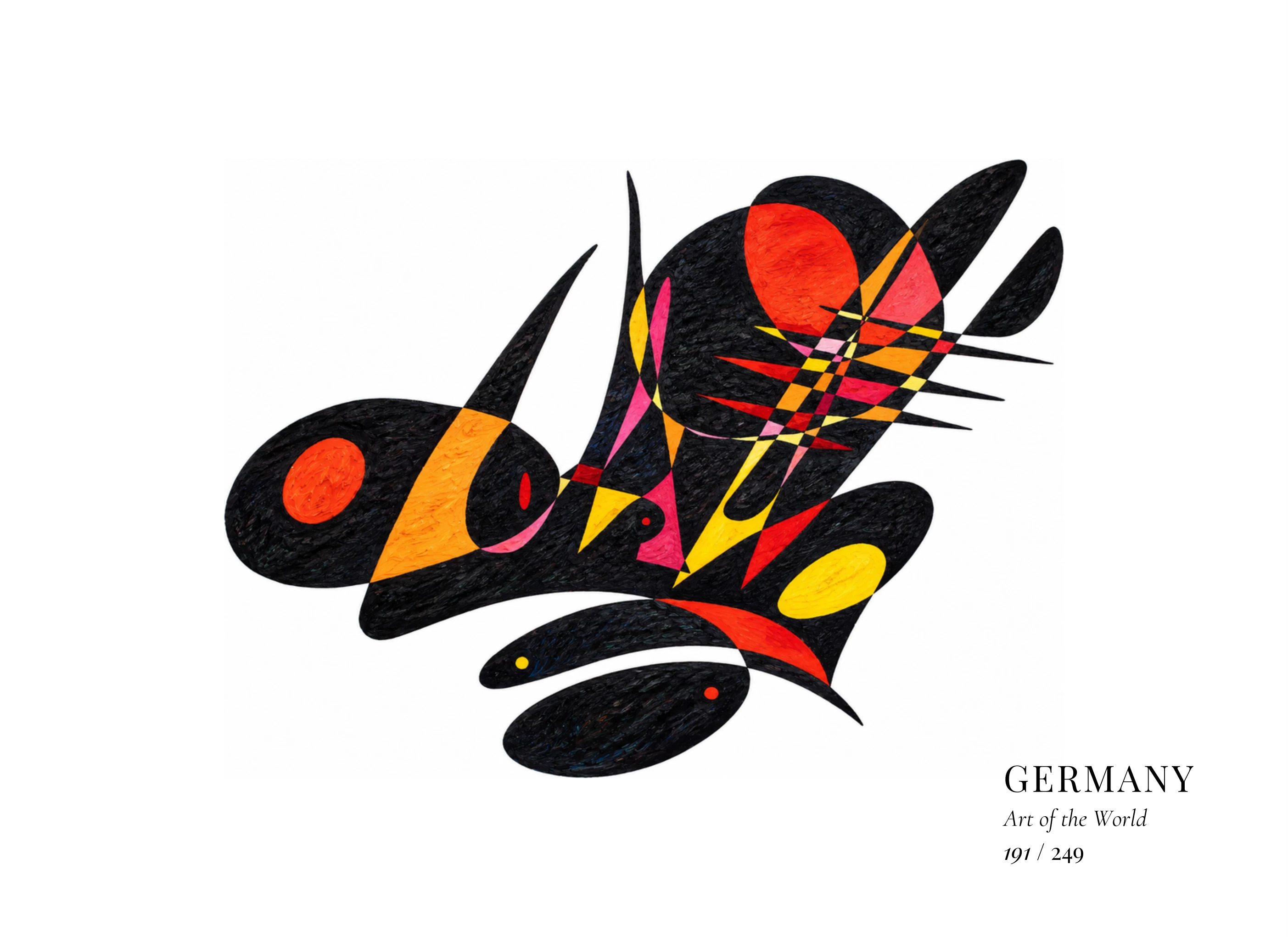
The composition's dark impasto ground intensifies its orange, yellow, red and pink passages. Rounded masses meet acute points, elongated extensions and intersecting bands, balancing organic movement with geometric order. Small circular accents provide quieter counterpoints, while surrounding white space sharpens the silhouette. The interlocking divisions suggest distinct yet dependent parts, evoking Germany’s federal plurality and layered historical memory through connection, contrast and structural balance.
Cultural Context
Germany occupies the centre of Europe, extending from the North and Baltic seas to the Alpine foothills. Its historical formation emerged through numerous principalities, duchies and free cities within the Holy Roman Empire. The Reformation and later intellectual and industrial transformations profoundly influenced Europe. Unified in 1871, Germany experienced division after the Second World War before reunification in 1990 established the present federal republic.
German cultural life combines strong regional identities with influential traditions in literature, philosophy, scholarship, classical music and theatre. Romanesque and Gothic architecture, timber-framed buildings, printmaking, porcelain and metalwork demonstrate enduring craftsmanship. The Bauhaus transformed modern architecture and design, while German photography, cinema, typography and contemporary visual culture continue traditions of experimentation and technical precision.