229 / 249
Greece
Aegean Continuities, Living Forms
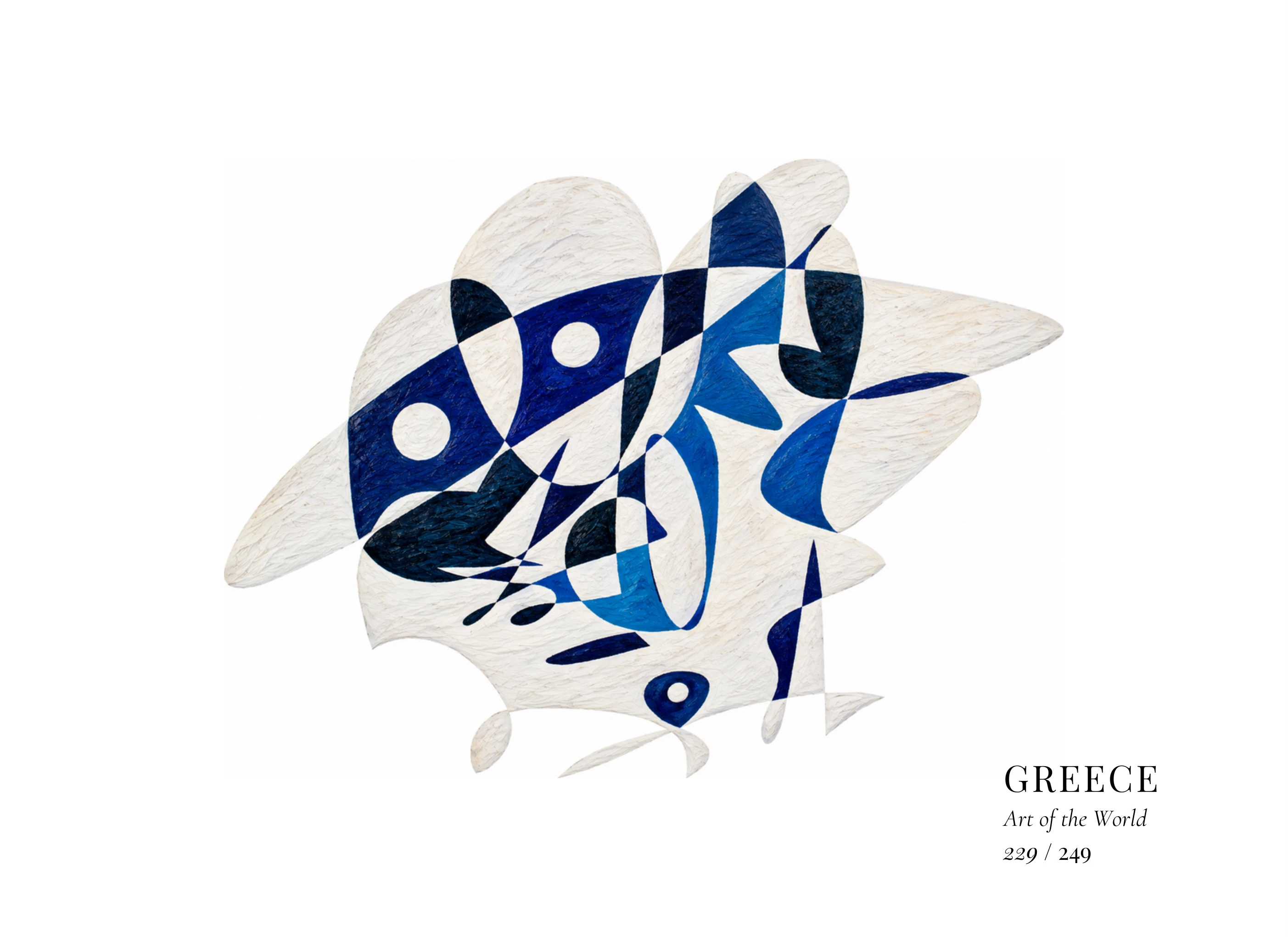
Description
The composition's luminous white impasto is structured by deep navy, cobalt, black and turquoise. Curved expanses meet sharp wedges, narrow extensions and recurring circular forms, creating a rhythm of opening and enclosure. Dark geometries concentrate near the centre before dispersing into paler projections across generous white space. The restrained chromatic relationship suggests clarity and light, while the interlocking and detached forms can be read as evoking Greece’s interplay of mainland, islands and maritime passages—a cultural memory continuously renewed across time.
Cultural Context
Greece occupies the southern Balkan Peninsula, extending through thousands of islands into the Aegean, Ionian and Mediterranean seas. Ancient city-states, the Hellenistic world and centuries within Roman and Byzantine spheres created enduring cultural inheritances. Ottoman and Venetian periods added further layers before the modern Greek state emerged in the nineteenth century.
Greek cultural identity is anchored in a language with an exceptionally long written tradition. Classical literature, philosophy and drama remain influential, while Orthodox Christianity shaped Byzantine architecture, icon painting, music and ceremonial arts. Textiles, embroidery, ceramics, woodcarving and regional music enrich this inheritance, alongside modern poetry, literature, cinema, architecture and design.