231 / 249
Hungary
The Currents of the Carpathian Basin
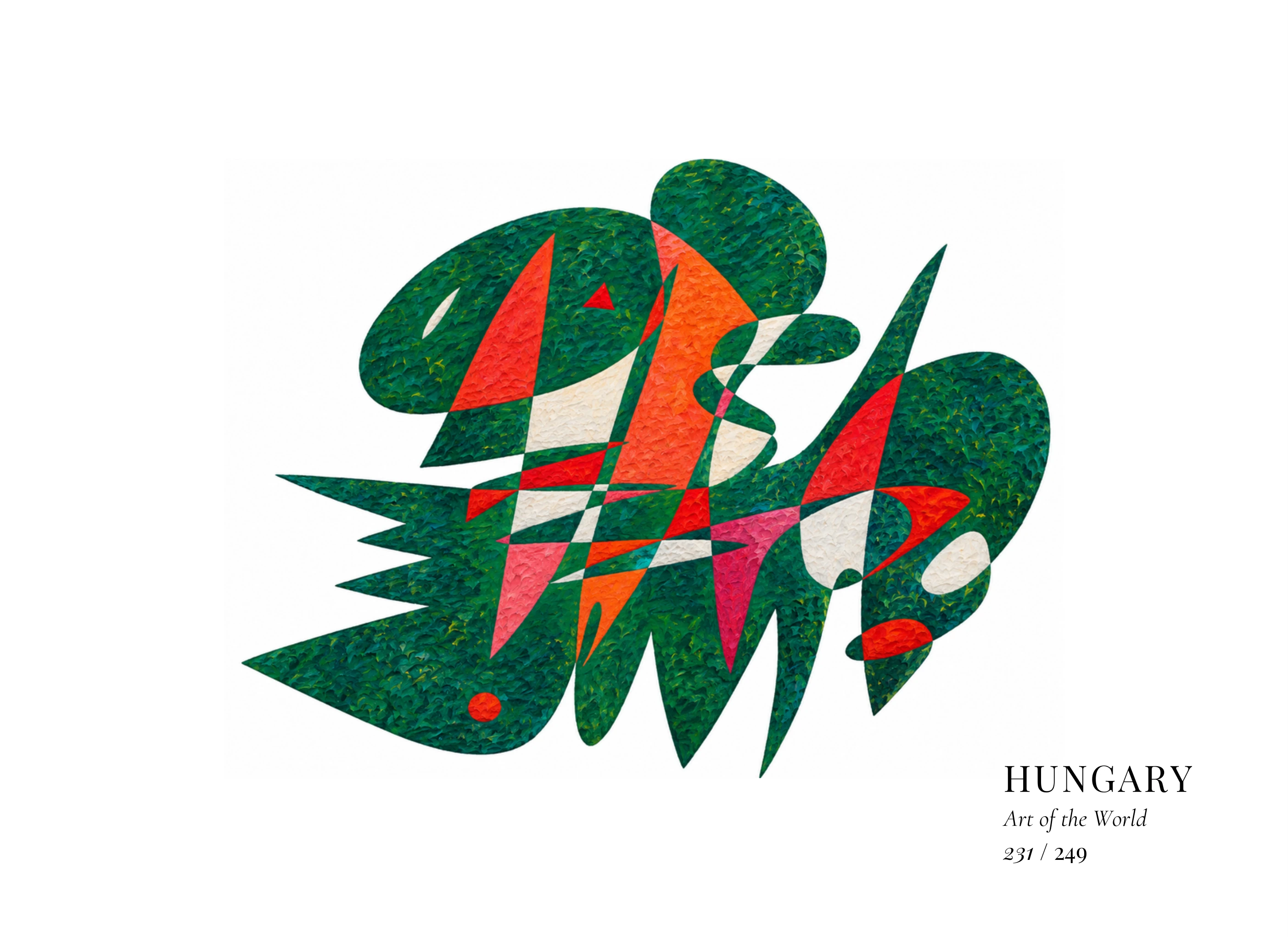
Description
The composition's saturated green and turquoise impasto forms a dense field animated by coral, crimson, orange, pink and white. Rounded masses meet long pointed extensions, while intersecting wedges create a taut internal rhythm. White compartments introduce luminous pauses and sharpen the geometry. The convergence of expansive forms and concentrated crossings can be read as evoking Hungary’s position within the Carpathian Basin, where routes, regions and histories meet. Its vigorous surface suggests cultural memory as something accumulated, interconnected and continually renewed.
Cultural Context
Hungary lies at the heart of the Carpathian Basin, crossed by the Danube and Tisza and shaped by broad plains and surrounding uplands. Magyar settlement in the late ninth century preceded the medieval Kingdom of Hungary. Ottoman and Habsburg periods, Austria-Hungary and the transformations of the twentieth century added successive historical layers. Today, Hungary’s identity remains closely connected to its distinctive language, Central European setting and enduring cultural inheritance.
Hungarian, a Uralic language, anchors a rich tradition of poetry, literature and storytelling. Regional cultures preserve embroidery, weaving, pottery, woodcarving and vernacular architecture, while folk and classical music hold particular importance. Budapest brings together historic architecture, Art Nouveau and modernism, and Hungarian achievements in photography, cinema, ceramics and design demonstrate a continuing dialogue between inherited traditions and innovation.