195 / 249
Italy
Peninsula of Many Inheritances
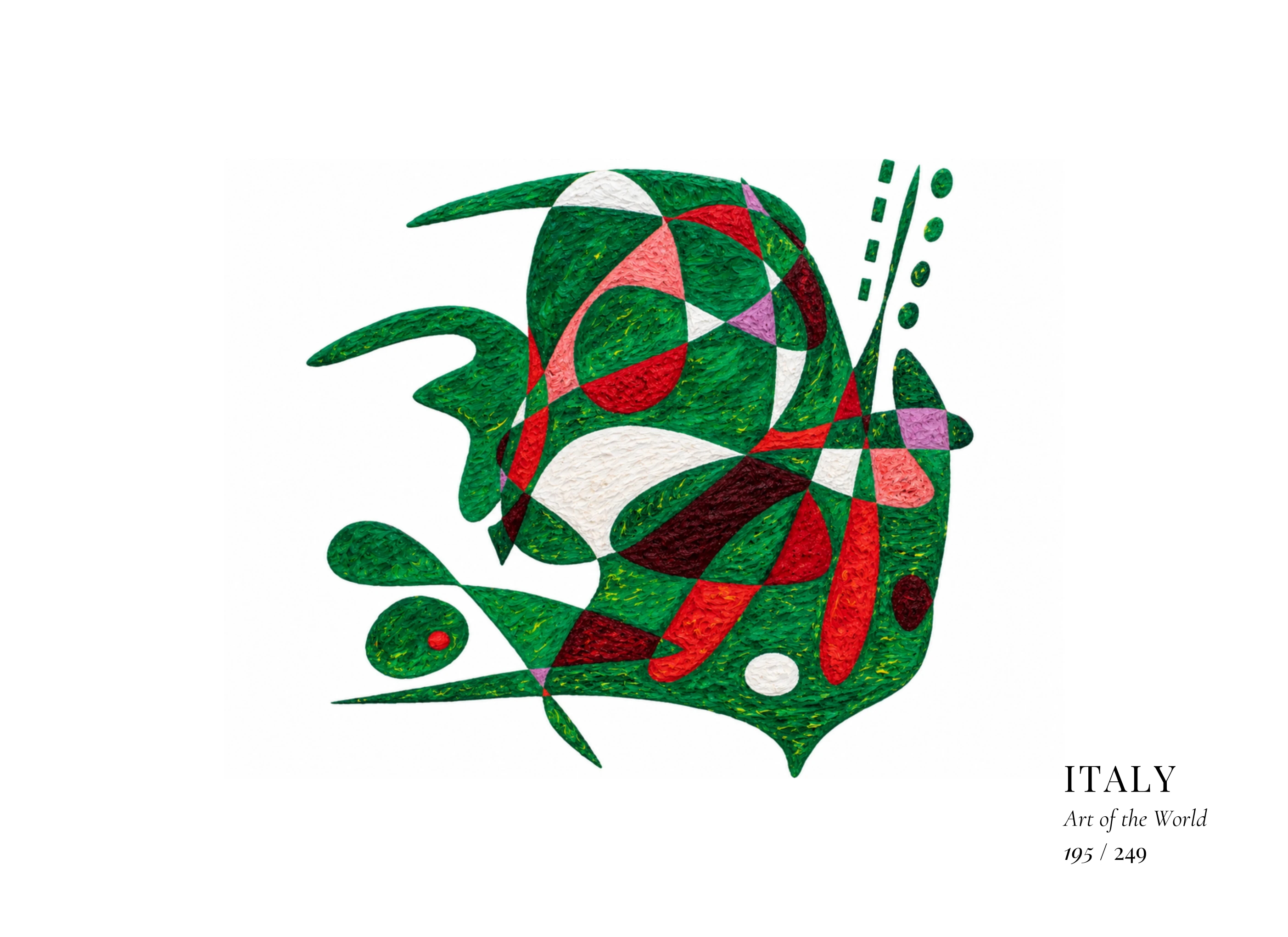
Description
The composition's richly worked green impasto forms an enveloping structure animated by crimson, coral, burgundy, lilac and white. Curving compartments intersect with sharp wedges and slender extensions, while detached circles and small floating elements create visual counterpoints beyond the principal mass. White passages open luminous intervals within the dense surface. The shifting geometry can be read as evoking Italy’s regional plurality: distinct forms gathered into an energetic whole. Its balance of cohesion and variation suggests a cultural memory continually renewed through encounters between locality, history and invention.
Cultural Context
Italy extends into the Mediterranean from the Alps through the Apennine Peninsula to Sicily and Sardinia, its landscapes encompassing mountains, fertile plains, volcanic territories and long coastlines. Etruscan societies, Greek settlements and Rome shaped antiquity, while medieval communes, maritime republics and regional courts created numerous centres of power and exchange. The Renaissance transformed European art and learning, and political unification in the nineteenth century brought these historically varied territories into the modern Italian state.
Italian identity remains strongly regional, expressed through Italian and numerous local languages and dialects. Architecture, sculpture and painting form an extraordinary inheritance alongside literature, opera and musical traditions. Glassmaking, ceramics, mosaics, textiles and metalwork connect historic craftsmanship with Italy’s modern achievements in cinema, fashion, furniture, architecture and industrial design. Across these fields, technical refinement frequently meets imaginative experimentation.