83 / 249
Kosovo
A Plateau of Layered Memory
Description
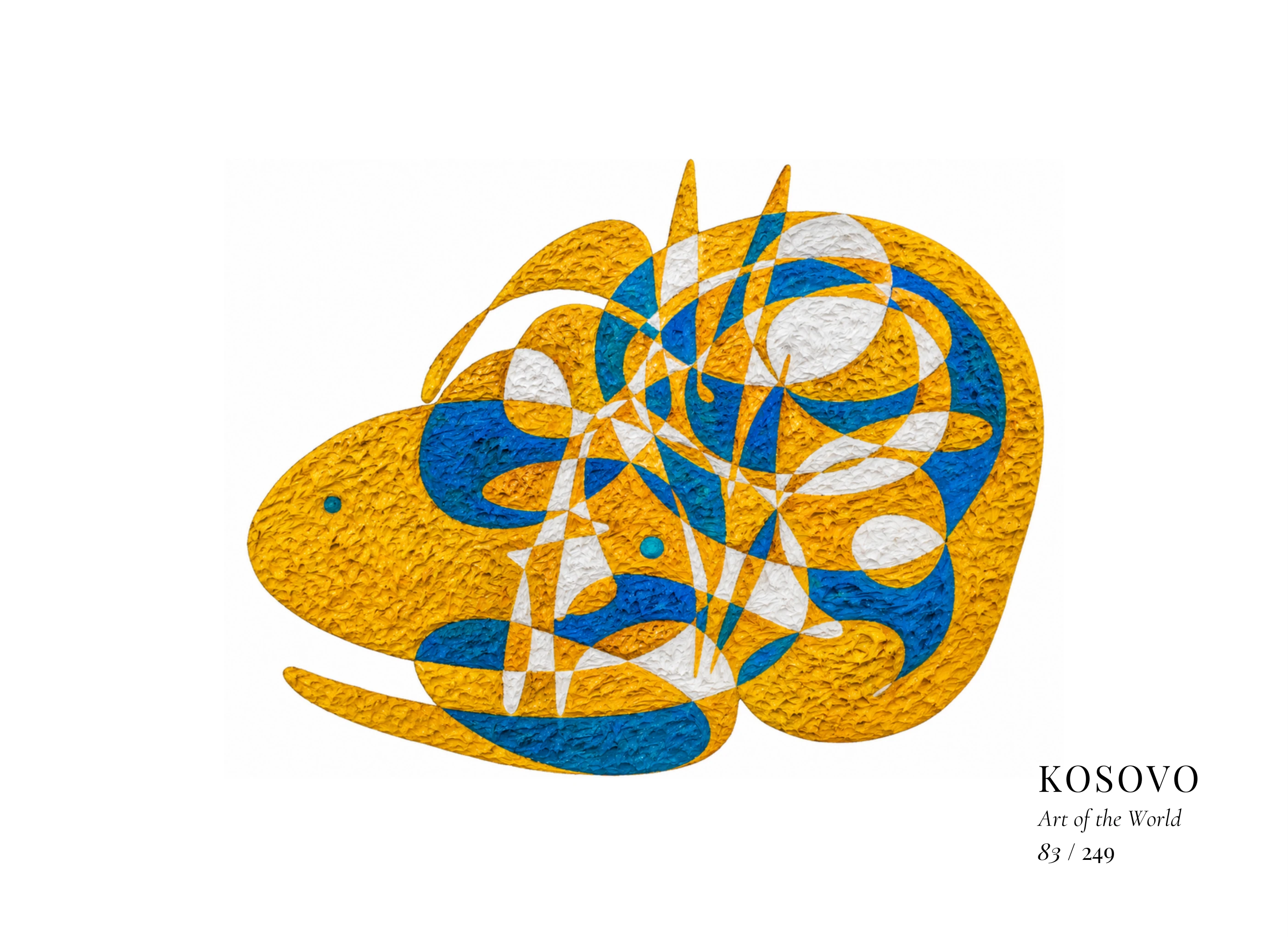
The composition's golden-yellow impasto establishes a radiant ground crossed by turquoise and white forms. Rounded masses meet pointed extensions, narrow verticals and tightly interlocking compartments, creating a sense of concentrated movement. White passages provide luminous intervals, while blue-green curves circulate through the composition and bind its divisions together. The balance between dense central geometry and broader outer forms can be read as evoking Kosovo’s layered cultural memory: distinct histories held within a closely connected landscape. Its vigorous texture gives the composition a sense of continuity, energy and renewal.
Cultural Context
Kosovo lies in the central Balkans, shaped by broad plains, river valleys and mountains bordering Albania, Montenegro, North Macedonia and Serbia. Its position has placed it within successive Roman, Byzantine, medieval Serbian and Ottoman worlds, leaving a landscape rich in overlapping histories. During the twentieth century Kosovo formed part of Yugoslavia; it declared independence in 2008. Today its cultural landscape reflects deep local attachments alongside longstanding connections across the Balkans and Europe.
Kosovo’s cultural identity is principally shaped by its Albanian majority alongside Serb, Bosniak, Turkish, Roma, Ashkali, Egyptian and Gorani communities. Albanian and Serbian are official languages. Oral traditions, epic poetry, music, embroidery, weaving, metalwork and woodcraft contribute to a varied inheritance, while historic mosques, churches and monasteries testify to centuries of religious and architectural history. Contemporary literature, film, music and design add new voices to this cultural plurality.