200 / 249
Latvia
Baltic Rhythms of Land and Memory
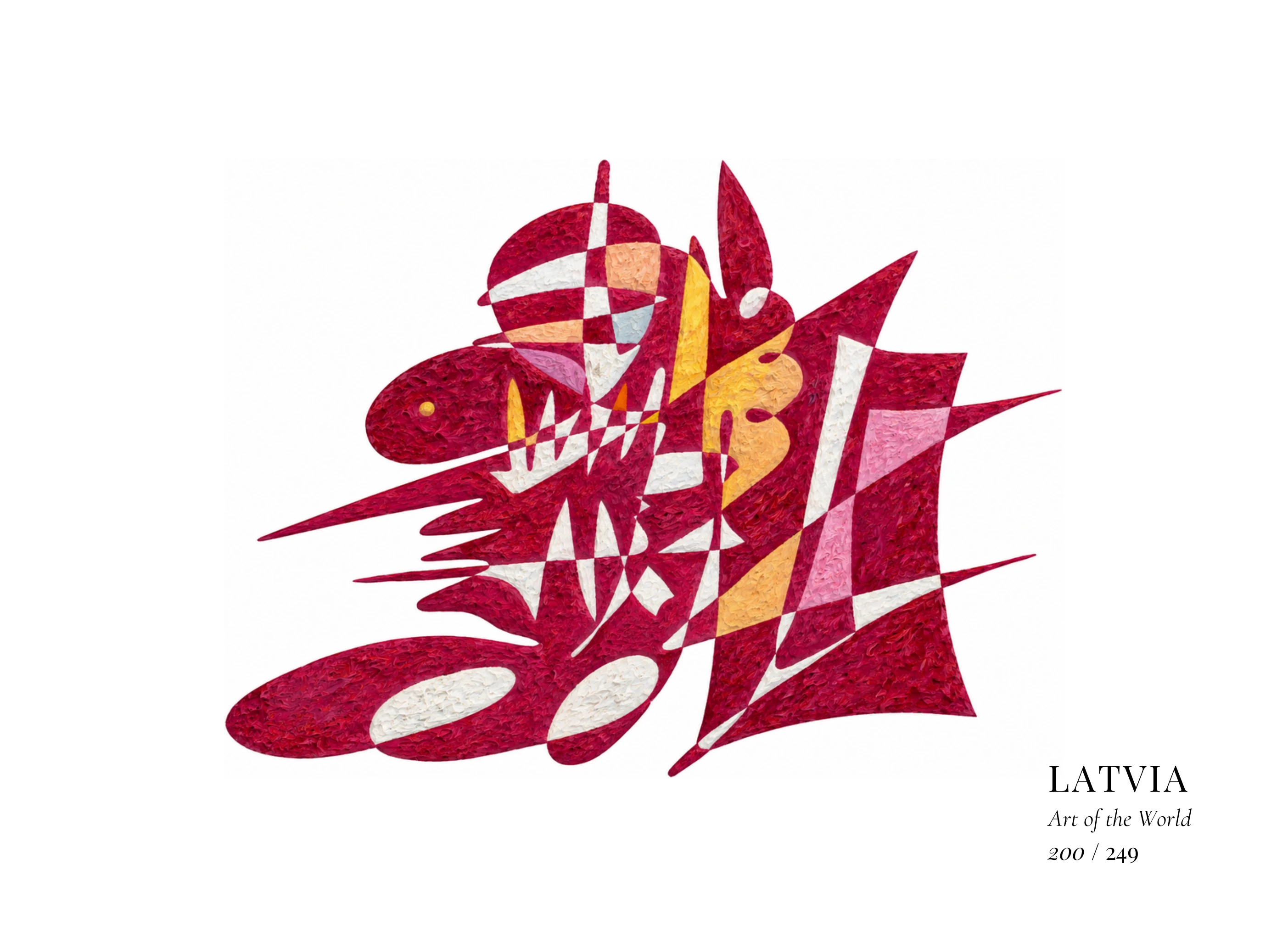
Description
The composition's dominant magenta impasto creates a dense, energetic field punctuated by white, pale pink and warm golden forms. Rounded masses meet sharp projections, narrow extensions and a complex central lattice of intersecting divisions. White passages act as luminous intervals, while the elongated lower elements and outward-pointing forms give the silhouette a strong directional rhythm. The balance between intricate internal structure and generous surrounding space can be read as evoking Latvia’s layered historical memory: concentrated yet open, rooted yet outward-looking. Its repeated crossings suggest continuity created through connection and renewal.
Cultural Context
Latvia lies on the eastern Baltic Sea, a landscape of forests, rivers, lakes and low coastal plains. Baltic peoples developed communities here long before medieval trading networks connected ports such as Riga with the Hanseatic world. German, Polish-Lithuanian, Swedish and Russian periods contributed successive historical layers. Latvia declared independence in 1918 and restored it in 1991, renewing a statehood closely associated with language, landscape and cultural continuity.
Latvian identity is centred on the Latvian language and enriched by regional traditions and minority communities. The dainas, concise traditional folk songs preserved across generations, form an exceptional body of oral culture. Choral singing, national song festivals, weaving, patterned textiles, ceramics and woodcraft remain important expressions of heritage. Riga’s architecture, together with Latvian literature, music, theatre, cinema and contemporary design, demonstrates a creative culture connecting tradition with modern European life.