234 / 249
Liechtenstein
Between Alpine Heights and the Rhine
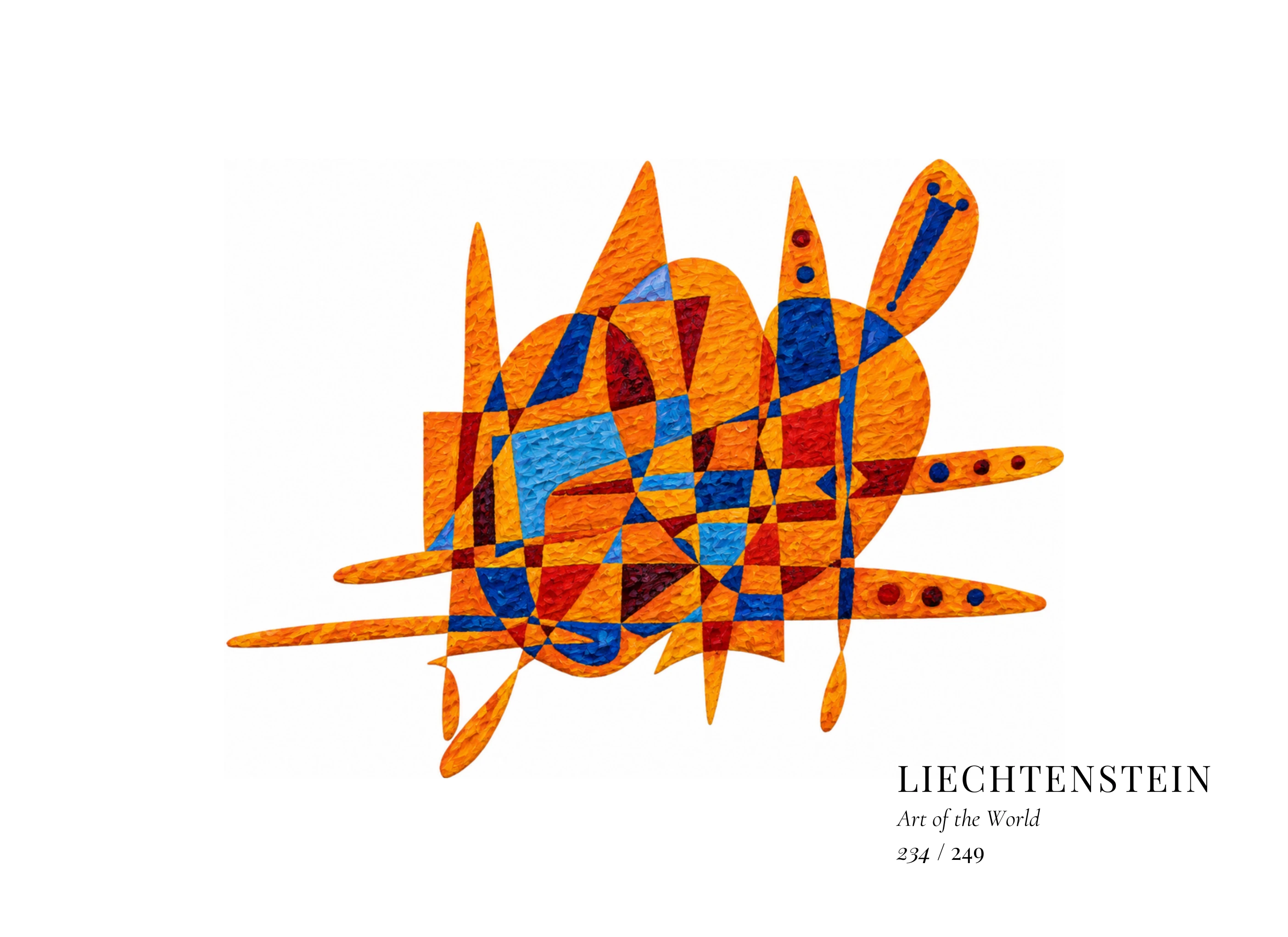
Description
The composition's golden-orange impasto forms a radiant structure crossed by cobalt, pale blue, crimson and burgundy. Tall pointed extensions rise from a tightly interwoven centre, while long horizontal forms project beyond the main silhouette. Geometric compartments shift between curves, wedges and narrow bands, producing a precise yet energetic rhythm. Small circular accents create moments of concentration within the wider structure. The balance between vertical ascent and horizontal connection can be read as evoking Liechtenstein’s Alpine setting and Rhine Valley geography, while the dense interlocking forms suggest a compact cultural memory enriched by connections beyond its borders.
Cultural Context
Liechtenstein lies between Switzerland and Austria, where the Rhine Valley meets the Alps. Its territory combines cultivated lowlands with steep mountain landscapes that have shaped settlement and economic life. The principality emerged within the complex political geography of the Holy Roman Empire and became sovereign in 1806. Over time, close connections with neighbouring Alpine and German-speaking regions accompanied its development into a modern constitutional hereditary monarchy with a distinctive national identity.
German is the official language, while Alemannic dialects remain important in everyday life. Liechtenstein’s cultural inheritance includes Alpine customs, music, religious architecture, woodcraft and traditions associated with rural communities. Historic buildings coexist with contemporary architecture, museums and a strong engagement with modern art and design, reflecting a society in which local heritage and international cultural exchange complement one another.