211 / 249
Lithuania
Amber Light and Baltic Continuity
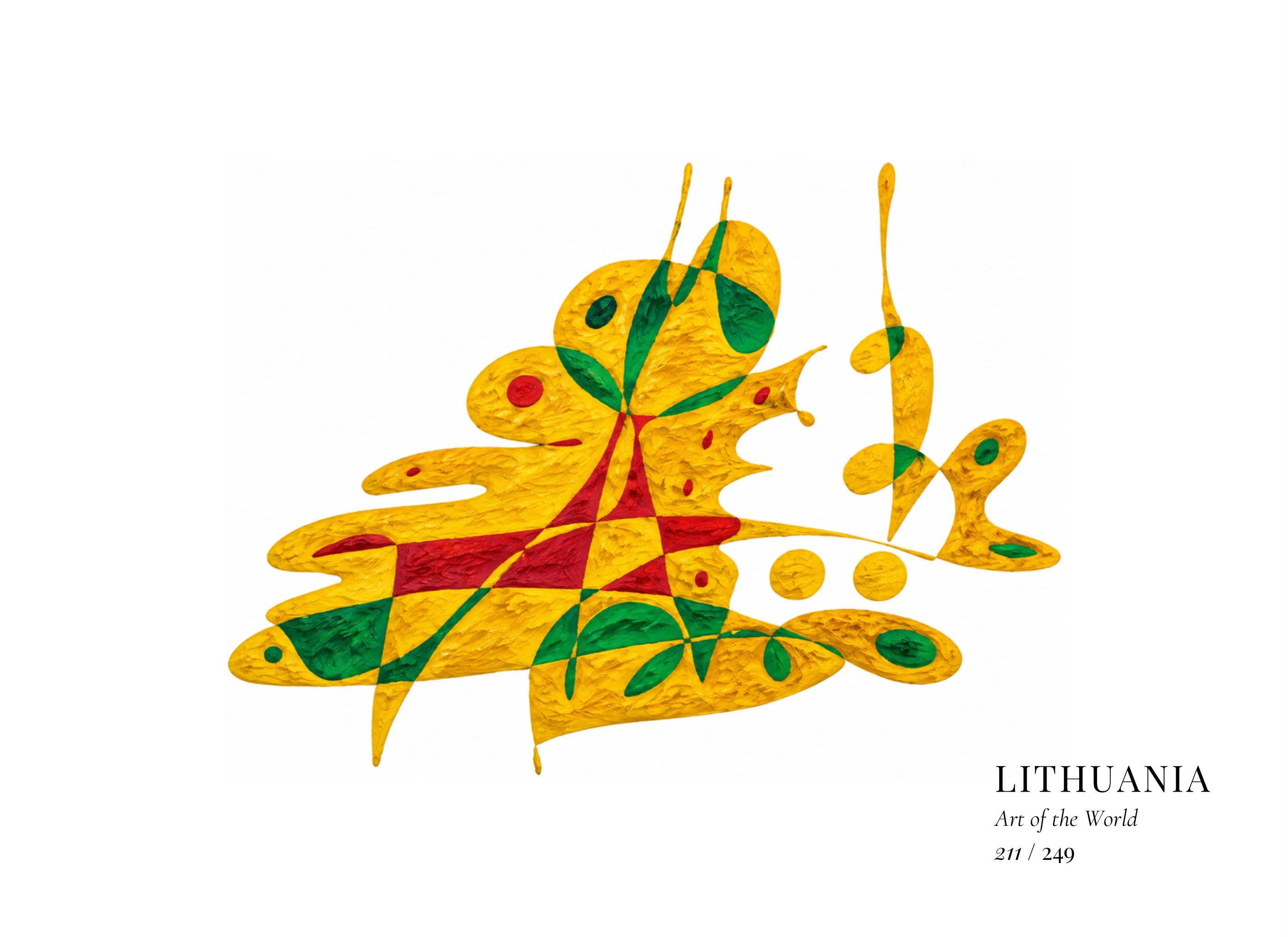
Description
The composition's luminous yellow impasto creates an expansive field crossed by saturated green and concentrated crimson. Rounded forms gather above angular lower structures, while narrow vertical extensions and detached elements introduce height and spaciousness. Red passages form a strong internal axis, balanced by green compartments and small circular accents. The generous white ground allows the irregular silhouette to remain open and weightless despite its dense texture. Its interplay of connected and separated forms can be read as evoking Lithuania’s layered Baltic memory, where historical continuity, landscape and cultural renewal remain dynamically intertwined.
Cultural Context
Lithuania lies on the eastern Baltic Sea, a country of forests, lakes, rivers and fertile plains. Its medieval Grand Duchy became one of Europe’s largest states before entering a long political union with Poland. Later incorporated into the Russian Empire, Lithuania declared independence in 1918 and restored it in 1990. These historical transformations shaped a national culture strongly connected to language, landscape and Baltic identity.
Lithuanian, one of the two surviving Baltic languages, preserves an exceptionally ancient linguistic heritage. Folk songs, oral traditions, weaving, woodcarving, ceramics and distinctive cross-crafting remain important cultural forms. Vilnius reflects Gothic, Renaissance, Baroque and later architectural traditions, while Lithuanian literature, choral music, theatre, cinema and contemporary design extend this inheritance into modern European culture.