224 / 249
Luxembourg
A Small Country at Europe’s Crossroads
Description
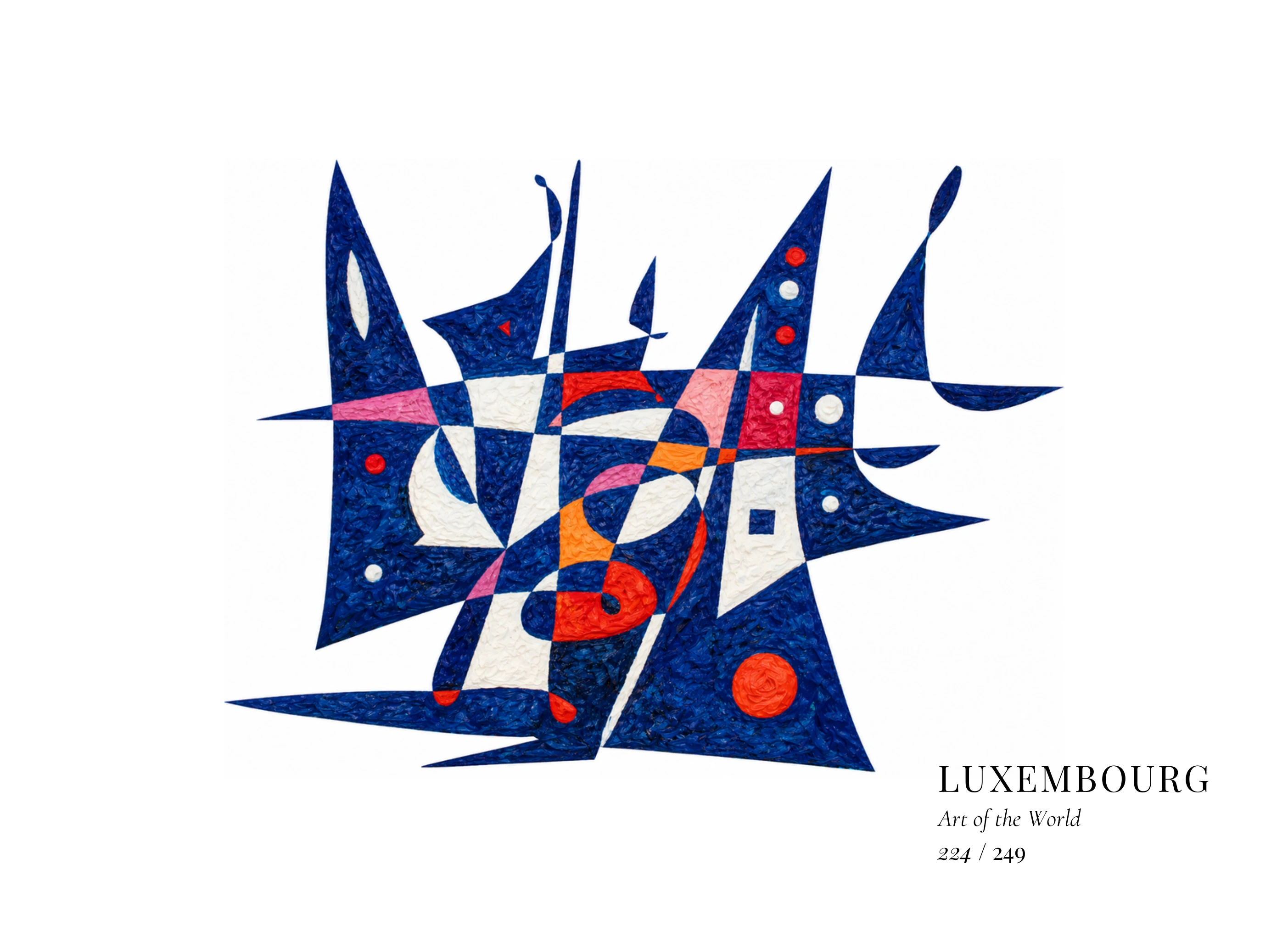
The composition's deep blue impasto creates a strong structural field animated by white, crimson, orange and pink. Tall pointed extensions rise above interlocking horizontal and curved forms, while small circular accents punctuate the composition like measured beats. White compartments open luminous spaces within the darker mass, and long projections extend its energy beyond the centre. The balance between concentrated geometry and outward movement can be read as evoking Luxembourg’s position at a European crossroads: compact in scale yet connected in many directions. Its layered intersections suggest cultural memory formed through continuity, exchange and plurality.
Cultural Context
Luxembourg lies between Belgium, Germany and France, its landscape extending from the wooded Ardennes in the north to gentler valleys and farmland in the south. Its strategic position gave the medieval fortress of Luxembourg exceptional importance, while Burgundian, Habsburg and other European connections shaped its history. The modern Grand Duchy emerged in the nineteenth century and developed into an independent constitutional monarchy, closely engaged with European integration.
Luxembourgish, French and German together reflect the country’s multilingual character, enriched by communities with roots across Europe and beyond. Historic fortifications, castles and religious architecture coexist with contemporary cultural institutions and ambitious modern design. Literature, music, theatre, photography and visual arts move naturally between languages and traditions, expressing an identity shaped by both local continuity and international exchange.