140 / 249
Moldova
Between Rivers, Vineyards and Memory
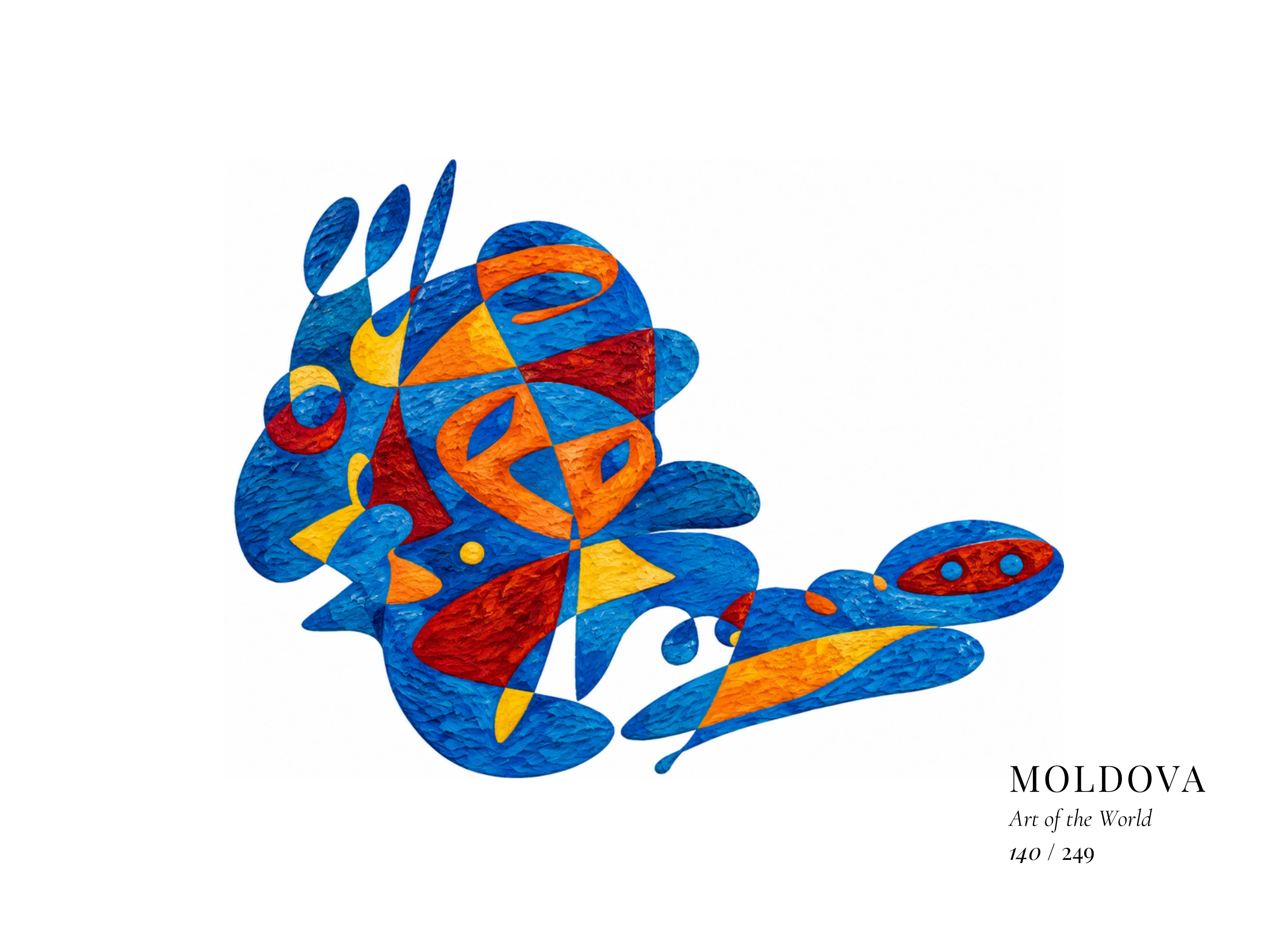
Artist: Gheorghe Virtosu
Catalogue: Art of the World
Catalogue Nr: 140/249
Source of Print: Excerpt from Divine DNA, 2016 (oil on canvas)
Medium: Limited Edition Print
Edition: 1/1
Authentication: Approved and signed by the artist on the reverse.
Artwork Classification: Civilisational Portraiture
Part of Art of the World, an El Arte Monumental project exploring contemporary art, cultural identity and visual memory.
Description
The composition's vivid blue impasto creates a flowing field animated by orange, crimson and yellow. Rounded masses and curling forms are countered by pointed vertical extensions and a more detached, elongated structure to the right. Internal divisions generate a lively rhythm of arcs, wedges and concentrated colour, while generous white space keeps the silhouette open. The interplay between connected and separated elements can be read as evoking Moldova’s layered cultural memory and its position between historical routes. Dense texture gives the composition a sense of vitality, continuity and movement.
Cultural Context
Moldova lies between Romania and Ukraine, across rolling plains and fertile river valleys shaped principally by the Dniester and Prut. Its history developed within the medieval Principality of Moldavia and through later Ottoman, Russian and Romanian connections. The twentieth century brought major political transformations before the Republic of Moldova declared independence in 1991. Its position between cultural regions has created a distinctive historical identity rooted in both continuity and exchange.
Moldova’s cultural life is principally shaped by Romanian-language traditions alongside Russian, Gagauz, Ukrainian, Bulgarian and other communities. Folk poetry, music, dance, embroidery, weaving, ceramics and woodcraft remain important forms of expression. Orthodox religious architecture and rural traditions coexist with modern literature, theatre, cinema, visual arts and design. Wine-growing also forms a longstanding element of the country’s agricultural and cultural heritage.
Exhibition Context
A low blue head and yellow fins connect to a red interior, making a compact swimming figure that changes as its parts are followed. Moldova's historical ties to Moldavia, Russian and Romanian periods, and Soviet rule complicate any simple origin story. The painting's blue body feels assembled from several overlapping contours. It can be read as an identity whose shape has changed under different political frames while its inner gaze remains active, without assigning those frames to particular colours.