230 / 249
Netherlands
A Landscape Made Through Water
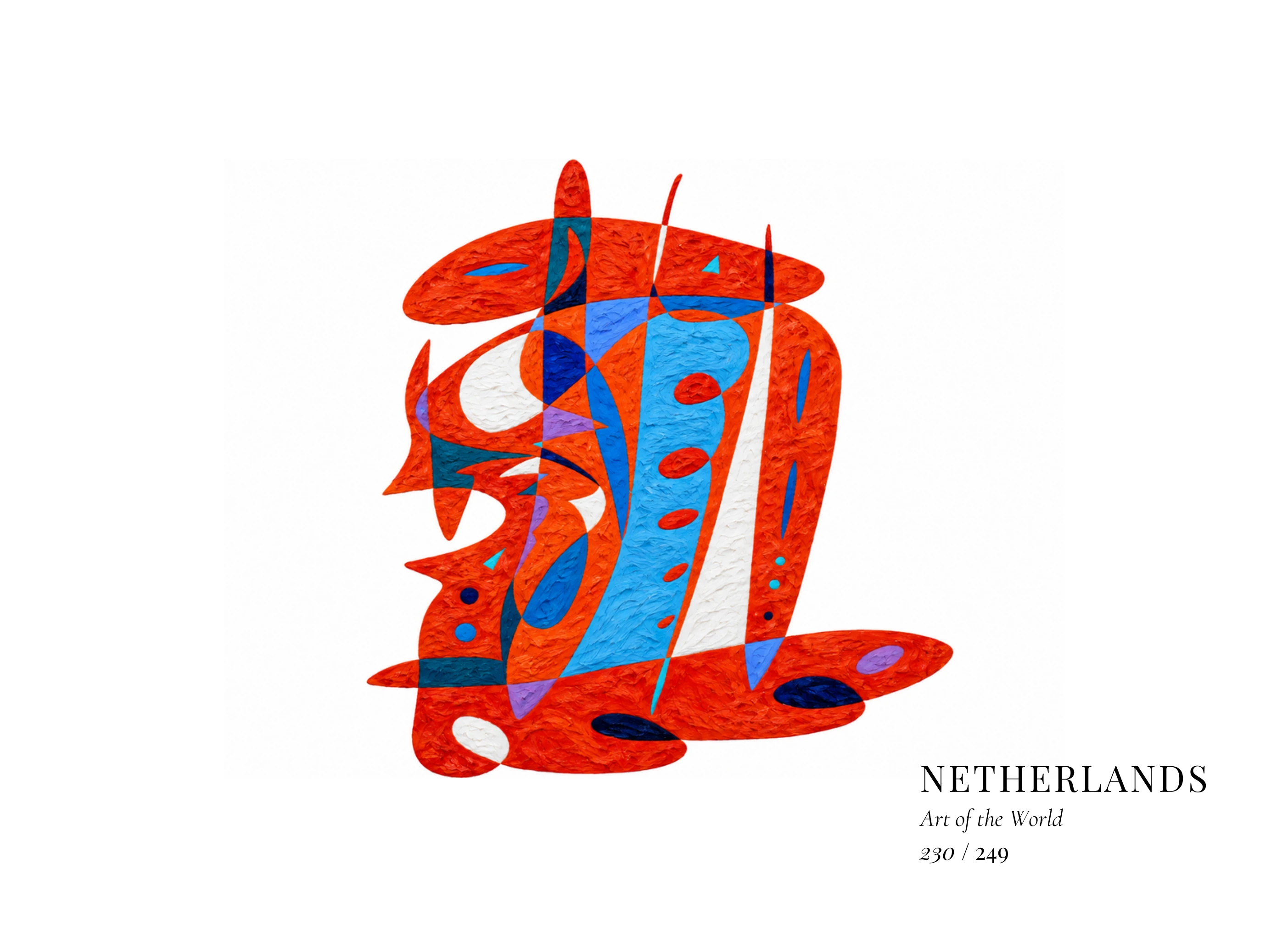
Description
The composition's burnt-orange impasto forms a dense framework around a striking vertical passage of pale blue. White, cobalt, turquoise and lavender compartments interrupt the warmer field, while narrow extensions and pointed forms create a strong upward rhythm. Circular accents punctuate the surface, and broad horizontal shapes stabilise the composition above and below. The central blue expanse can be read as evoking the Netherlands’ enduring relationship with water, while the surrounding interlocking geometry suggests containment, connection and carefully negotiated space. Dense texture gives this visual structure an energetic sense of continuity and renewal.
Cultural Context
The Netherlands occupies the low-lying delta of the Rhine, Meuse and Scheldt on Europe’s North Sea coast. Rivers, wetlands and reclaimed land have profoundly shaped its geography and settlement. Medieval trading towns developed into powerful commercial centres, and the Dutch Republic became a major maritime and intellectual force during the seventeenth century. Modern Dutch society grew from this history of urban development, water management, international exchange and adaptation to a demanding landscape.
Dutch cultural identity encompasses regional traditions and languages alongside a strongly international outlook. Painting, printmaking and cartography hold exceptional places in its artistic inheritance, while architecture, ceramics and decorative arts reflect long traditions of craftsmanship. Literature, music, photography, cinema and especially modern architecture, typography and industrial design continue a culture in which practical ingenuity often meets formal experimentation.