186 / 249
North Macedonia
Valleys of Memory, Paths of Encounter
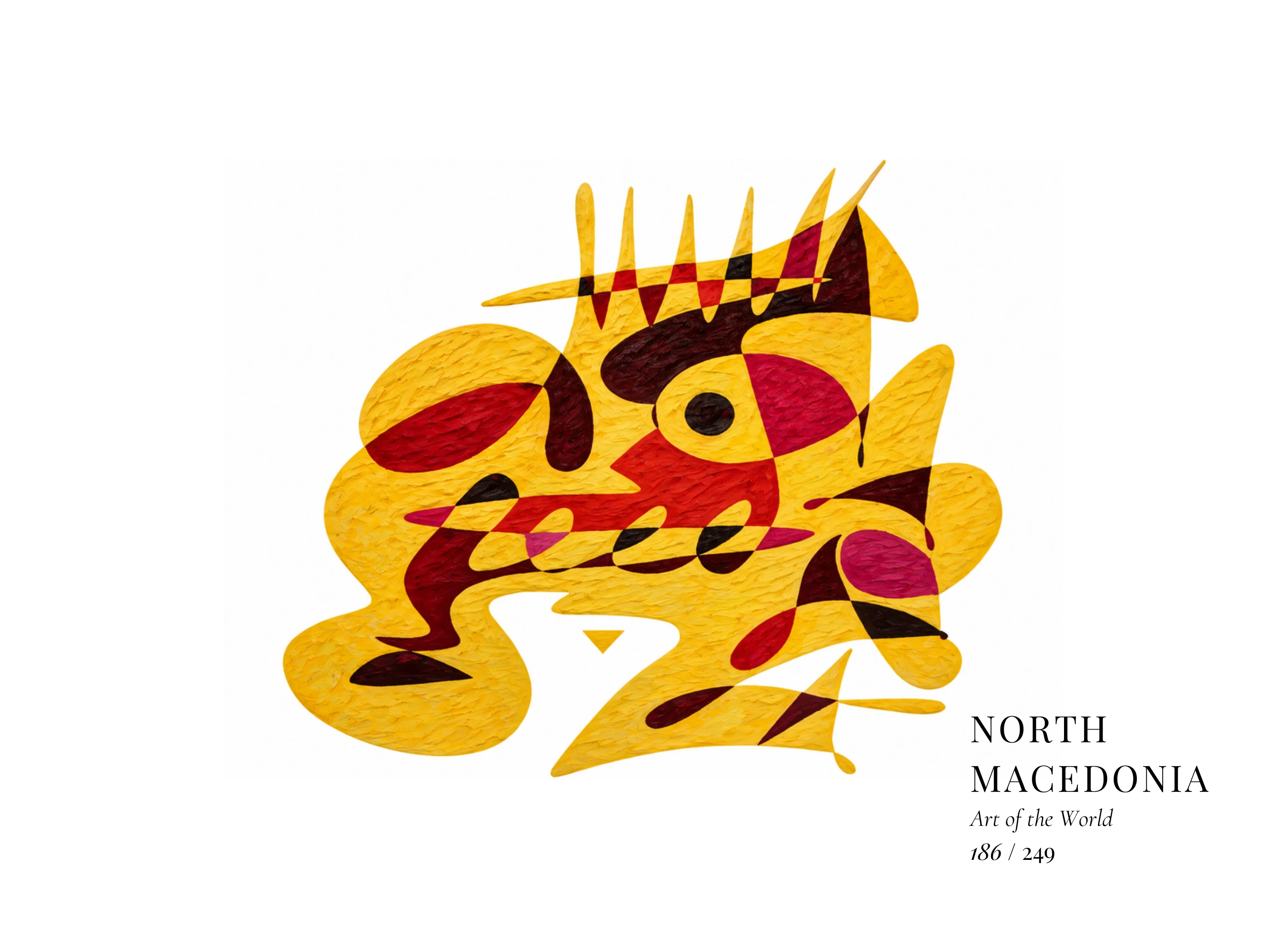
Description
The composition's golden-yellow impasto creates a luminous ground animated by crimson, burgundy, magenta and near-black. Rounded masses intersect with sharp points, elongated extensions and rhythmic bands of alternating colour. A circular centre anchors the composition, while curved internal forms and open white spaces create movement between density and release. The interlocking geometry can be read as evoking North Macedonia’s position at a historic Balkan crossroads, where different cultural currents have met and endured. Its rich surface suggests memory as layered, connected and continually renewed.
Cultural Context
North Macedonia lies in the central Balkans, a mountainous country shaped by the Vardar valley and the lakes of Ohrid, Prespa and Dojran. Its territory has formed part of ancient, Roman, Byzantine, medieval and Ottoman worlds, creating successive layers of settlement and exchange. During the twentieth century it became part of Yugoslavia before declaring independence in 1991. Its position on historic routes between the Aegean and continental Balkans remains central to its cultural geography.
North Macedonia is home to Macedonian, Albanian, Turkish, Roma, Serbian, Vlach and other communities. Its cultural inheritance encompasses Slavic and Albanian oral traditions, Orthodox and Islamic architecture, fresco painting, woodcarving, embroidery, weaving and distinctive musical traditions. Ohrid holds particular importance for medieval Christian culture and literacy, while contemporary literature, cinema, theatre and design sustain a diverse modern cultural life.