220 / 249
Poland
A Landscape of Continuity and Renewal
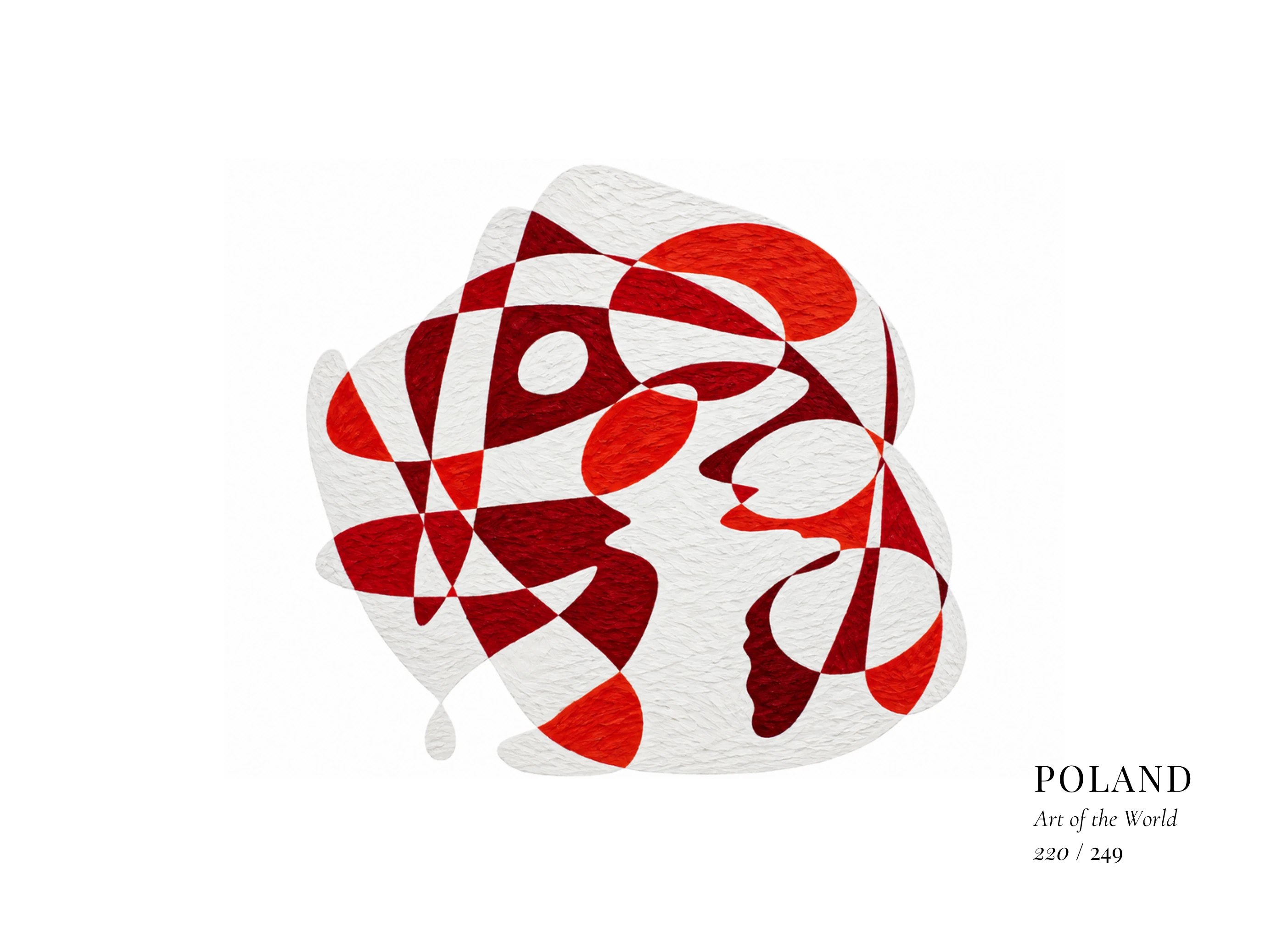
Description
The artwork concentrates crimson, scarlet and white within a broad, irregular silhouette. Curving bands intersect with pointed divisions, oval openings and compact geometric passages, creating a rhythm of enclosure and release. Dense impasto gives even the pale areas physical presence, while the restrained palette intensifies contrasts between mass and negative space. The interlocking structure suggests continuity through transformation: separate forms remain distinct yet participate in a larger visual whole, evoking Poland’s enduring cultural memory and capacity for renewal.
Cultural Context
Poland lies at the heart of Central Europe, extending from the Baltic coast across broad plains to the Carpathian and Sudeten mountains. The medieval Piast and Jagiellonian dynasties helped shape a powerful kingdom and, later, the Polish–Lithuanian Commonwealth. Despite partitions that erased Poland from the political map for more than a century, national culture endured; independence returned in 1918, followed by reconstruction after the profound upheavals of the twentieth century.
Polish identity draws strength from a rich literary, musical and artistic inheritance. Polish is the principal language, while regional traditions contribute distinctive dialects, crafts and customs. Folk textiles, woodcarving, paper-cutting and ceramics coexist with celebrated traditions in poetry, theatre, classical music, poster design, cinema and modern architecture. Historic cities such as Kraków, Warsaw, Gdańsk and Wrocław embody successive layers of European cultural exchange.