139 / 249
Romania
Carpathian Crossroads, Enduring Threads
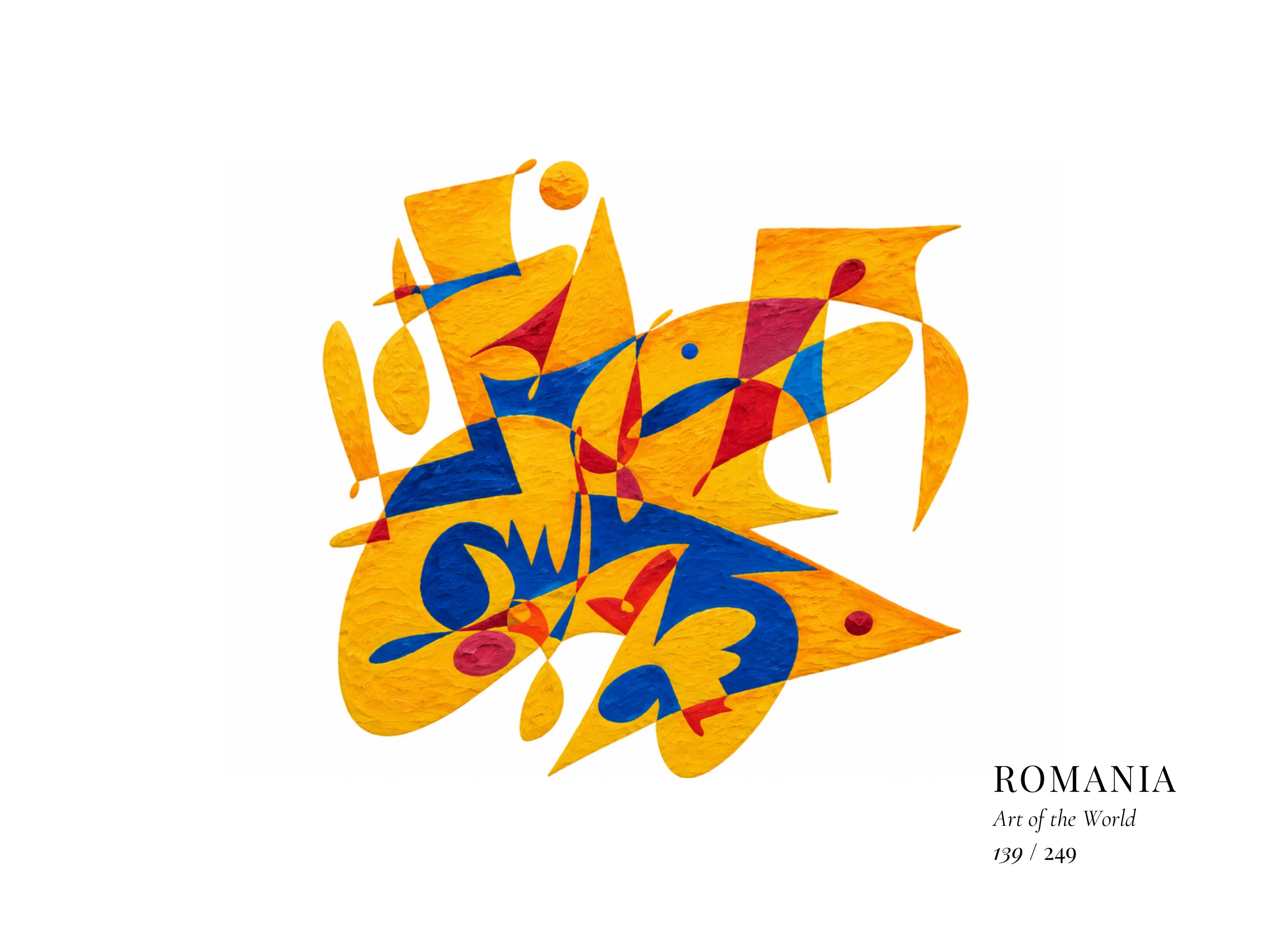
Description
The artwork is built around a radiant field of ochre and gold, crossed by intense blues, crimson passages and smaller rose accents. Dense impasto unifies sweeping curves, pointed extensions, circular forms and intricate internal divisions. White negative spaces penetrate the silhouette, allowing its clustered geometry to remain open and mobile. The interplay of broad masses and narrow crossings suggests layers meeting without losing their individuality. Its rhythm can be read as evoking Romania’s position at a cultural crossroads: complex, interconnected and sustained by continuity through change.
Cultural Context
Romania stretches from the Carpathian Mountains across the Transylvanian plateau and fertile plains to the Danube and Black Sea. Its historical formation reflects ancient Dacian and Roman legacies, medieval principalities including Wallachia, Moldavia and Transylvania, and centuries of interaction between Central, Eastern and Southeastern Europe. The modern Romanian state emerged through nineteenth-century unification, later developing within borders shaped by the transformations of the twentieth century.
Romanian culture combines a shared Romanian language with the traditions of Hungarian, Roma, German and other communities. Its heritage encompasses richly patterned textiles, carved wooden architecture, painted monasteries, ceramics, folk music and dance, alongside distinguished traditions in poetry, theatre, classical music, cinema and modernist sculpture. Regional identities give this cultural landscape remarkable variety while remaining part of a connected national inheritance.