190 / 249
Serbia
At the Confluence of Roads and Memory
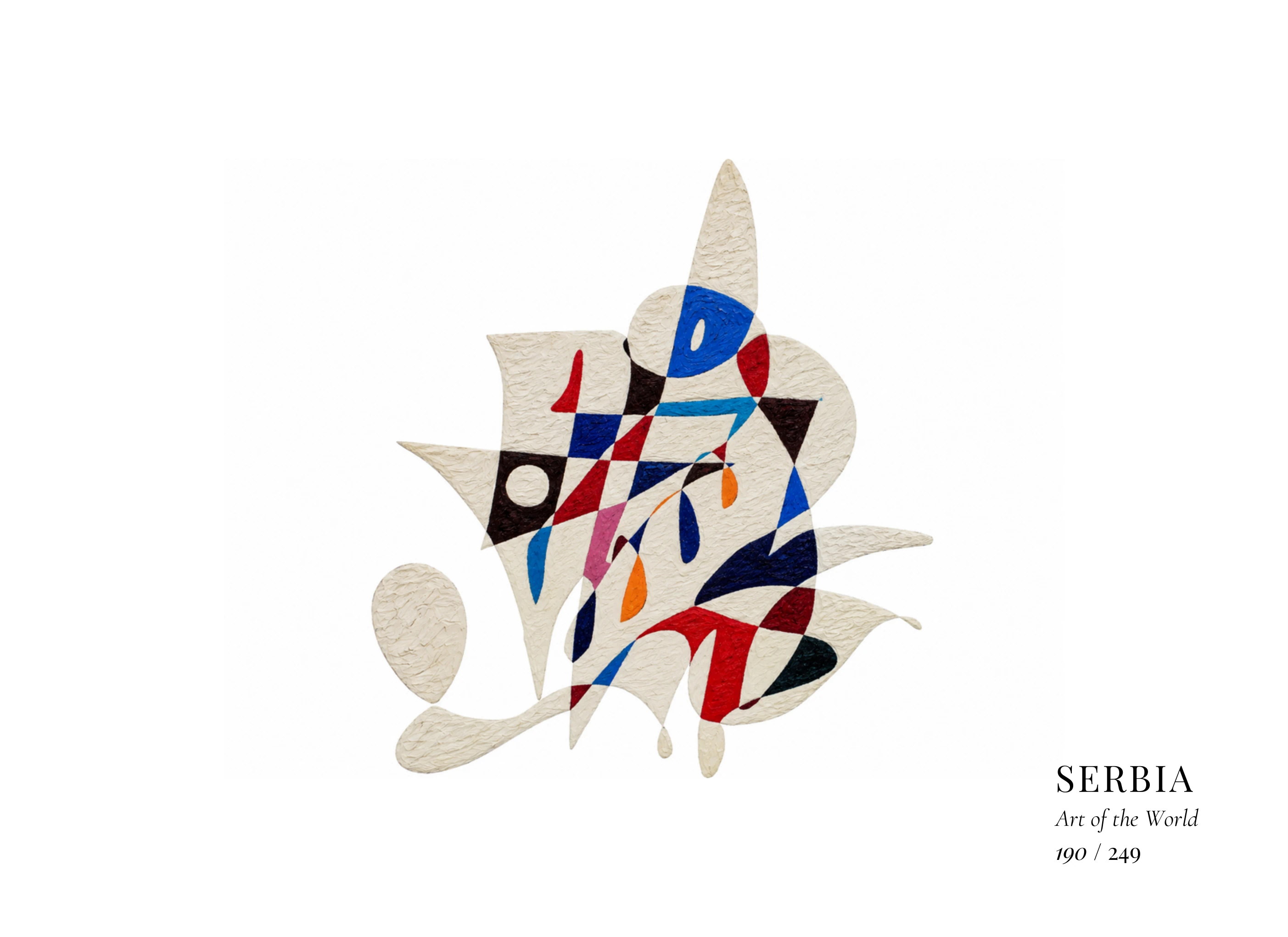
Description
The artwork builds its structure from textured ivory-white, crossed by cobalt and navy blue, crimson, black and smaller accents of turquoise, pink and orange. Curved masses meet sharp triangles, elongated points and narrow descending forms, while a detached oval introduces a quiet counterweight. Dense impasto unifies the fragmented geometry without suppressing its irregularity. The shifting intersections and open white spaces suggest movement between distinct regions, while the vertical thrust gives the composition unusual presence. Its interwoven forms can be read as evoking Serbia’s layered cultural memory and its longstanding position among intersecting European traditions.
Cultural Context
Serbia lies in Southeast Europe, where the Danube and Sava meet and the Pannonian Plain gives way southward to hills, valleys and mountains. Its historical formation encompasses medieval Serbian states, centuries of interaction with Byzantine, Ottoman and Central European worlds, and the emergence of modern Serbian statehood during the nineteenth century. Belgrade’s position on major continental routes reflects the country’s enduring place at a European crossroads.
Serbian culture combines a strong Serbian-language tradition with the heritage of Hungarian, Bosniak, Roma, Slovak and other communities. Medieval monasteries preserve distinguished traditions of architecture and fresco painting, while epic poetry, oral storytelling and folk music remain important cultural inheritances. Textile arts, woodwork and ceramics accompany influential achievements in literature, theatre, film, music, architecture and contemporary visual culture.