150 / 249
Slovakia
Carpathian Crossroads, Living Continuities
Description
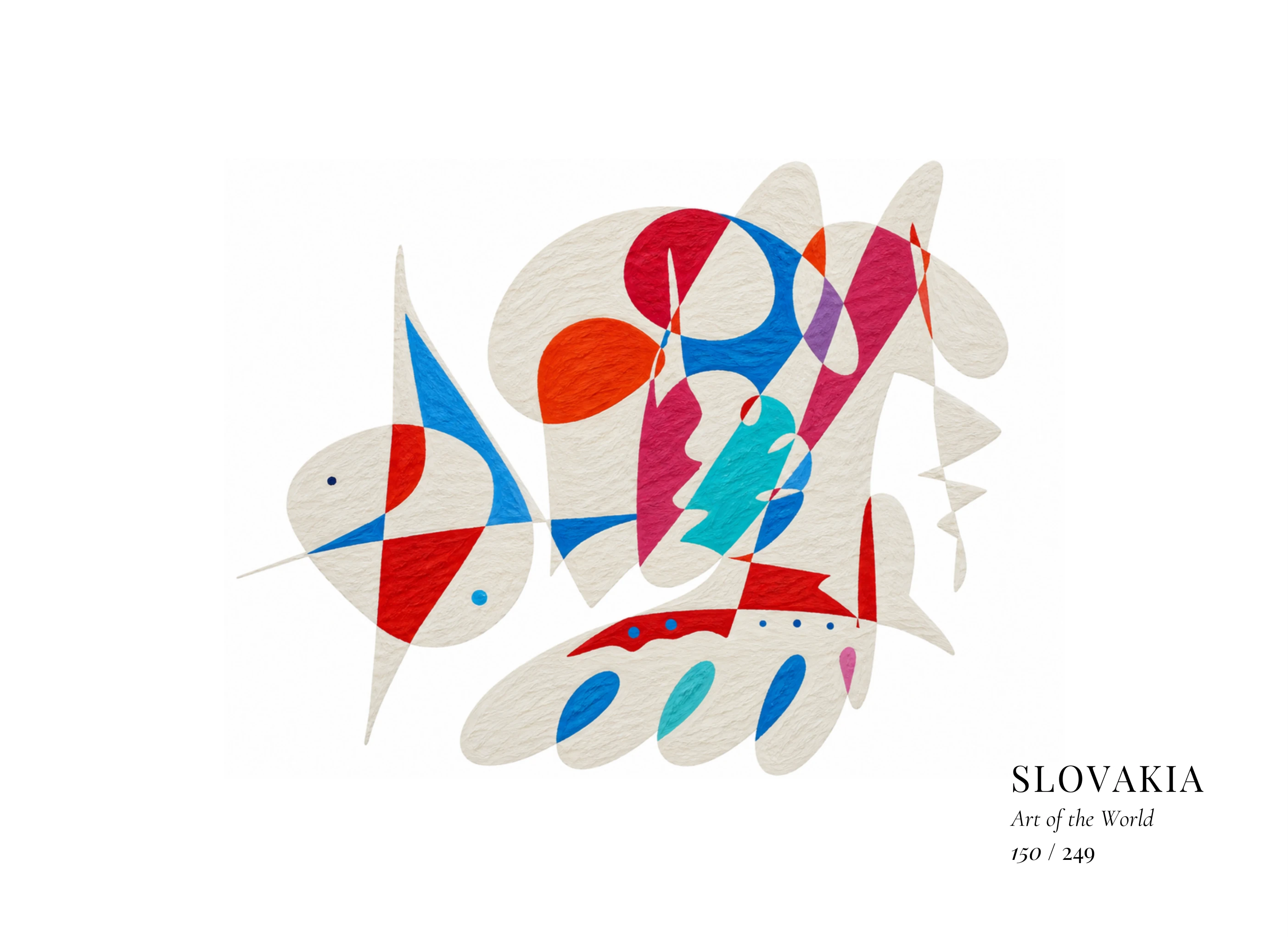
The artwork is dominated by textured ivory-white forms articulated by crimson, magenta, turquoise and several intensities of blue. Broad rounded masses are interrupted by pointed extensions, narrow crossings and small detached marks. A circular form at left counterbalances the denser vertical construction, while repeated ovals below create a measured visual rhythm. Dense impasto gives even the pale areas material presence. The overlapping divisions and passages of colour suggest a landscape of connections, while the generous white space evokes openness around a complex centre. The composition can be read as recalling Slovakia’s layered historical position within Central Europe.
Cultural Context
Slovakia lies in the heart of Central Europe, shaped by the Carpathian Mountains, fertile lowlands and the Danube basin. Its territory developed through Celtic and Slavic settlement, the medieval Kingdom of Hungary and the Habsburg and Austro- Hungarian realms, before becoming part of Czechoslovakia in 1918. The peaceful dissolution of that federation brought independent Slovakia in 1993, establishing a modern state whose history remains closely connected with the wider Central European world.
Slovak cultural identity is rooted in the Slovak language while embracing Hungarian, Roma, Rusyn and other communities. Folk architecture, carved wood, ceramics, embroidery and richly patterned textiles preserve distinctive regional traditions, particularly across mountain communities. Oral song and dance remain prominent, alongside a literary culture strengthened by nineteenth-century national revival, and significant achievements in theatre, classical and popular music, cinema, architecture and contemporary design.