46 / 249
Åland Islands
Autonomy in the Swedish-Speaking Baltic
Description
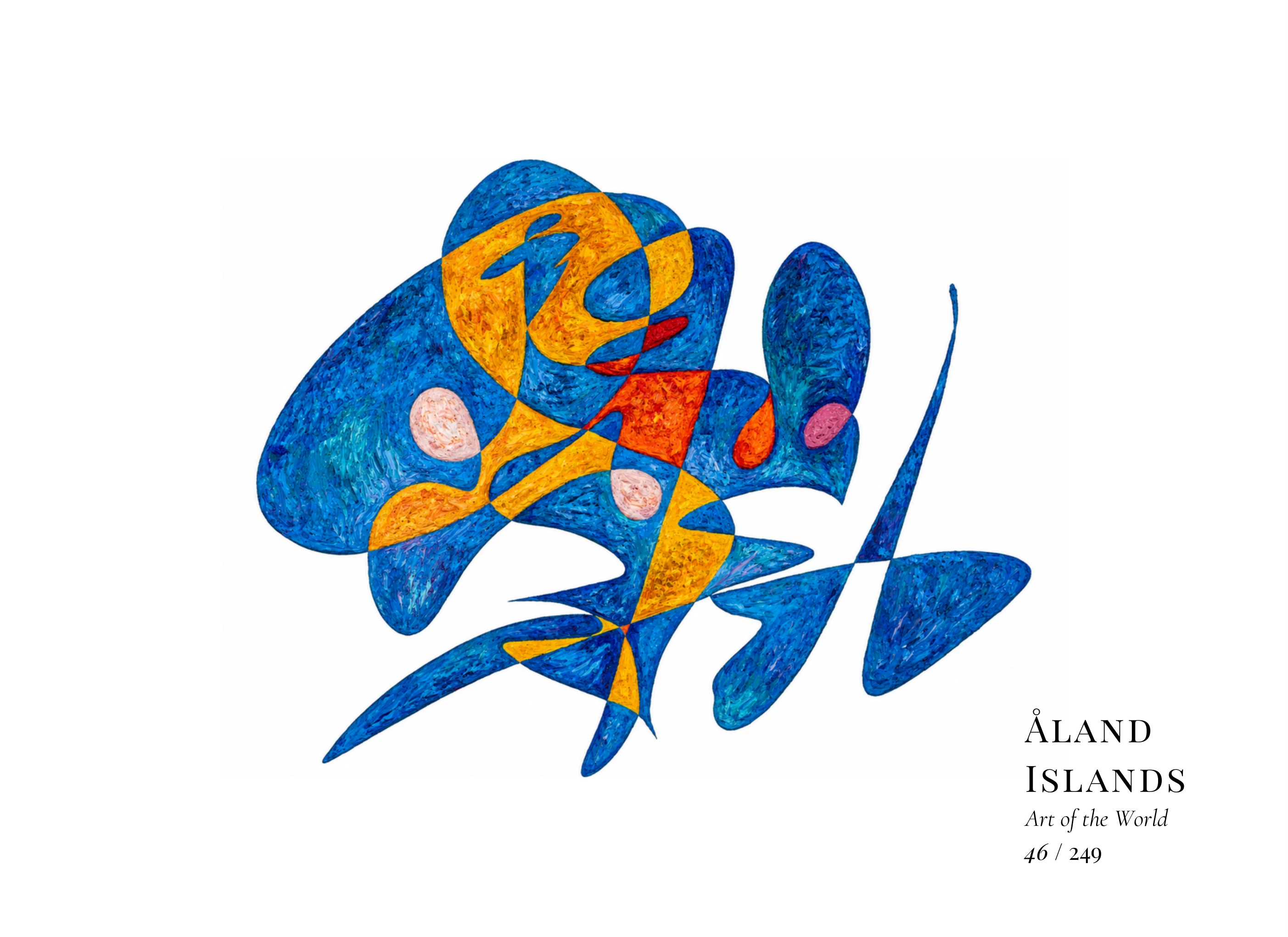
The artwork is dominated by layered cobalt, turquoise and deep blue, crossed by brilliant yellow, orange, red and muted pink. Rounded masses gather at the upper left before the composition disperses into pointed and detached forms. Interlocking yellow geometry creates a concentrated internal rhythm, while large white openings separate the lower extensions and intensify their movement. Dense impasto gives the blues a shifting, almost mineral depth. The balance between a compact centre and autonomous surrounding elements can be read as recalling Åland’s unusual constitutional position: culturally distinctive, politically self-governing and yet connected to a larger national structure.
Cultural Context
The Åland Islands form an archipelago at the entrance to the Gulf of Bothnia, between Finland and Sweden. Long integrated into the Swedish realm, the islands became part of the Russian Empire with Finland in 1809. After Finnish independence, competing Finnish and Swedish claims produced the Åland question, settled by the League of Nations in 1921: sovereignty remained with Finland while the islands received guarantees of autonomy, Swedish language and cultural protection. Åland is also demilitarised and neutralised under international agreements.
Ålandic identity is strongly maritime and Swedish-speaking, shaped by fishing, farming, seafaring and generations of contact across the Baltic. Wooden architecture, boatbuilding and maritime craftsmanship remain important elements of its cultural inheritance, while local museums, literature, music and design sustain a distinct island culture within Finland. Autonomy has allowed this relatively small population to maintain unusually strong political and linguistic institutions.