113 / 249
Bahamas
An Archipelago of Light and Passage
Description
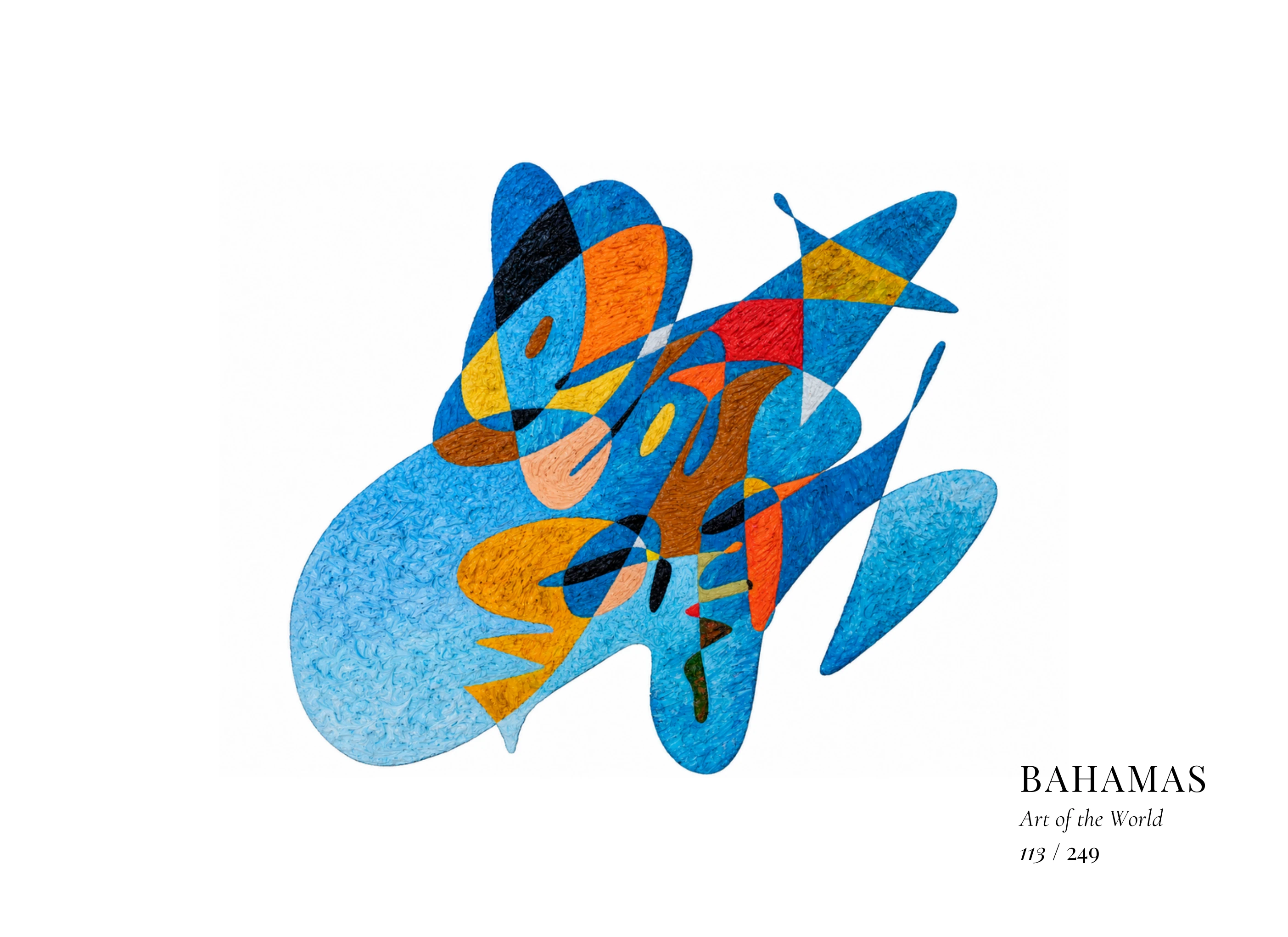
The artwork is dominated by luminous blues, ranging from pale turquoise to deeper marine tones, interrupted by orange, ochre, black and white. Overlapping curves, pointed extensions and fragmented internal divisions create continuous movement, while a detached blue form preserves a sense of separation within the whole. Dense impasto gives the colour a strongly tactile presence. The composition suggests an archipelagic rhythm: distinct forms held together through movement, proximity and shared visual energy.
Cultural Context
The Bahamas stretches across the Atlantic southeast of Florida, comprising hundreds of islands and cays. Lucayan communities inhabited the archipelago before European arrival. Centuries of colonial history followed, including settlement under British rule and the development of communities shaped by African and European histories. The Bahamas achieved independence in 1973 while retaining strong Caribbean and Atlantic connections.
Bahamian culture is rooted especially in African-Bahamian traditions and the distinctive life of its islands. English is the official language, alongside Bahamian Creole in everyday expression. Junkanoo, with its music, dance and elaborate craftsmanship, is among the country’s celebrated traditions. Storytelling, straw work, visual arts, religious music and contemporary Caribbean forms further enrich its cultural identity.
Exhibition Context
Blue finlike ovals and orange marks move in separate currents across the white field, with no single central body to command them. The Bahamas spans many islands, and Lucayan histories preceded later British settlement. The painting's dispersed marine anatomy gives geographical breadth to the title while refusing the notion that scattered islands lack connection. Its eyes and points suggest independent presences held by the same moving environment rather than a solitary island mascot.