160 / 249
Belize
Where Forest, Sea and Memory Converge
Description
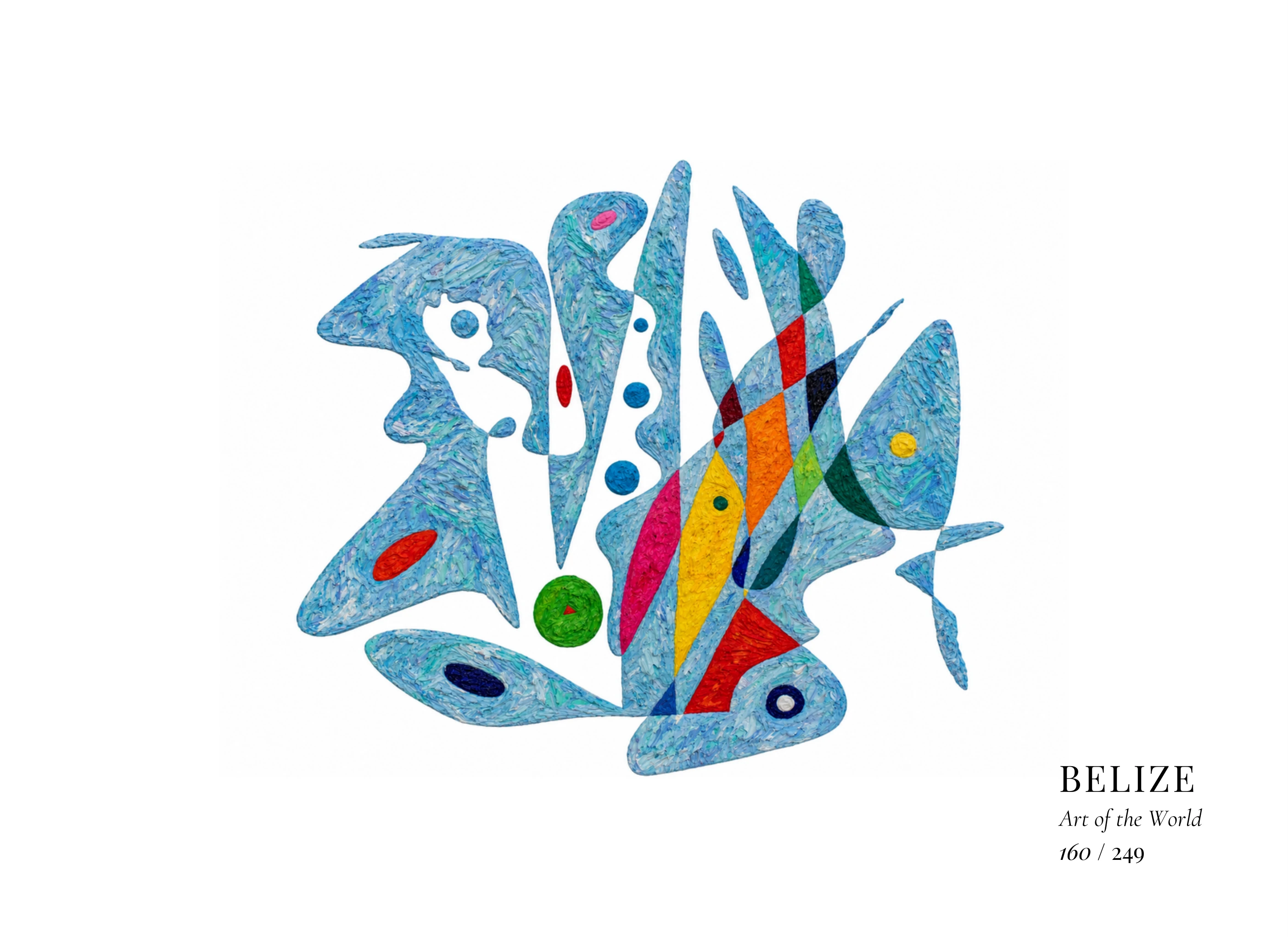
The composition's pale blue impasto creates an airy field crossed by vivid yellow, orange, red, green and pink. Tall pointed forms rise through the composition, while circular and detached elements establish pauses within generous white space. The central cluster is denser and more colourful, balanced by quieter peripheral shapes. This interplay of separation and convergence can be read as evoking Belize’s cultural plurality and its meeting of land, water and layered historical memory.
Cultural Context
Belize lies on the Caribbean coast of Central America, bordered by Mexico and Guatemala, with tropical forests, rivers, islands and an extensive barrier reef. Ancient Maya civilisation flourished across the region, leaving important cities and cultural traditions. Later shaped by British colonial rule as British Honduras, Belize achieved independence in 1981 and developed a distinctive identity connecting Central America and the Caribbean.
Belizean culture reflects remarkable plurality, including Maya, Mestizo, Creole, Garifuna, Mennonite and other communities. English is the official language, alongside widely spoken Belizean Creole, Spanish, Maya and Garifuna languages. Music, dance, oral traditions, carving, textiles, cuisine and festivals express this rich cultural inheritance.
Exhibition Context
Many light-blue aquatic shapes overlap, with eyes scattered through long, pale openings. Belize's reef and forest landscapes meet histories of Maya communities and later British colonial rule. The blue group can evoke the reef, yet its multiple eyes make it a portrait of inhabitants and viewpoints rather than a nature postcard. White channels hold its parts apart and together, a visual analogue for a country whose marine and inland worlds touch without becoming the same landscape.