108 / 249
Dominican Republic
Rhythms Between Mountain and Sea
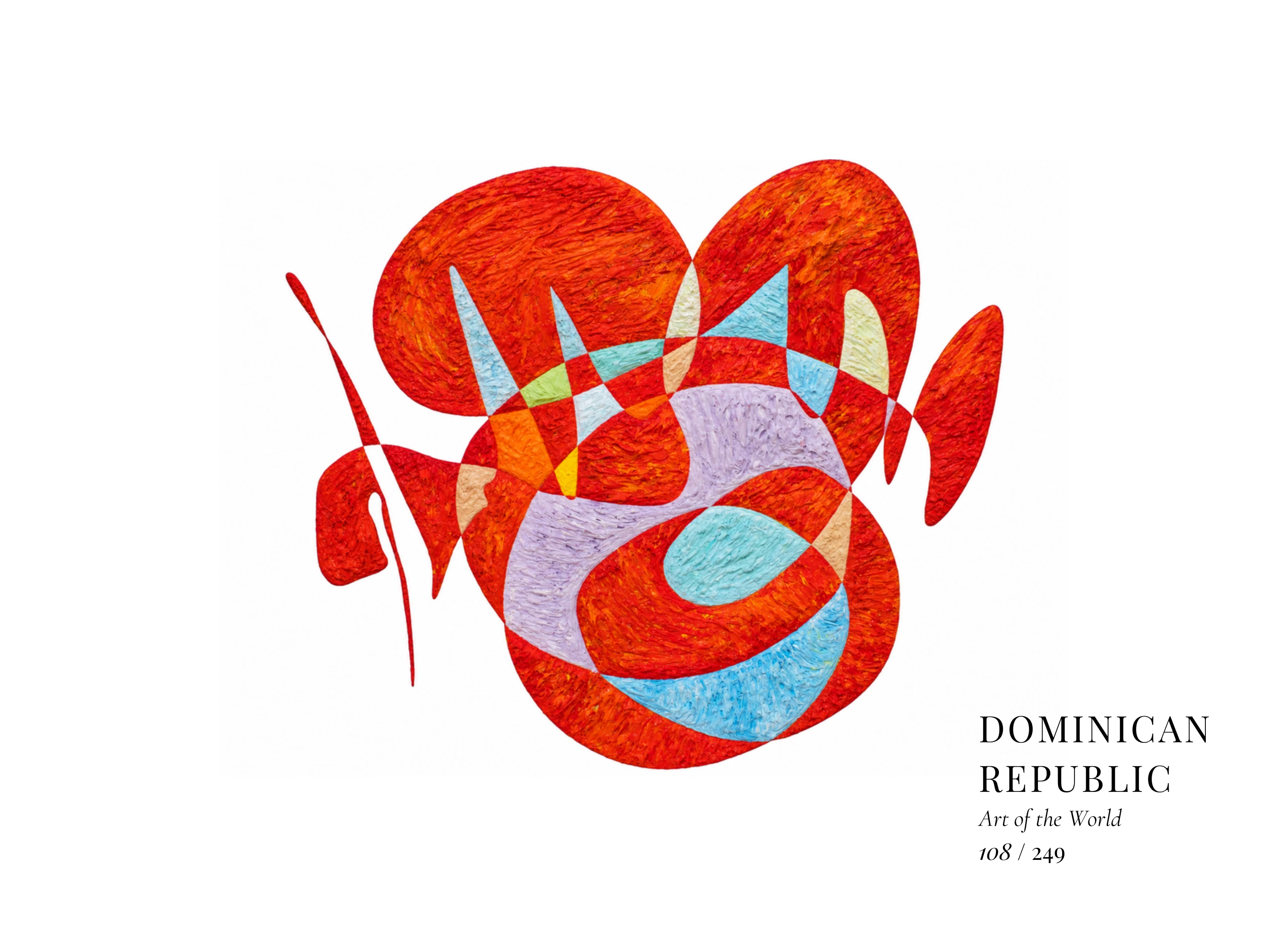
Artist: Gheorghe Virtosu
Catalogue: Art of the World
Catalogue Nr: 108/249
Source of Print: Excerpt from Divine DNA, 2016 (oil on canvas)
Medium: Limited Edition Print
Edition: 1/1
Authentication: Approved and signed by the artist on the reverse.
Artwork Classification: Civilisational Portraiture
Part of Art of the World, an El Arte Monumental project exploring contemporary art, cultural identity and visual memory.
Description
The composition's fiery red-orange field is crossed by pale blue, lavender, cream, green and yellow forms. Dense impasto gives its rounded masses physical energy, while pointed extensions and narrow suspended elements create tension and movement. The interlocking geometry suggests cultural layers held within a vigorous whole, while the surrounding white space allows the composition to breathe with an expansive, rhythmic presence.
Cultural Context
The Dominican Republic occupies the eastern two-thirds of Hispaniola, where the Caribbean Sea and Atlantic Ocean frame fertile valleys, tropical coasts and the mountainous Cordillera Central. Taíno civilisation preceded Spanish settlement from the late fifteenth century, while African, European and Caribbean histories subsequently shaped the nation. Independence, achieved in 1844, established a distinctive Dominican national identity.
Dominican culture draws strength from this layered inheritance. Spanish is the principal language, while music and dance— especially merengue and bachata—have achieved international recognition. Literature, visual arts, architecture, craft and vibrant popular traditions express a society whose cultural life connects historical memory with contemporary creativity.
Exhibition Context
Round red and orange bodies fold together around a pale blue opening that looks like an eye, a passage or a space left between faces. The Dominican Republic's Taíno, Spanish and African histories make a layered human reading possible. Its national portrait is neither one face nor a generic tropical emblem; it is a set of presences temporarily held by a common curve. Each way of following the outline shifts who seems to occupy the centre.