42 / 249
El Salvador
Between Volcanoes and Pacific Light
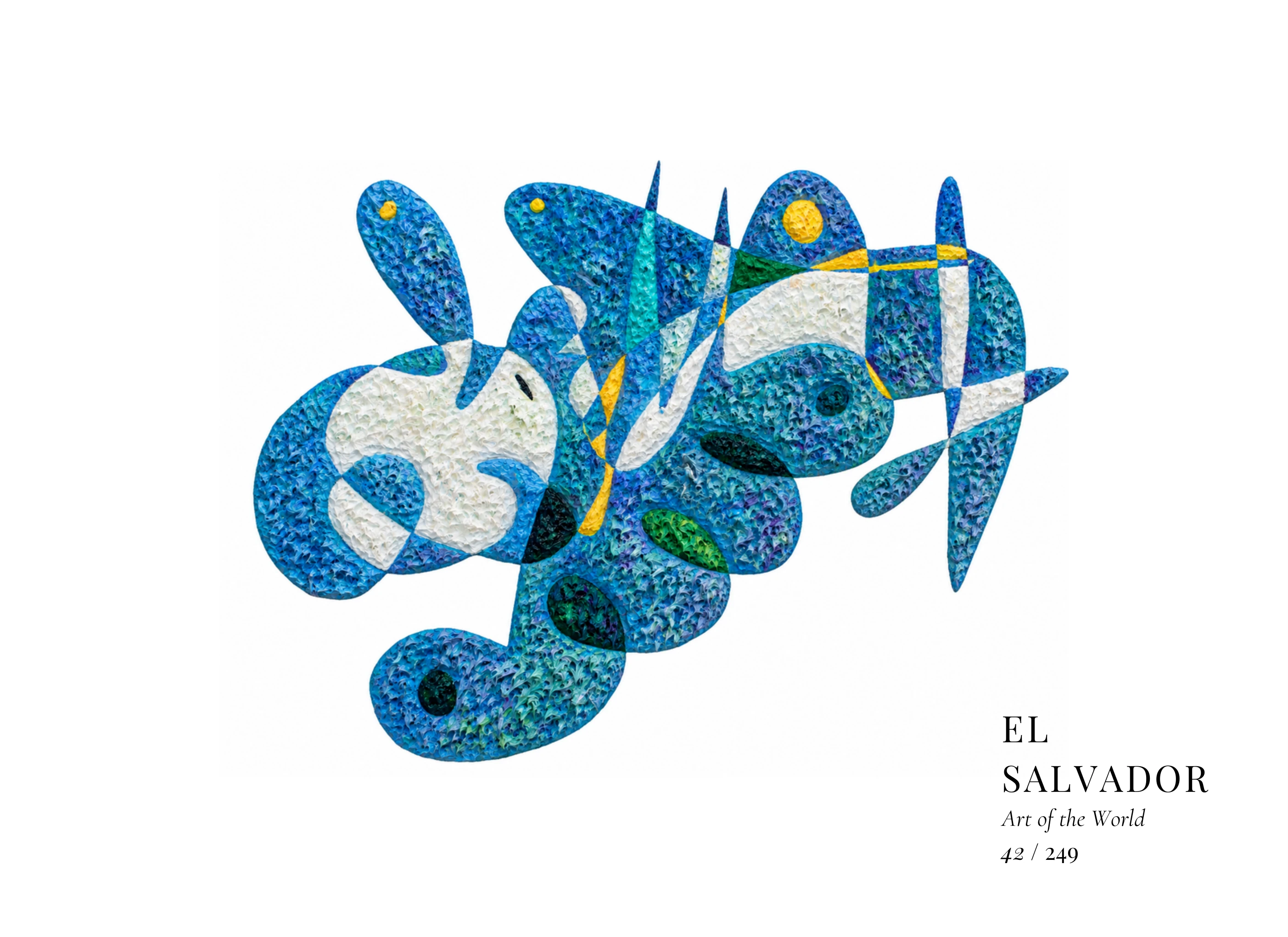
Description
The artwork is dominated by layered blues, turquoise and white, enriched by small passages of green, yellow and deep black. Dense impasto gives the surface a mineral, almost geological vitality. Interlocking rounded forms, sharp verticals and detached elements suggest movement across a concentrated terrain, while the white negative spaces create openness and balance within the complex structure.
Cultural Context
El Salvador lies on Central America’s Pacific coast, shaped by volcanic highlands, fertile valleys and a compact tropical landscape. Indigenous Pipil and other communities formed part of the region’s pre-Columbian world before Spanish colonisation. Independence came in the nineteenth century, and the country’s modern identity has developed through resilience, renewal and strong connections between land and community.
Salvadoran culture combines Indigenous and Hispanic inheritances with distinctive contemporary expression. Spanish predominates, while Indigenous traditions remain culturally significant. Literature, poetry, music, religious festivals, ceramics, weaving and mural traditions contribute to a creative culture sustained both within the country and across its global diaspora.
Exhibition Context
Blue coils with yellow eyes and small red passages seem to be several bodies that also make one larger figure. El Salvador's compact territory holds histories reaching from Indigenous Pipil societies through Spanish colonial rule to independence. The painting's nested motion can be read as one life containing other lives, without assigning an era to a loop. Its small, watchful figures give the country a sense of density rather than reducing it to its size.