107 / 249
Saint Kitts and Nevis
Two Islands, One Caribbean Memory
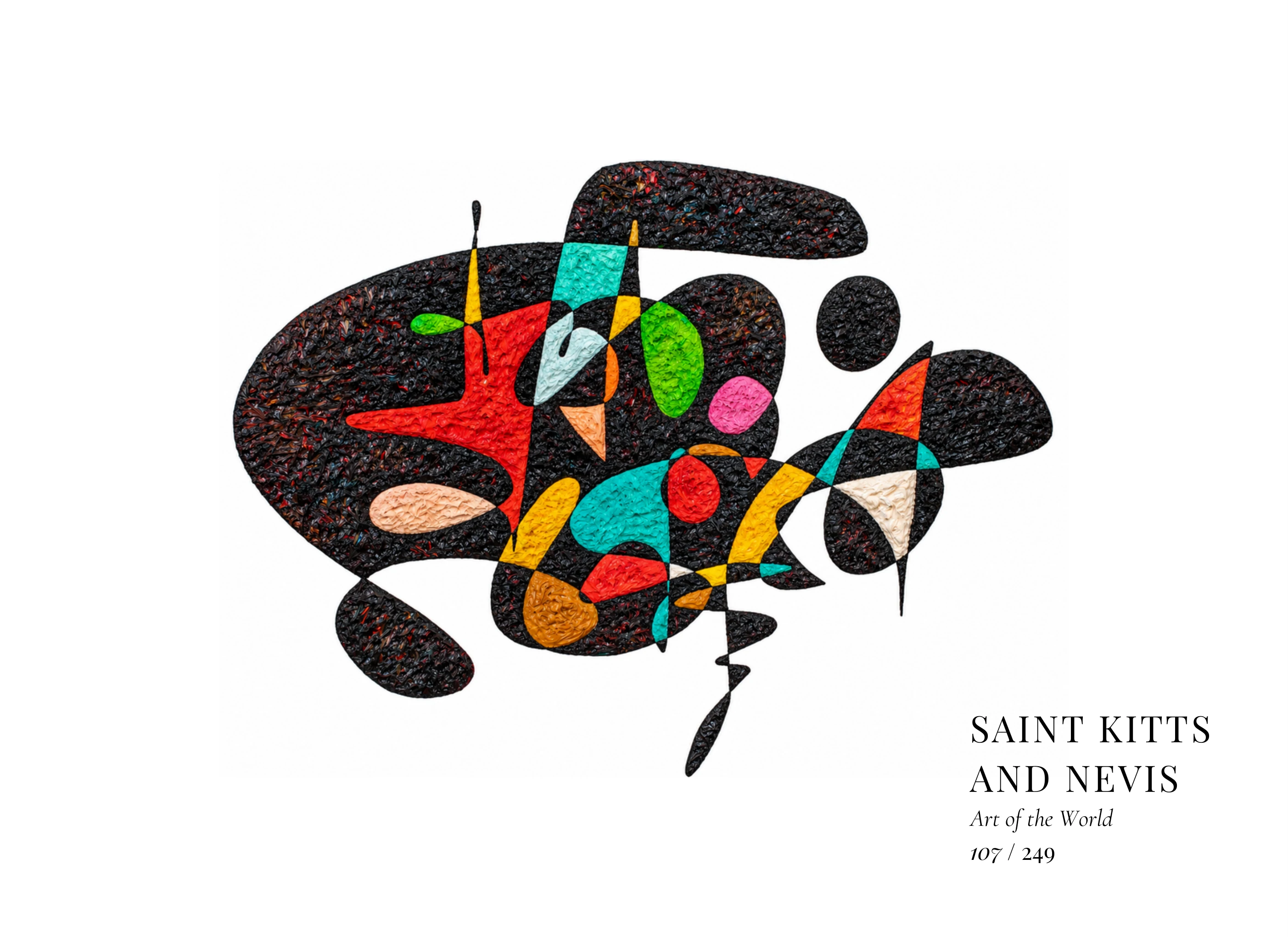
Description
The artwork gathers dark, heavily textured masses around vivid passages of turquoise, red, green, yellow and pink. Rounded forms are interrupted by sharp points, narrow extensions and detached elements, producing a lively rhythm across generous white space. The dense impasto gives the composition unusual physical depth. Its paired masses and interlocking geometry suggest distinct identities held in dynamic relationship, evoking the federation’s dual-island character and its layered Caribbean memory.
Cultural Context
Saint Kitts and Nevis lies in the eastern Caribbean, where two volcanic islands rise amid fertile slopes and tropical coastlines. Indigenous Caribbean histories preceded European settlement, while centuries of colonial agriculture profoundly shaped the islands. Independence in 1983 established the modern federation, the smallest sovereign state in the Americas by area and population.
Its culture reflects African, Caribbean and European inheritances, sustained through music, storytelling, carnival, cuisine and community traditions. English is the official language, alongside a widely spoken English-based Creole. Architecture, performance and festival culture preserve a strong sense of continuity while expressing the distinct character of both islands.
Exhibition Context
Black heads and brightly coloured eyes cluster in one dark body, with white openings breaking up the mass. Saint Kitts and Nevis consists of two volcanic islands whose plantation colonial history preceded independence. The crowd of inner forms feels larger than the small territory named in the title. It invites a reading of lives and histories gathered within a shared setting, while the open cuts prevent the group from appearing effortlessly unified. Nothing in the painting should be taken as an illustration of slavery itself.