154 / 249
Saint Vincent and the Grenadines
An Archipelago of Living Currents
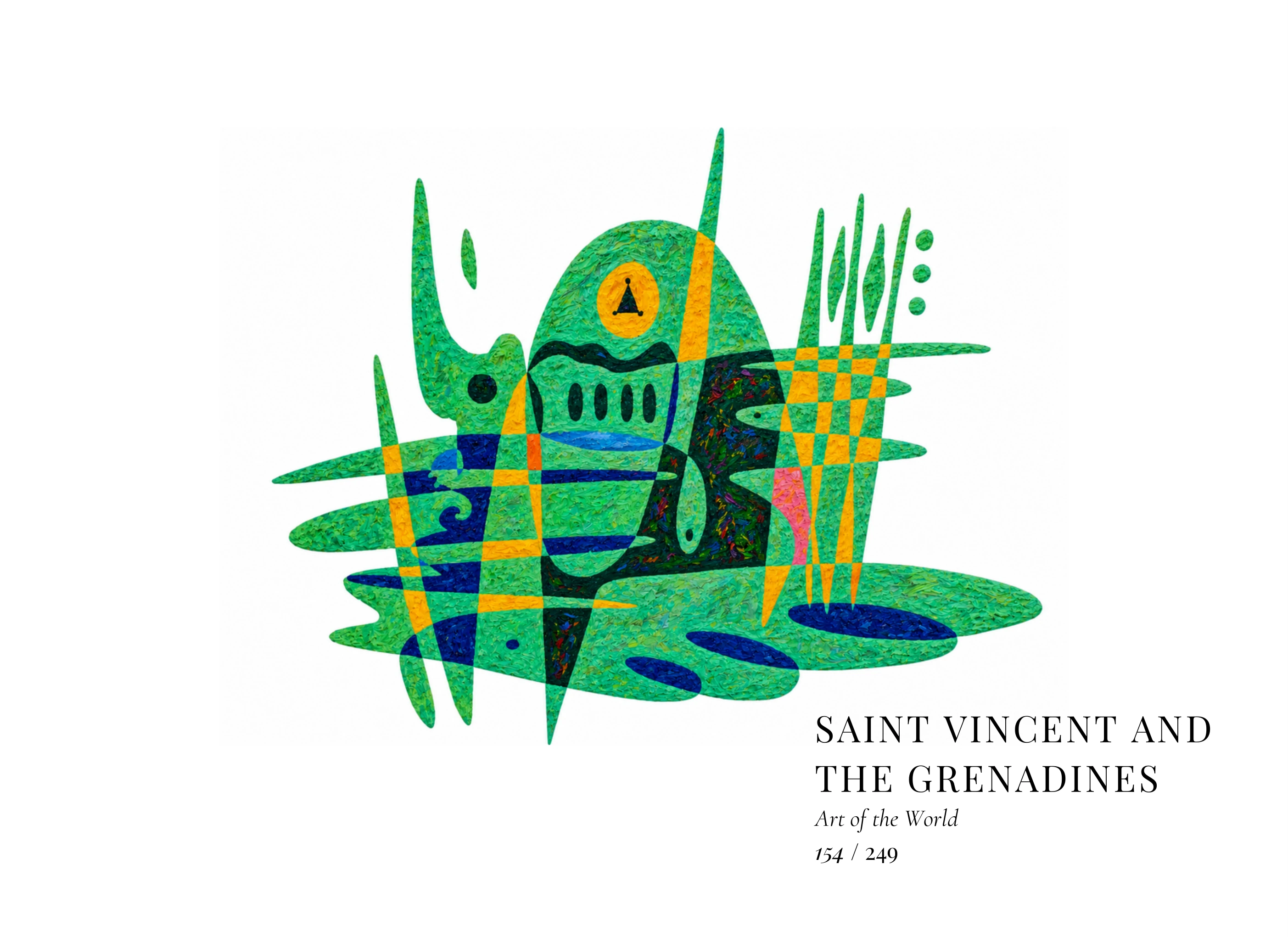
Description
The artwork is dominated by luminous greens, structured by gold and deep blue passages. Vertical lines intersect broad horizontal forms, while pointed extensions and small detached elements create an intricate rhythm. Dense impasto gives the surface an organic vitality. The combination of connected structures and open white space suggests an archipelago held together across distance, evoking the country’s relationship between land, water and collective memory.
Cultural Context
Saint Vincent and the Grenadines extends across the eastern Caribbean, with mountainous Saint Vincent surrounded by a chain of smaller Grenadine islands. Indigenous Kalinago history, European colonisation and African heritage shaped the islands over centuries. Independence in 1979 established a sovereign nation whose identity remains closely connected to sea, volcanic landscape and inter-island life.
Its culture brings African, Indigenous, European and Caribbean traditions together through music, dance, storytelling, festivals, boatbuilding and craft. English is official, while Vincentian Creole is widely spoken. Distinct island communities contribute to a shared culture grounded in continuity, movement and maritime connection.
Exhibition Context
A green rectangular head bristles with vertical spines and bright eyes, while a patterned body seems to gather below it. Saint Vincent and the Grenadines brings one principal island and an extensive chain of smaller islands into a common history, including Kalinago life and African and colonial inheritances. The painting's front-facing structure feels inhabited rather than neatly geographic. Small colour patches keep interrupting its grid, suggesting a collective identity that cannot be reduced to one island or era.