152 / 249
Trinidad and Tobago
Two Islands, Many Currents
Description
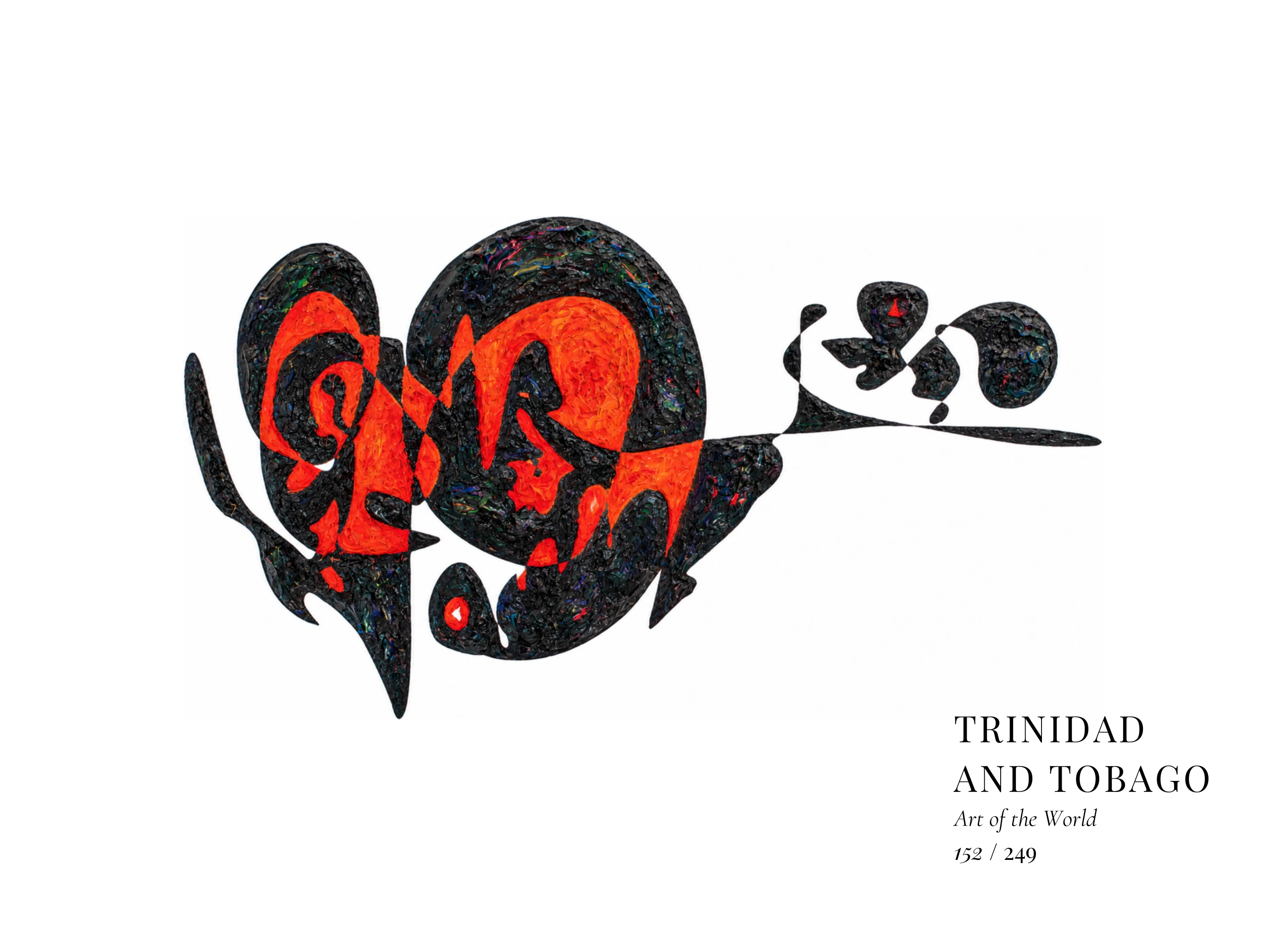
The artwork concentrates deep black around fiery orange-red passages, creating a powerful interplay of enclosure and illumination. Spiralling curves, pointed projections and detached forms produce rhythmic movement across the white ground. Thick impasto makes colour almost sculptural. The composition suggests multiple energies gathering without losing their individuality, evoking the layered communities, musical vitality and interconnected histories of the two-island nation.
Cultural Context
Trinidad and Tobago lies at the southern edge of the Caribbean, close to Venezuela. Indigenous histories preceded Spanish and British rule, while migration from Africa, India, Europe, China and the wider Caribbean profoundly shaped the islands. Independence in 1962 established a modern nation distinguished by remarkable cultural plurality.
English is the official language, within a society enriched by African, Indian, European, Indigenous and Caribbean traditions. Trinidad and Tobago gave the world steelpan and developed calypso and soca into internationally recognised musical forms. Carnival, literature, dance, religious traditions and craftsmanship further express its exceptional creative energy.
Exhibition Context
Two black and red rounded heads dominate a shared body, while small detached circles pull the gaze toward the right. Trinidad and Tobago's paired islands were shaped by African, Indian, European, Chinese and wider Caribbean migrations. The doubled heads could offer an island analogy, but the many interior marks prevent a simplistic one-island-per-head equation. Their shared, busy form makes cultural plurality visible as an active composition rather than as a tidy list of origins.