208 / 249
Fiji
Archipelago of Oceanic Memory
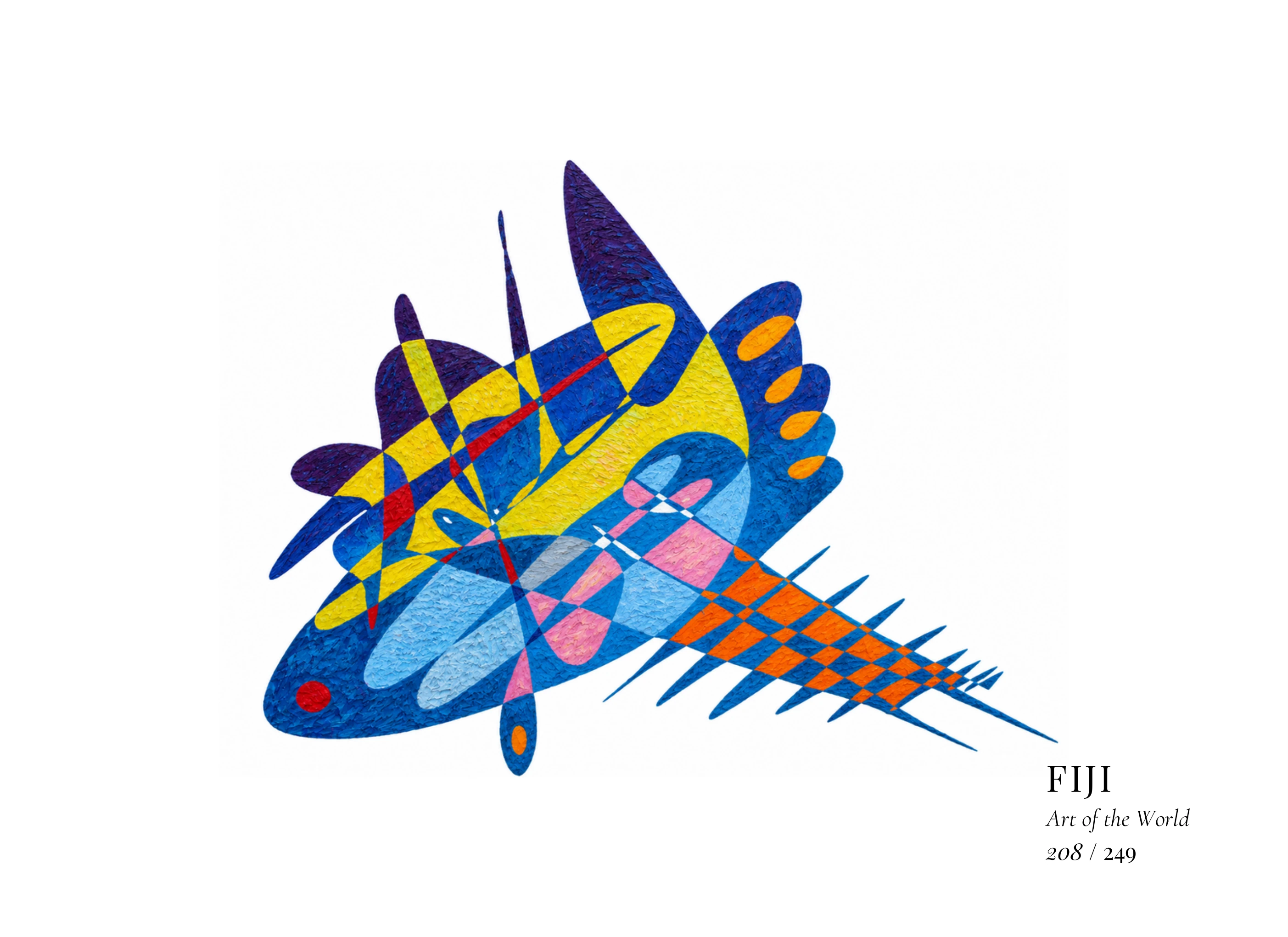
Description
The artwork advances through a vigorous diagonal silhouette, its dense impasto carrying cobalt, turquoise, yellow, violet, orange and softened pink. Broad overlapping forms gather at the left before narrowing into an intricate lattice of blue and orange toward the right. Tall pointed extensions counterbalance rounded divisions and small detached details, creating alternating density and openness. The converging geometry suggests Fiji’s archipelagic character: separate forms held in dynamic relationship, while the radiant colour contrasts evoke a visual memory shaped by plurality, movement and connection across oceanic space.
Cultural Context
Fiji lies in the South Pacific, an archipelago of more than 300 islands shaped by volcanic landscapes, coral reefs, tropical forests and surrounding ocean. Indigenous iTaukei society developed sophisticated maritime, agricultural and communal traditions within the wider world of Oceania. European contact intensified from the eighteenth century, and Fiji became a British colony in 1874. The arrival of indentured labourers from India profoundly enlarged its social fabric before independence in 1970 established the modern sovereign state.
Fijian identity brings together iTaukei, Indo-Fijian and other communities within a distinctly Pacific cultural environment. English, iTaukei and Fiji Hindi are widely spoken, while communal ceremonies, oral traditions, dance and music remain important forms of cultural expression. Masi barkcloth, mat and basket weaving, woodcarving and decorated objects demonstrate enduring knowledge of pattern, material and craftsmanship. Contemporary literature, visual art, music and design extend these inheritances while reflecting Fiji’s multilingual and internationally connected society.