128 / 249
Marshall Islands
Constellations of Land and Ocean
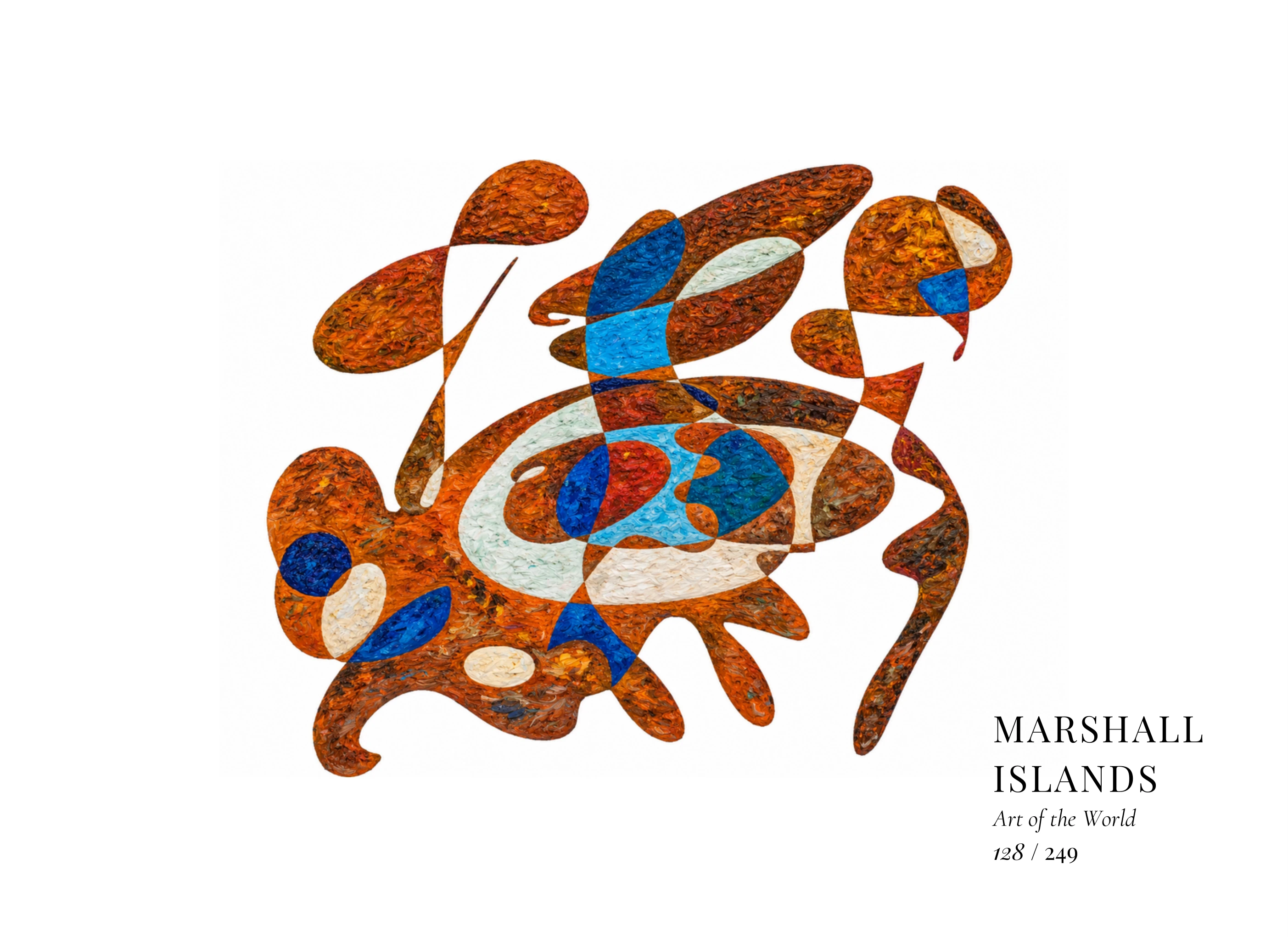
Description
The composition's earthen browns and burnt oranges establish a dense, textured ground through which luminous blues and ivory passages circulate. Curving forms gather around a layered centre, while detached shapes and narrow extensions create intervals of white space between larger masses. The impasto gives every segment a tactile, almost geological presence. Its dispersed but interconnected structure suggests an archipelagic rhythm: separate elements appear suspended yet visually related, while concentrated blue passages evoke movement and continuity across an expansive field.
Cultural Context
The Marshall Islands form a far-reaching Pacific nation of 29 coral atolls and five individual islands, arranged across an immense expanse of ocean north of the equator. Marshallese communities developed exceptional traditions of navigation and settlement adapted to narrow atoll environments. European encounters were followed by successive colonial administrations and, after the Second World War, United States trusteeship. The Republic of the Marshall Islands became self-governing in 1979 and entered free association with the United States in 1986, carrying forward a distinctive Micronesian identity.
Marshallese culture is deeply connected to genealogy, community, land and sea. Marshallese is the principal Indigenous language, with English also widely used. Oral histories, chants and customary knowledge preserve relationships between generations and places. The celebrated navigation charts of the islands embody sophisticated understanding of ocean swells and island positions, while canoe-building, weaving and finely worked mats demonstrate highly developed material traditions. Contemporary cultural expression continues these inheritances within a globally connected island society.