238 / 249
New Zealand
Islands of Ancestry and Renewal
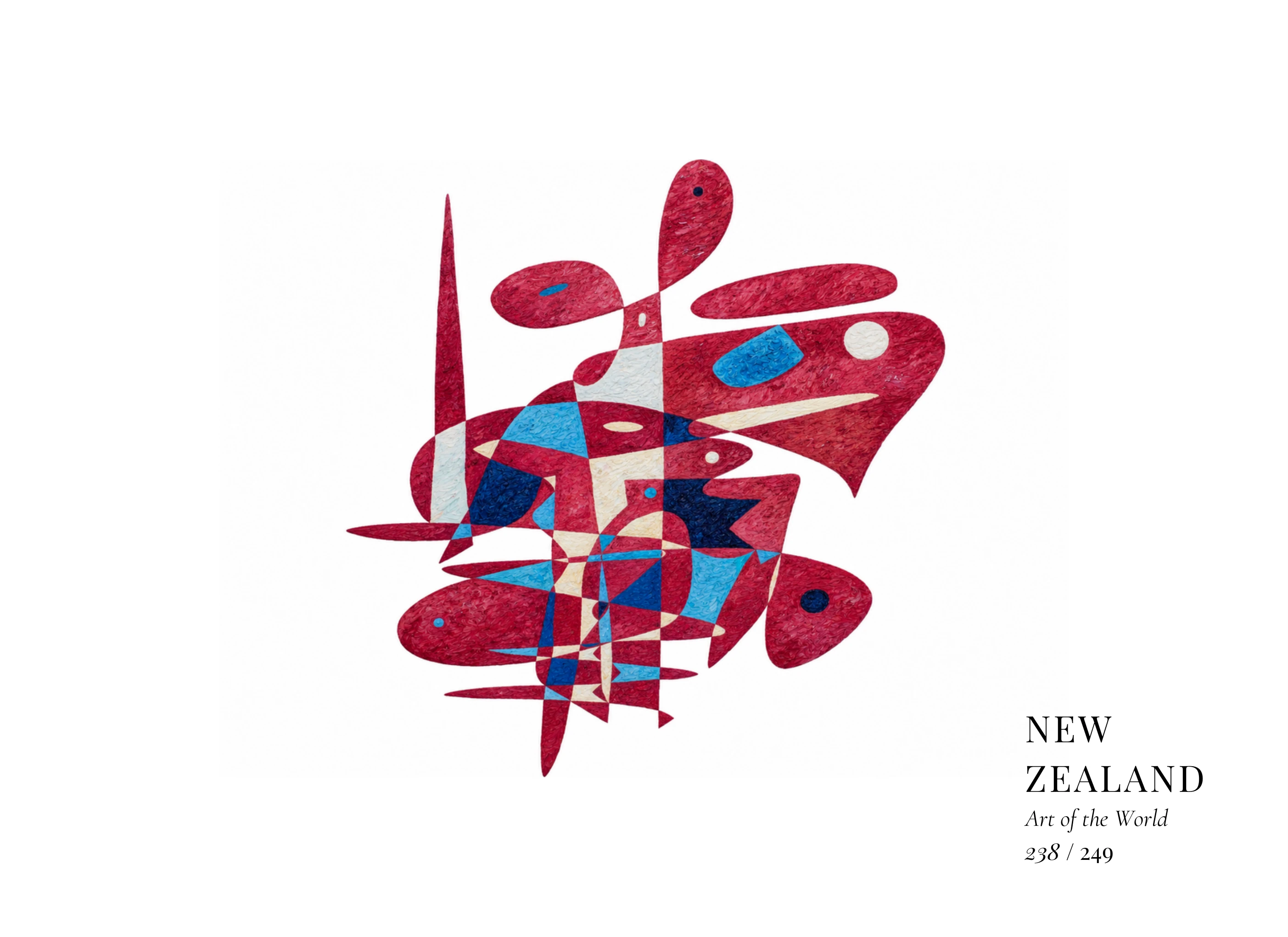
Description
The composition's crimson field is articulated by cool blues, whites and deep navy, forming an intricate network of elongated masses, pointed projections and intersecting geometries. Dense impasto gives the colour a tactile intensity, while oval forms appear to orbit a compressed central structure. Slender extensions create upward and lateral momentum; white passages open breathing spaces within the density. The composition suggests an archipelagic rhythm—separate forms held in dynamic relation —evoking New Zealand’s layered histories, oceanic setting and continuing exchange between inheritance and transformation.
Cultural Context
New Zealand lies in the south-western Pacific, an archipelago shaped by dramatic geological forces, with mountains, volcanic plateaux, fertile plains and deeply indented coasts. Polynesian navigators settled the islands from the wider Pacific, developing the distinctive Māori culture of Aotearoa. European settlement expanded during the nineteenth century, and the Treaty of Waitangi, signed in 1840 between representatives of the British Crown and many Māori chiefs, became foundational to the country’s evolving constitutional life. Modern New Zealand has developed through continuing dialogue between Māori inheritance, migration and a diverse Pacific-facing society.
Māori and English are central to national cultural life, alongside New Zealand Sign Language and the languages of communities from across the Pacific, Asia and beyond. Māori traditions of whakapapa, oral history, carving, weaving, kapa haka and marae architecture sustain profound connections between people, ancestry and place. Literature, film, music, contemporary visual culture and design have extended New Zealand’s international presence while drawing energy from its distinctive landscapes and plural cultural experience.