207 / 249
Tonga
The Kingdom Where the Pacific Remembers
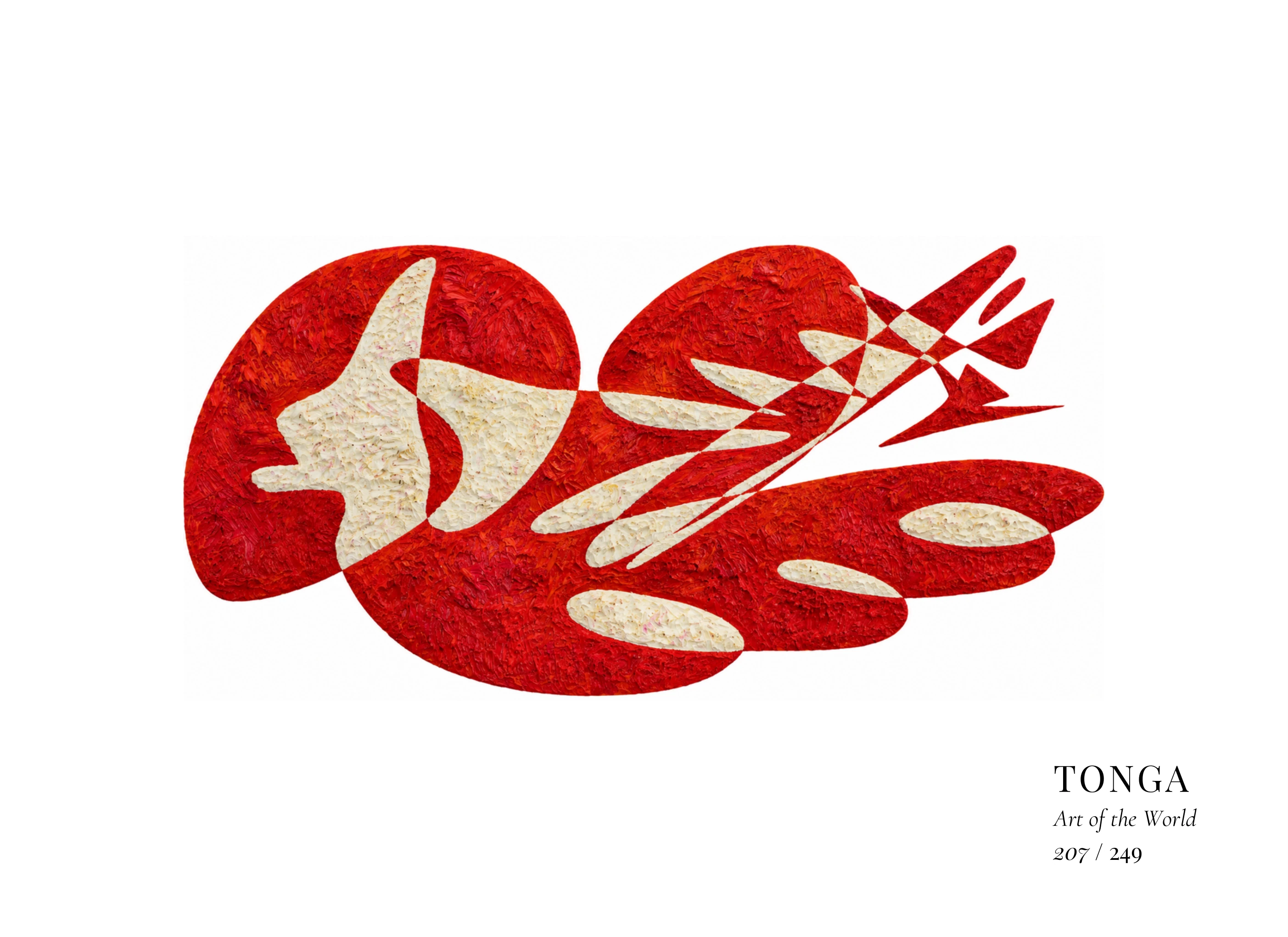
Description
The composition's intense crimson silhouette is opened by sweeping ivory forms. Dense impasto gives the surface physical energy, while rounded masses accelerate into narrow diagonals, pointed extensions and detached elements. Repeated crossings suggest movement and connection, evoking Tonga’s history of voyaging, kinship and oceanic exchange. The balance between concentrated forms and outward momentum can be read as a visual memory of a nation both deeply rooted and Pacific-facing.
Cultural Context
Tonga is a South Pacific archipelago of coral and volcanic islands, settled by Austronesian voyagers more than three millennia ago. It became an influential centre of Polynesian navigation, exchange and dynastic culture. Unified as a constitutional monarchy in the nineteenth century, Tonga preserved its Indigenous monarchy and became fully independent in 1970.
Tongan identity is sustained through language, family, chiefly traditions, Christian faith and communal responsibility. Genealogy, ceremonial speech, poetry, dance and music carry cultural memory across generations. Ngatu barkcloth, fine mats and weaving unite artistry with social relationships, while contemporary literature and visual culture extend Tongan traditions throughout the wider Pacific world.
Exhibition Context
A broad red body with white openings narrows toward an extended end, its interior held securely inside the outer curve. Tonga's Polynesian dynastic history and constitutional monarchy give that embracing shape a possible image of continuity. Yet the pale cuts keep the red mass from becoming an unbroken royal seal. The painting balances a stable interior with outward movement, presenting endurance as something capable of change rather than a monument to a single reign.