178 / 249
Tuvalu
Nine Islands, One Ocean
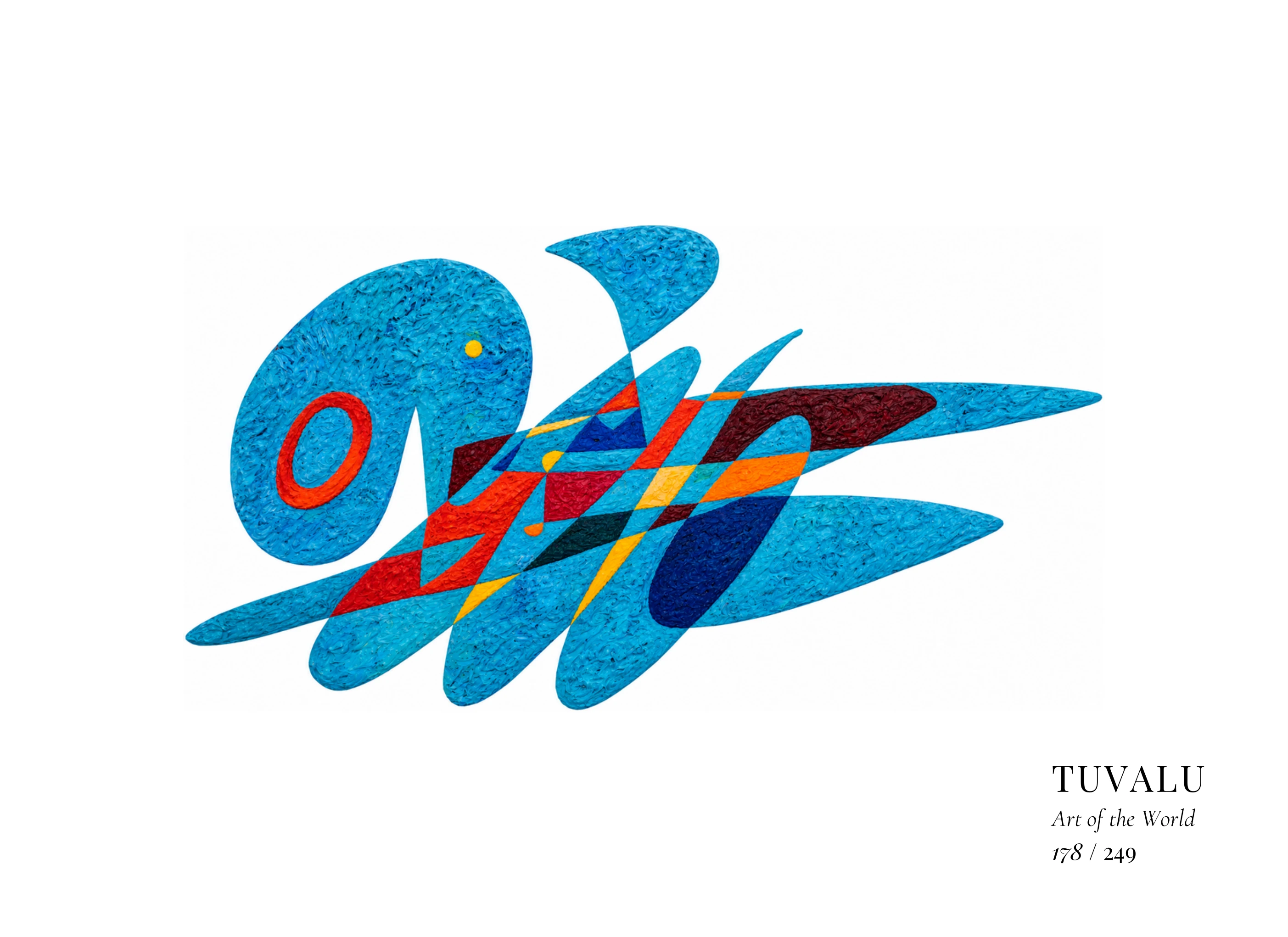
Description
The artwork is carried by expansive turquoise forms crossed by red, yellow, orange, deep blue and burgundy. Thick impasto creates a restless surface, while long pointed extensions give the silhouette remarkable lateral momentum. Intersecting bands compress colour at the centre before releasing it into open white space. The composition suggests currents and pathways, evoking islands connected across immense distances by movement, memory and the sea.
Cultural Context
Tuvalu is a Polynesian nation of nine low-lying islands and atolls in the central Pacific. Settled by Pacific voyagers over many centuries, its communities developed around navigation, fishing, kinship and exchange. Formerly administered with the Gilbert Islands under British rule, Tuvalu became independent in 1978. Its geography has always made the ocean central to movement, livelihood and national imagination.
Tuvaluan culture is sustained through language, extended families and close island communities. Oral history, dance, song, weaving and communal celebrations transmit knowledge between generations. Distinct traditions across the islands enrich a shared national identity, while contemporary Tuvaluan culture connects ancestral inheritance with education, migration and wider Pacific networks.
Exhibition Context
A rounded blue body stretches into long horizontal strokes, with red and yellow crosses shifting its apparent direction. Tuvalu's nine low atolls depend upon oceanic connections and face environmental vulnerability, so the sense of simultaneous drifting and propulsion is unusually poignant. No particular island is mapped in the painting. The small blue body remains active rather than helpless, riding the tension between a wide sea and the fragile form it sustains.