172 / 249
Chile
Between Andes and Ocean
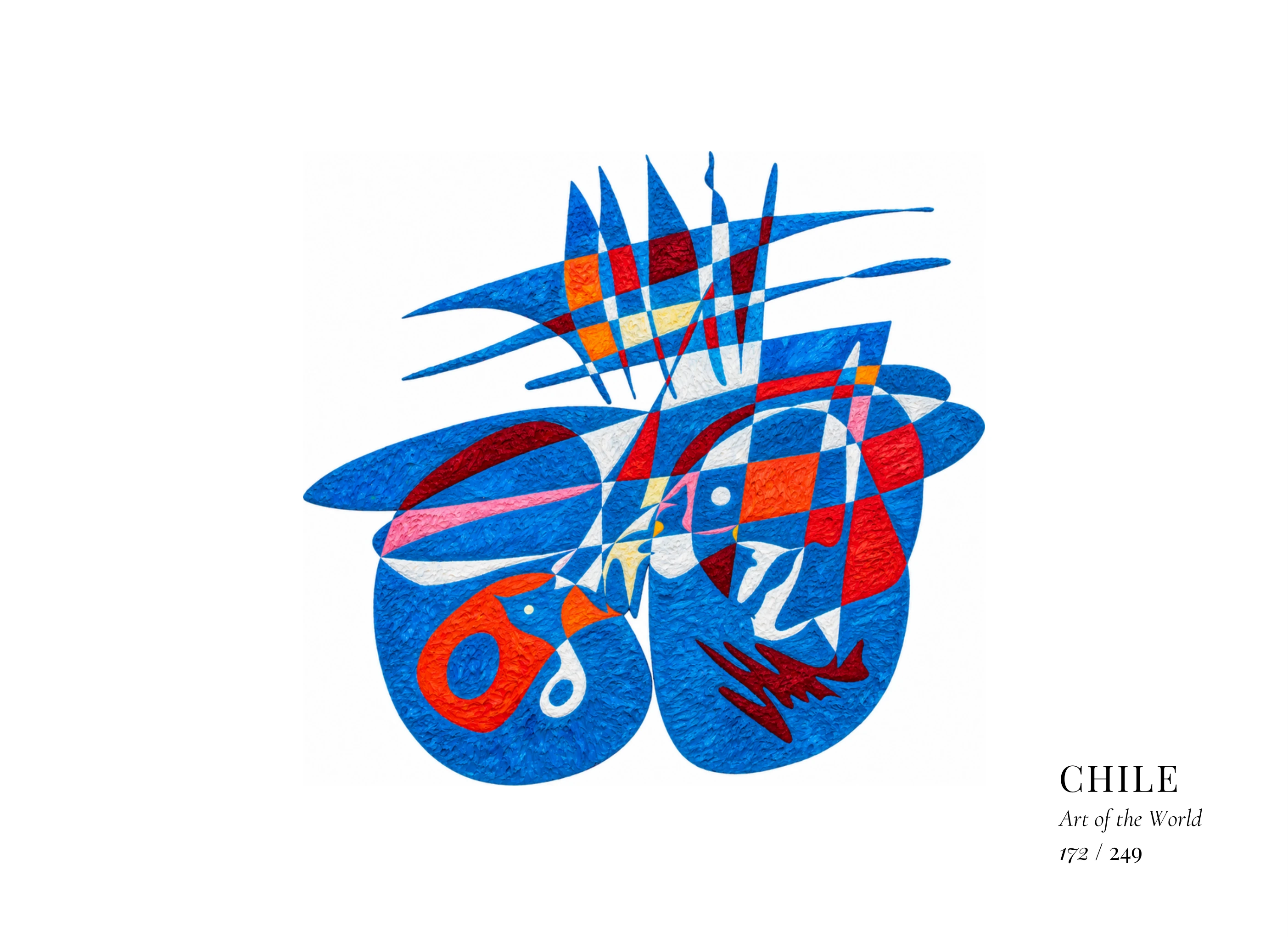
Description
The artwork is propelled by brilliant blue, crossed by red, orange, pink and white. Long horizontal extensions contrast with vertical spikes, rounded lower masses and tightly interwoven geometric passages. Thick impasto gives the surface a restless physical energy, while narrow white spaces separate and reconnect the forms. The elongated composition suggests Chile’s distinctive geography, while its intersecting rhythms can be read as an evocation of a nation continually shaped by mountain, ocean, distance and human connection.
Cultural Context
Chile forms a remarkable ribbon along South America’s Pacific coast, extending from the Atacama Desert through Mediterranean valleys and temperate forests to the fjords of Patagonia. Indigenous cultures, including Mapuche traditions, long preceded Spanish colonisation. Independence in 1818 opened the path towards the modern republic, shaped by geography, migration and regional exchange.
Chilean culture brings together Indigenous, European and wider Latin American inheritances. Spanish is predominant, alongside Indigenous languages and strong regional traditions. Poetry, literature, music, architecture, textiles, crafts and cinema reflect a society deeply conscious of landscape, memory and cultural continuity.
Exhibition Context
A long blue body with one eye extends horizontally through red and white cuts, while finlike parts rise above it. Chile's coastline runs from northern desert through central valleys to the fjords of the south, making the elongated silhouette a persuasive geographic association. It is not a coastline traced to scale. The breaks and secondary directions keep the country from being a simple strip, and the eye at one end lets the long terrain become a living, attentive presence.