247 / 249
Guyana
Where Rivers Meet the Forest
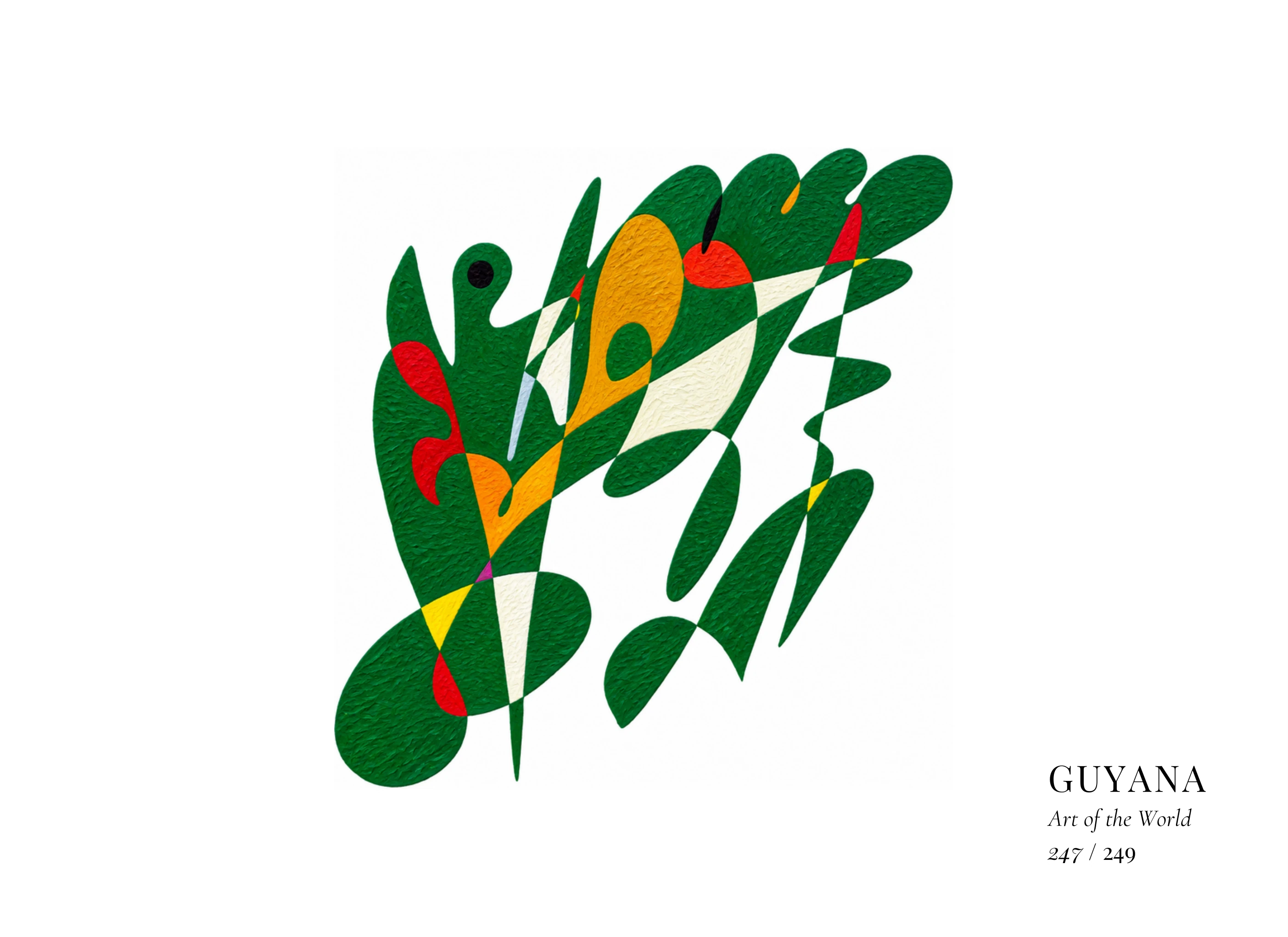
Artist: Gheorghe Virtosu
Catalogue: Art of the World
Catalogue Nr: 247/249
Source of Print: Excerpt from Divine DNA, 2016 (oil on canvas)
Medium: Limited Edition Print
Edition: 1/1
Authentication: Approved and signed by the artist on the reverse.
Artwork Classification: Civilisational Portraiture
Part of Art of the World, an El Arte Monumental project exploring contemporary art, cultural identity and visual memory.
Description
The artwork is dominated by deep, densely worked green, illuminated by ochre, orange, crimson and white. Its upward- reaching silhouette combines rounded forms with sharp projections, suspended elements and broad openings of untouched white. Thick impasto gives the green an almost living density. The branching geometry suggests movement through an abundant landscape, while the distinct coloured forms can be read as an evocation of Guyana’s many cultural histories flourishing within a shared environment.
Cultural Context
Guyana lies on South America’s Atlantic coast, where vast tropical forests, highlands, savannahs and powerful river systems shape the landscape. Indigenous peoples established enduring societies long before European colonisation. Dutch and later British rule preceded independence in 1966, while African, Indian, Indigenous, European and other histories contributed to the modern nation.
Guyana’s culture is notably plural. English is the official language, alongside Guyanese Creole and numerous Indigenous languages. Amerindian traditions, African and Indian inheritances, music, storytelling, festivals, craft, weaving and literature reflect communities whose identities have developed through both continuity and exchange.
Exhibition Context
A long-beaked green head and leaflike wings gather red and yellow centres along their extended shape. Guyana's Indigenous societies, Dutch and British colonial periods and later independence offer a historical frame for this body assembled from multiple inheritances. The plant and bird suggestions overlap, which is fitting for a country of river and forest landscapes without making the work a wildlife illustration. Its several centres turn a single profile into a more complex, shared territory of attention.